Marvellous Nyang

March 4, 2026
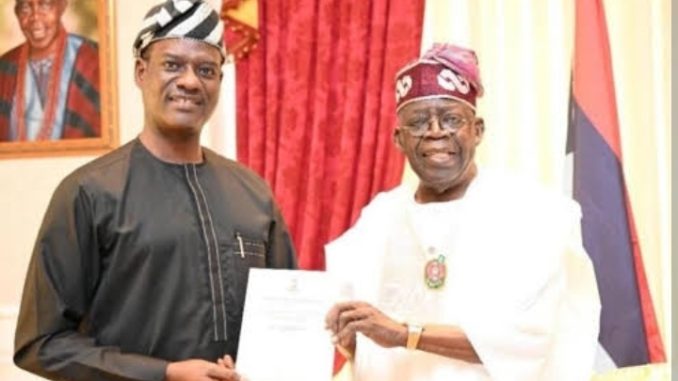
President Bola Tinubu has nominated Mr Taiwo Oyedele as the new Minister of State for Finance, a strategic decision aimed at advancing his economic reform agenda by placing the architect of Nigeria’s sweeping tax reform at the helm of revenue policy and fiscal implementation within the Federal Ministry of Finance.
The nomination, formally transmitted to the Senate for screening and confirmation in a letter signed by the President, reflects a deliberate shift by the administration to embed policy architects into key implementation roles.
Meanwhile, the outgoing Minister of State for Finance, Doris Uzoka-Anite, has been reassigned to the Ministry of Budget and National Planning as part of the cabinet realignment.
Mr Oyedele, who until his nomination chaired the Presidential Committee on Fiscal Policy and Tax Reforms, is expected to bring continuity and technical rigour to the next phase of fiscal change as Nigeria battles structural revenue challenges and seeks to broaden its tax base.
Nigeria’s economy has faced persistent fiscal pressures in recent years, driven by a combination of weak non-oil revenue, declining government revenue relative to the size of the economy and heavy reliance on borrowing to fund public expenditure.
At about 10.8 per cent of GDP, the tax-to-GDP ratio remains one of the lowest in Africa, constraining the federal government’s capacity to finance infrastructure, public services and social programmes without resorting to debt.
ALSO READ: Nigeria, AFC forge $1.3 billion pact to power mega alumina refinery, industrial leap
Since assuming office, Tinubu has pursued a series of policy measures aimed at stabilising the macroeconomy and modernising fiscal management, including the removal of petrol subsidies, liberalising the foreign exchange regime, and recalibrating government finances.
Within this broader package lies the comprehensive tax reform initiative that Mr Oyedele steered.
The reforms, which consolidated more than 60 overlapping taxes into fewer than 10 statutes, introduced exemptions for low-income earners, and simplified the tax code, are designed to stimulate investment, improve compliance and enhance ease of doing business in the country.
Bringing reform to implementation
By nominating Mr Oyedele to the finance ministry, the presidency is signalling that the focus now shifts from policy formulation to execution.
Senior economic advisers say that closing the gap between tax design and real-world application is vital if Nigeria is to achieve meaningful gains from the new tax architecture.
Embedding the reform leader within the ministry should, in theory, strengthen coordination with revenue agencies such as the National Revenue Service and align legislative and administrative approaches to revenue mobilisation.
The tax reform laws, which took effect on January 1, 2026, introduced a raft of provisions including zero personal income tax for Nigerians earning under N800, 000 per year, full exemptions from company income tax and development levy for small businesses under specified thresholds, and incentives for job creation and wage increases.
Implementing these changes effectively will require strong leadership and collaboration between government agencies and the private sector to ensure compliance and minimise disruption.
Profile and expertise of the nominee
Mr Oyedele, 50, is an economist, accountant and public policy expert with more than two decades of experience in tax advisory and fiscal reform.
He began his professional career at PricewaterhouseCoopers in 2001, rising to become Fiscal Policy Partner and Africa Tax Leader after 22 years.
He holds a Higher National Diploma in accountancy and finance from Yaba College of Technology and a Bachelor of Science in applied accounting from Oxford Brookes University, and has completed executive education programmes at esteemed institutions including the London School of Economics, Yale University and the Harvard Kennedy School.
He also serves as a professor at Babcock University and a visiting scholar at Lagos Business School.
Observers note that Mr Oyedele’s track record as the chairman of the tax reform committee, his ability to navigate complex policy trade-offs, engage stakeholders and produce legislation with far-reaching implications, positions him to play a central role in Nigeria’s fiscal direction.
His appointment is thus seen as a practical step to ensure that the visionary elements of the tax reform are translated into operational success.
The nomination also carries political implications, as overhauling Nigeria’s fiscal architecture touches on entrenched interests at federal, state and local levels.
Bringing a technocrat with deep policy credibility into a ministerial position may help counter resistance from those opposed to change.
It may also signal to international investors and multilateral partners that Nigeria remains committed to structural reforms crucial for economic stability and growth.
However, analysts caution that implementation will not be without challenges.
Tax reform is often politically sensitive, and public perceptions of fairness, the capacity of revenue agencies to enforce new laws and the broader economic environment will all shape the outcome.
Ensuring clear communication and managing stakeholder expectations will be critical for the success of the reforms Mr Oyedele championed.
The Senate is expected to schedule a confirmation hearing for Mr Oyedele’s nomination in the coming days.
If confirmed, he will assume his duties and begin working alongside the substantive Finance Minister, Mr Wale Edun, to implement the tax reform agenda and support the broader economic policy frameworks of the Tinubu administration.
At a critical juncture in Nigeria’s fiscal evolution, the elevation of the tax reform architect to ministerial office highlights the administration’s determination to close the loop between policy design and policy delivery.