By Gideon Maxwell

April 8, 2026
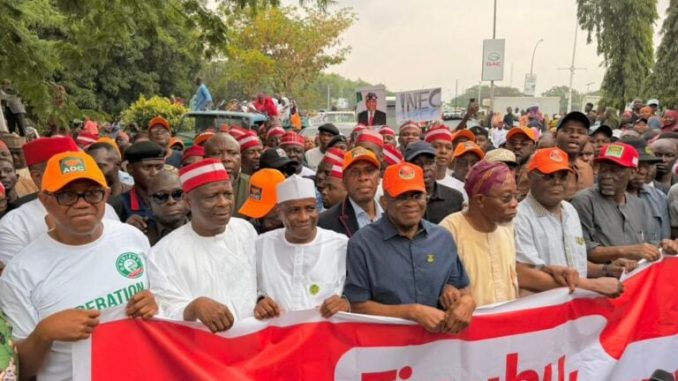
Leaders and members of the African Democratic Congress (ADC) on Wednesday staged a peaceful protest at the Independent National Electoral Commission (INEC) headquarters in Abuja, objecting to decisions by the electoral body they say undermine the party’s internal leadership process and Nigeria’s democratic integrity, particularly ahead of the 2027 general elections.
The demonstration, tagged #OccupyINEC, drew a broad coalition of opposition figures, including former Vice‑President Atiku Abubakar, former Minister of Transportation Rotimi Amaechi, former Anambra State governor Peter Obi, former Senate President David Mark, former Osun State governor Rauf Aregbesola, former Kano State governor Rabiu Kwankwaso, Aminu Tambuwal, and Dino Melaye, among others.
The protest was sparked by INEC’s derecognition of the faction of the ADC led by Senator David Mark, following legal disputes over party leadership.
The party faulted the commission’s handling of the matter and says its actions undermine internal democracy.
Alongside the street demonstration, ADC representatives submitted a formal petition to INEC demanding remedies, including the immediate resignation or removal of INEC’s chairman, withdrawal of disputed correspondence, and a commitment to non‑interference in party affairs.
Atiku was among those leading the march from the Maitama junction to the INEC headquarters, standing with other opposition leaders and calling on Nigerians to defend democratic processes. He has posted on social media that the protest was a peaceful stand against what participants see as partisan behaviour by the electoral umpire.
Peter Obi also took part in the protest and explained on his official X account that ADC members and “well‑meaning Nigerians” were saying that democracy “must not be killed,” and that they were standing against what they see as moves toward a one‑party system.
Kwankwaso spoke directly at the event, strongly criticising INEC for perceived partisanship, accusing the commission of abandoning neutrality, and describing the protest as unified action by opposition groups against that partisanship.
ALSO READ: APC to ADC: ‘Your crisis self‑inflicted, desperation for power got you here’
As ADC National Chairman, Mark was central to the protest and to submitting the formal petition during the rally, reinforcing the party’s position that the commission’s actions were improper and calling on constitutional mechanisms for accountability.
Rauf Aregbesola, Rotimi Amaechi and others
These leaders were part of the procession and visible in Abuja. Their presence underscored a consolidated opposition response to INEC’s stance, even as specific documented speeches vary by source.
The protest drew hundreds of participants, with slogans and banners focusing on defending democracy, questioning INEC’s neutrality, and backing the leadership of the ADC as recognised by the Mark faction. The march was orderly and peaceful despite steady rain.
The protest also drew criticism from some government officials. The Minister of Aviation and Aerospace Development, Festus Keyamo, dismissed the #OccupyINEC action as unjustified, asserting that it was not a credible threat to Nigeria’s democracy and questioning the basis for nationwide agitation over an intra‑party dispute.
After the march, ADC leaders met with INEC officials through submitted petitions and have warned of activating lawful constitutional mechanisms, including judicial action and continued civic engagement, if their demands are not met. The protest has intensified scrutiny on the electoral body’s actions and raised political tensions ahead of 2027.
Formal demands submitted by the ADC to INEC
During the protest at the INEC headquarters in Abuja on 8 April 2026, the African Democratic Congress submitted a written petition to the electoral commission through its National Secretary Rauf Aregbesola. The petition and subsequent public reports outline the following core demands and positions:
1. Immediate resignation or removal of the INEC chairman
The ADC demanded that Prof Joash Amupitan resign or be removed from office, accusing him of partisan conduct, gross misconduct and constitutional breaches that, the party says, undermine the neutrality and credibility of the electoral body. This demand was contained in the letter delivered to INEC officials.
2. Withdrawal of what the ADC described as “offensive correspondence”
The party asked that INEC retract recent communications with the ADC that it said improperly affected the party’s internal affairs and leadership status.
3. A formal apology from INEC to the ADC
The petition sought an apology from the electoral commission for actions and statements that the ADC said had deepened concerns about impartiality.
4. Commitment by INEC to refrain from interference in internal party affairs
The party stressed that INEC should not interfere, directly or indirectly, in the leadership structures of political parties, asserting that such actions threaten party autonomy.
5. Judicial enforcement measures if demands are ignored
ADC notified that failure to meet the above demands would lead to legal action in the courts, pursuing constitutional mechanisms to ensure accountability.
6. Coordinated civic action
The petition stated that the party would pursue coordinated civic and lawful actions, including mass mobilisation, if its demands were not addressed by INEC.
Context behind the demands
• The protest and petition were triggered by INEC’s decision to derecognise the leadership of the ADC after a Court of Appeal ruling required the commission to maintain the status quo ante bellum on a leadership dispute involving factions within the party. ADC leaders argue this action has effectively sidelined the Mark‑led leadership they recognise, undermining internal party autonomy.
• In their letter, the party also criticised public statements and actions by the INEC chairman that they said revealed a lack of neutrality and exceeded constitutional boundaries by interpreting court rulings outside judicial authority.
Summary of official ADC demands
ADC’s documented demands to INEC are:
• Immediate resignation or removal of Prof Joash Amupitan as INEC chairman
• Withdrawal of “offensive” official correspondence treated as interference
• A formal apology from INEC to the ADC
• A public commitment by INEC to stop interfering in party affairs
• Legal action through the courts if demands are ignored
• Activation of coordinated civic mobilisation if constitutional demands are unmet
All these points were formally communicated in the petition submitted at the INEC headquarters in Abuja and reported by multiple news outlets.