By Gideon Maxwell

April 17, 2026
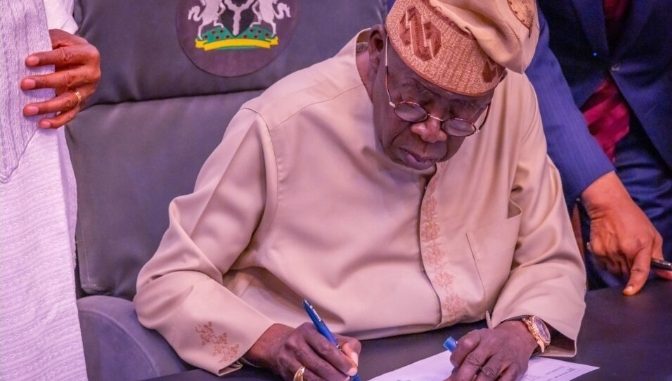
President Bola Ahmed Tinubu has signed into law Nigeria’s N68.32 trillion 2026 Appropriation Act, marking the country’s largest budget to date and setting the tone for an ambitious fiscal agenda centred on infrastructure expansion, economic stability, and social investment.
In a parallel move aimed at preserving ongoing capital projects, the president also approved an extension of the 2025 budget implementation timeline from March 31 to June 30, 2026, effectively allowing Ministries, Departments and Agencies to conclude critical expenditures and avoid project abandonment.
The newly signed budget authorises total federal spending of N68.32 trillion, reflecting a substantial increase from the initial proposal of N58.47 trillion submitted to the National Assembly in December 2025.
A detailed breakdown of the fiscal plan shows a deliberate balancing of statutory obligations, debt servicing, and development-focused expenditure:
N4.799 trillion allocated to statutory transfers
N15.8 trillion earmarked for debt servicing
N15.4 trillion assigned to recurrent expenditure
N32.2 trillion dedicated to capital projects through the Development Fund
ALSO READ: Fidelity Bank extends ‘Give Her Power’ initiative to Ogun, empowers 100 women with vocational tools
Notably, capital expenditure accounts for roughly 50 per cent of the total budget, a significant signal of the administration’s intention to prioritise infrastructure delivery, productivity growth, and long-term economic transformation.
The presidency described the fiscal plan as a strategic framework designed to stimulate inclusive growth, strengthen national security, and improve living standards, while maintaining fiscal discipline amid ongoing economic reforms.
Extension of 2025 budget and fiscal continuity
The extension of the 2025 budget cycle forms a critical component of the administration’s fiscal management strategy.
Originally scheduled to end on March 31, 2026, the implementation window has now been extended by three months to June 30, 2026, specifically targeting the capital component of the budget.
According to the presidency, the extension is intended to:
Ensure full utilisation of already appropriated funds
Allow completion of ongoing infrastructure projects at advanced stages
Improve project delivery timelines and value for public expenditure
This move also reflects Nigeria’s continued effort to address the long-standing challenge of overlapping budget cycles, which has historically affected planning efficiency and capital execution.
Policy direction and economic outlook
The 2026 budget, titled “Budget of Consolidation, Renewed Resilience and Shared Prosperity,” is positioned as a continuation of the administration’s reform-driven economic agenda.
Government projections underpinning the fiscal plan include:
Economic growth estimated at about 3.98 per cent
Inflation expected to moderate to around 14.45 per cent
Exchange rate stabilisation near N1,400 to the dollar
External reserves projected at approximately $47 billion
These projections align with earlier fiscal signals indicating a growth-oriented but disciplined spending framework, even as the country navigates debt pressures and revenue constraints.
The passage of the budget followed legislative review and upward adjustment by the National Assembly, underscoring the role of parliamentary scrutiny in shaping fiscal outcomes.
The president commended lawmakers for what was described as swift and cooperative consideration of the appropriation bill, emphasising the importance of executive-legislative synergy in achieving national development objectives.
He also directed all government agencies to ensure transparent, disciplined, and efficient utilisation of allocated resources, with strict adherence to value-for-money principles and timely project execution.
Reform agenda and implementation focus
Reaffirming the administration’s priorities, the presidency indicated that the 2026 budget would be instrumental in:
Deepening fiscal reforms
Enhancing revenue generation
Driving infrastructure investment
Creating jobs and boosting economic productivity
Strengthening social protection systems
The budget took effect from April 1, 2026, with full implementation already underway, aligning with the government’s broader “Renewed Hope” policy framework.
The approval of the N68.32 trillion budget represents a significant expansion in Nigeria’s fiscal envelope compared to previous years, reflecting both inflationary realities and increased government ambition in capital investment.
It also comes amid ongoing efforts to streamline Nigeria’s fiscal calendar and eliminate the inefficiencies associated with concurrent budget cycles, a reform direction that has gained momentum in recent policy discussions.
The signing of the 2026 Appropriation Act and the extension of the 2025 budget cycle together signal a dual strategy of expansion and consolidation.
While the record budget size underscores an aggressive push for development and economic recovery, the extension of prior spending reflects a pragmatic approach to ensuring continuity, completion, and efficiency in public sector investment.