By Gideon Maxwell

May 4, 2026
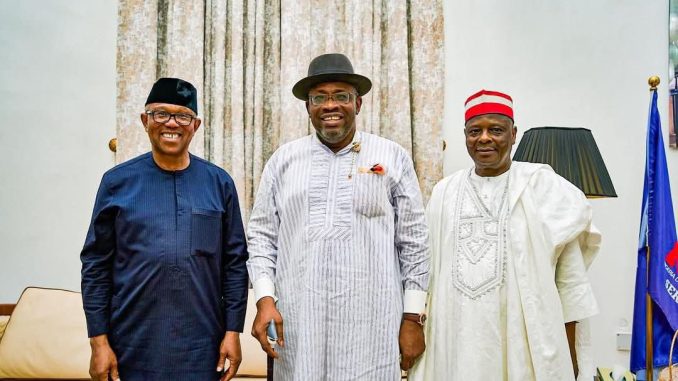
Nigeria’s opposition landscape is undergoing a renewed phase of consolidation as former Labour Party presidential candidate, Peter Obi, and Kano State ex-governor, Rabiu Kwankwaso, reposition within an emerging coalition structure now centred on the Nigeria Democratic Congress (NDC).
Rather than a routine party movement narrative, the development signals a wider strategic reordering of opposition forces ahead of the 2027 election cycle, with the ADC increasingly viewed as a transitional platform in an evolving merger process.
Political insiders indicate that the duo’s alignment is part of a coordinated effort to stabilise a single opposition bloc capable of negotiating internal leadership balance, resolving lingering legal disputes, and presenting a unified electoral front.
ALSO READ: Obi, Kwankwaso exit ADC amid Atiku’s tightening grip on presidential ticket bid
The shift follows weeks of consultations among allied political movements seeking to consolidate fragmented structures into a more coherent national platform.
Although public discourse has largely focused on exit narratives, the current phase is better understood as a recalibration of alliances within a broader opposition architecture, where influence is being redistributed rather than simply transferred.
Observers note that the NDC is positioning itself as the convergence point for multiple opposition streams, with ongoing discussions reportedly extending beyond Obi and Kwankwaso to other political stakeholders seeking an alternative to existing party structures.
The unfolding realignment underscores a central theme in Nigeria’s pre election politics, where coalition engineering is becoming as decisive as party loyalty in shaping presidential viability.
As developments continue, attention is shifting from individual party exits to the durability of the emerging opposition framework and its capacity to withstand internal contestation ahead of 2027.