By Marvellous Nyang

June 26, 2026
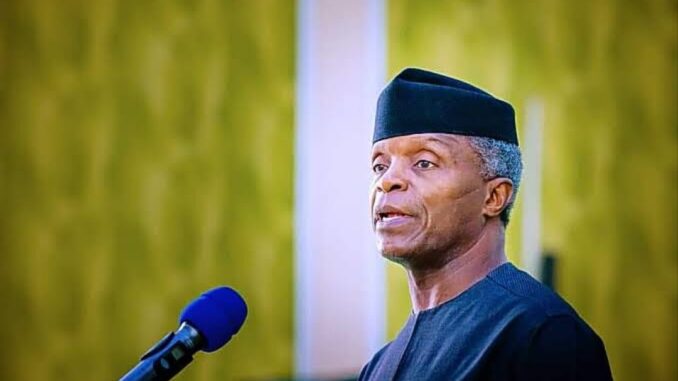
Former Vice President Yemi Osinbajo has said Nigeria cannot solve its housing deficit by simply building more houses, stressing that sustainable solutions require long term planning, sound legal frameworks and policies that keep pace with the country’s rapidly growing population.
Osinbajo spoke at the 35th anniversary dinner of Ubosi Eleh & Co in Lagos, where he emphasised that tackling Nigeria’s housing challenges demands strategic planning for both current and future needs.
He said increasing the housing stock alone would not resolve the crisis unless governments establish legal and institutional frameworks that encourage investment in the sector while ensuring efficient mechanisms for resolving tenancy and land disputes.
Recalling his experience during the administration of President Bola Tinubu as Governor of Lagos State, Osinbajo said a survey conducted at the time revealed a decline in investments in low and middle income housing.
According to him, many investors were reluctant to build rental properties because recovering rent from defaulting tenants was difficult and legal disputes in magistrates’ courts often took years to conclude.
ALSO READ: Osinbajo extols Igwe Ilo’s legacy, calls for systems driven social transformation
“One of the reasons the housing stock was declining was because investors were afraid that tenants could stay in their properties for years without paying rent, while legal disputes took too long to resolve,” he said.
Osinbajo explained that the challenge prompted the establishment of mediation centres in Lagos State to provide quicker alternatives for resolving tenancy and land related disputes.
He noted that while magistrates’ courts handled about 2,000 cases annually, the introduction of mediation centres increased dispute resolution capacity to between 8,000 and 9,000 cases each year, with more than 20,000 cases now being resolved annually.
Beyond housing, the former Vice President called for comprehensive national planning to prepare for Nigeria’s rapidly expanding population, which he said grows by about five million people every year.
He warned that the country must make deliberate plans for future demands in housing, education, healthcare and other critical sectors.
“By 2030, there will be at least 85 million children under the age of seven. There is no question that we must plan for education and other essential services,” he said.
Osinbajo also urged policymakers to anticipate the impact of emerging technologies, particularly Artificial Intelligence, saying the technology is reshaping economies and labour markets across the world.
He observed that AI could significantly transform employment over the next decade, especially in finance, law, consulting and technology related professions.
According to him, Nigeria’s ability to meet future challenges will depend on deliberate planning, innovation and proactive policies that address both present realities and emerging opportunities.