

By Vitalis Obi and O J Peters

January 25, 2026
Book review
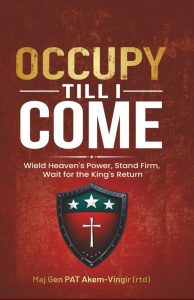
OCCUPY TILL I COME
By Maj Gen PAT Akem Vingir Rtd
“And he called his ten servants, and delivered them ten pounds, and said unto them, Occupy till I come.” — Luke 19:13 KJV
 Speaking during one of his many public engagements, the late American civil rights activist, Rev. Dr. Martin Luther King Jr., famously observed that one of the major challenges to human progress is the misconception of time. He explained that misconception is “the tragic assumption that there is something in the very flow of time that will inevitably cure all ills.”
Expanding his view on this important subject, he stated that “human progress never rolls in on the wheels of inevitability, it comes through the tireless efforts of men and women who must be willing to become co workers with God, and without this hard work, time itself becomes an ally of the forces of social stagnation. We must use time creatively, he says, with the knowledge that the time is always right to do right.”
While Dr. King’s observation focused primarily on analysing America’s race relations and the state of the civil rights movement during his days, it also came with a universal message of courage that continues to resonate, especially to Christians, who must be daring enough to become co workers with God in the progressive use of time for the advancement of their communities, nations or human progress at the broader scale. It is in the light of the above that the book Occupy Till I Come would be contextualised and valued.
The author is a retired Nigerian General who is also a pastor in Jesus House Abuja, a prominent parish in the Redeemed Christian Church of God.
At such a time as this when most Christians are tempted to be driven by worldly ambitions and thus forget their mission, the book Occupy Till I Come re echoes St Paul’s admonition to us in 2 Timothy 2:4 which reads, “No one engaged in warfare entangles himself with the affairs of this life, that he may please him who enlisted him as a soldier.”
This verse, which compares the Christian life to military service and uses the metaphor of a soldier to explain that a Christian should focus on serving God with the gifts and the positions that God has given him without being distracted by worldly concerns, captures the theme of this remarkable book.
It is important to note that Paul’s admonition is not a command to withdraw from all secular work, but rather to be actively engaged and avoid becoming over engrossed in it to the detriment of one’s spiritual life.
ALSO READ: With Jesus in the boat of your life, you will smile — Pastor Moji Jaiyebo
According to the author, “To Occupy means to take possession of the time, place, and gifts God has entrusted to you and to use them faithfully until the King arrives.” This becomes very instructive when one considers the fact that the ultimate goal of a good soldier is to please his commanding officer, and Jesus Christ who is our commanding officer gave us the charge to occupy till He comes.
In this context, every believer’s primary goal should be to please Jesus Christ, who has enlisted us in His service. Thus, as believers, we must see ourselves as partners with God in advancing His kingdom on Earth. This partnership involves active participation in God’s work, such as sharing the gospel, serving others, and striving to fulfil one’s potential and purpose in alignment with His purpose. We must also be conscious of the fact that as co labourers, God is depending on us to carry out His will and to advance His cause.
It is also important to note that To Occupy is a call to active participation, meaning that Christians are called to be partners with God in building lives and spreading the Christian faith, rather than being passive recipients of His power. This therefore requires taking initiative and working alongside God in various endeavours. Being co labourers with God also entails a responsibility to align with God’s programme, positively impacting the world for Christ. It is a partnership in which God entrusts believers with a crucial role in fulfilling destiny and advancing His kingdom.
The author captures this eloquently by quoting D L Moody who urged, “Let us go forth and proclaim the gospel, not as if we are apologising for it, but as if we were heralding the King.”
Retelling the remarkable story in Luke 19:11 to 27, where Jesus told the parable of a nobleman who was embarking on a journey and then gave his servants money and instructed them to occupy till I come, the author makes a compelling argument, reminding us that the word Occupy carries connotations of active engagement, referring to the act of being busy, engaging in trade, or conducting business profitably. It evokes, the author says, not mere possession or preservation, but strategic investment and multiplication. This becomes very instructive when one considers the fact that upon His return, the nobleman evaluates each servant’s efforts, rewarding those who generated increase and rebuking the one who hid his Mina in fear.
So, we can all agree that the central message of that parable is a call to action, a call for us to use the gifts and abilities entrusted to us by God to work for the Lord’s kingdom until His return, rather than being idle.
The Lord’s command means that believers should be actively engaged in using their talents, resources, and abilities for God’s purposes until He returns. This could include working in their profession as unto the LORD, serving others, and spreading the gospel. The parable was told in part because some people were in the habit of passively expecting the kingdom of God to come, and Jesus wanted to explain that we should focus on fulfilling our roles and responsibilities in the interim.
Being conscious of the above, the author gives an insightful answer to a common question often posed by those who fear that emphasising works undermines grace or distracts from eager expectation. That question is, how does this call to Occupy align with the blessed hope of the Rapture and the simplicity of faith?
In his answer, the author argues that “active faithfulness is the outworking of genuine faith, and the hope of Christ’s return energises rather than paralyses our efforts,” citing James 2:26 which states that “faith without works is dead.” He therefore observes that “the Christian life is a purposeful campaign, a divine enterprise where we are not idle spectators, but active participants in God’s unfolding story.”
Drawing from Ephesians 6:12, “For we wrestle not against flesh and blood, but against principalities, against powers,” the author observes that even though we are called to serve as soldiers of Christ, the nature of our warfare is not carnal, but spiritual. He balances the narrative by explaining the arsenals that are at the disposal of every soldier of Christ. These include the name of Jesus, Philippians 2:9 to 11, the protective blood of the Lamb, Revelation 12:11, the cutting sword of the Spirit, Hebrews 4:12, and the transformative power of praise, Psalms 149:6 to 7.
The author also reveals that the deceiver and accuser of the brethren uses sophisticated tactics such as spreading lies and accusations with the aim of silencing the witness of the Gospel. He then offers a practical response by quoting James 4:7, “Submit yourselves therefore to God. Resist the devil and he will flee from you.”
In Romans 15:4, Paul observes that “whatsoever things were written aforetime were written for our learning, that we through patience and comfort of the scriptures might have hope,” and the author does a commendable job in chronicling the inspiring testimonies of notable soldiers of Christ so that we can learn from their stories and have hope.
Drawing from Hebrews 11, often regarded as the Hall of Fame of faith, and connecting it to the outstanding testimonies of modern day elite soldiers of Christ, he shows the extraordinary manifestation of God’s grace to any believer who decides to answer His call to action.
Notable amongst these testimonies are the stories of God’s generals such as Archbishop Benson Idahosa, Pastor E A Adeboye, Apostle Ayo Babalola, Pastor W F Kumuyi, Reinhard Bonnke, and Bishop David Oyedepo, amongst others.
Perhaps the most inspiring part of the book is the author’s insight on prayer, especially corporate prayer. He captures this powerfully by stating that “prayer is not a timid gathering in the shadows, it is a savage charge, blades whirring, explosions tearing through demonic ranks, as believers unite under the Holy Spirit’s unerring command.” What more can one say?
This remarkable book is going out into the world and shall be read by people we may not know, touch lives we may never meet, start conversations we may never hear, and inspire even the next generation of believers.
It is our sincere hope that everyone who reads this book will be enlisted into the elite force of Christ, being conscious of the fact that “we do not fight for victory, rather, we fight from victory.”
Above all, may such a fellow soldier be inspired by the testimonies of others towards making a personal commitment to OCCUPY till Christ our commanding officer returns.
The book is therefore a notable and commendable effort by a pastor who ran his career as a soldier side by side with his calling as a minister. Testimonies known about him indicate that even his superiors in the military, while he was in active service, knew him as a serious Christian believer who was not afraid to place his faith at the centre of his life. To know General Akem is to know that his Christian and pastoral calling is the main driving force of his life.
So here is a pastor who is also a soldier, reminding Christians of the military calling of their faith. He is not only a pastor and a soldier, he is also a lawyer and a PhD holder.
He must know what he is saying.
If you need a copy of the book, send an email to empowered42@gmail.com