By Seyi Gesinde

May 3, 2026
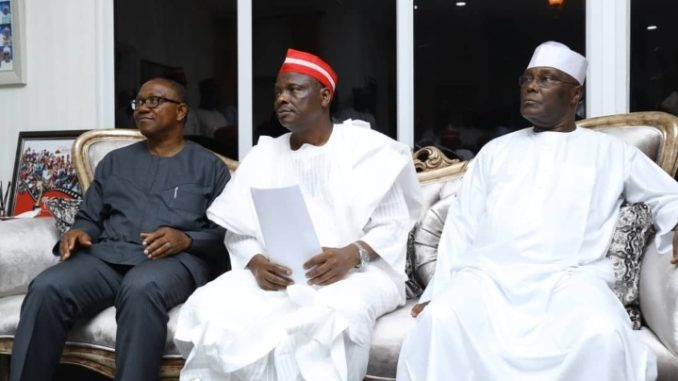
Peter Obi and Rabiu Musa Kwankwaso have moved in the direction of exiting the African Democratic Congress (ADC) amid deepening internal tensions over the 2027 presidential ticket structure, with the Peoples Redemption Party (PRP) and Nigeria Democratic Congress (NDC) emerging as alternative political platforms under active consideration.
A key but unspoken reality driving the unfolding realignment of Obi-Kwankwaso is the growing belief within political networks that the ADC structure is increasingly aligning around Atiku Abubakar’s influence, particularly in relation to the emerging presidential ticket architecture.
This perception, according to opposition insiders, is reshaping trust in the party as a neutral coalition platform.
Kwankwaso stated in his clarification: “We have noted recent media reports and discussions suggesting a possible realignment within the African Democratic Congress due to the current challenges facing the party”
He further added: “In light of the misleading narratives in the public domain, I wish to state categorically that no final decision has been taken regarding my political future or that of my political associates”
He also confirmed ongoing consultations: “We have commenced wide ranging consultations including with leaders from the NDC, PRP and others to explore the best options for protecting our democratic interests”
Obi, in his own statement, said: “My decision to leave the ADC is not because Senator David Mark or Alhaji Atiku Abubakar or any other respected leaders did anything personally wrong to me”
He also added: “The same Nigerian state and its agents that created unnecessary crises and hostility within the Labour Party that forced me to leave now appear to be finding their way into the ADC”
Atiku factor and the 2023 political fracture debate
The current tensions are being interpreted by political analysts through the lens of Atiku Abubakar’s long standing presidential ambition and its impact on opposition party cohesion, particularly during the 2023 electoral cycle within the Peoples Democratic Party (PDP).
In 2023, the PDP was widely reported to have been deeply divided over zoning expectations, with a strong section of the party and political stakeholders arguing that after eight years of northern presidency under Muhammadu Buhari, political balance and electoral strategy favoured a southern presidential candidate to consolidate national inclusion and strengthen electoral competitiveness against the ruling party.
That argument was rooted in a widely discussed political principle within Nigerian party dynamics that rotational balance enhances legitimacy and improves cross regional electoral appeal.
Critics of the PDP internal outcome at the time argue that the failure of Atiku to consolidate around a broadly acceptable southern consensus candidate weakened unity, triggered defections, and contributed to strategic electoral losses.
Within that interpretation, Atiku Abubakar’s persistence in contesting the ticket is often cited by analysts and party insiders as a factor that intensified internal fragmentation.
This is not presented as a singular cause, but as part of a broader pattern of elite competition that weakened opposition cohesion at a critical moment.
That same analytical framework is now being applied by Obi and Kwankwaso aligned strategists to the ADC situation, where concerns are emerging that another tightly contested structure dominated by a strong northern presidential contender could reproduce similar internal fractures.
ALSO READ: I ignore Obi supporters’ online attacks to focus on issues, we don’t abuse — Amaechi
In their view, political arithmetic suggests that a southern candidate would offer a balancing force capable of matching President Bola Ahmed Tinubu more effectively in a direct national contest, particularly in building a broader coalition across regions and voter blocs.
As one strand of opposition thinking frames it, the 2027 contest is not only about party strength but about national equilibrium, where zoning perception, regional acceptance and coalition psychology may determine electoral viability as much as party machinery.
Kwankwaso clarifies political position
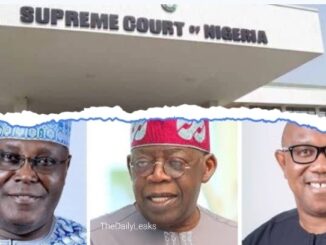
Beyond the political zoning issues, Kwankwaso also addressed the structural tensions within ADC, stating: “The recent Supreme Court judgment while affirming the legitimacy of the David Mark led National Working Committee also remitted the matter back to the High Court”
He added: “This has left the party in a precarious position”
He further noted: “We have commenced wide ranging consultations including with leaders from the NDC, PRP and others”
He also stated: “I have therefore neither declared any intention to run for president nor endorsed any aspirant”
Peter Obi confirms exit and explains decision
Obi expanded on his broader political reflections, stating: “We now live in an environment that has become increasingly toxic where the very system that should protect and create opportunities for decent living often works against the people”
He added: “Even within spaces where one labours sincerely one is sometimes treated like an outsider in one’s own home”
On his departure he said: “My decision to leave the ADC is not because Senator David Mark or Alhaji Atiku Abubakar or any other respected leaders did anything personally wrong to me”
He further stated: “I am not desperate to be President, Vice President or Senate President”
He concluded: “A new Nigeria is POssible”
PRP and NDC positioning as alternative platforms
The Peoples Redemption Party is positioning itself as an ideologically stable platform, actively engaging dissatisfied opposition figures seeking organisational predictability and clearer internal structure.
The Nigeria Democratic Congress is also emerging as a potential convergence point for realignment discussions, particularly for actors seeking to preserve an Obi Kwankwaso political structure outside ADC instability.
Both platforms are increasingly being assessed not simply as party alternatives, but as potential vehicles for rebuilding opposition coherence ahead of 2027.
Atiku’s position and internal ADC tensions
Atiku Abubakar remains firmly positioned within the ADC internal contest space, with allies maintaining that he is not inclined to withdraw from any presidential consideration within the party.
His political network insists he retains the structure, experience and national reach to compete effectively under the current arrangement.
However, within rival camps, this posture is interpreted as reinforcing concerns about concentration of influence within the party’s ticket architecture, especially at a time when coalition building is considered critical for opposition competitiveness.
This tension is now feeding into broader fears among Obi and Kwankwaso aligned strategists that ADC may struggle to function as a neutral consensus platform if internal competition remains heavily weighted around one dominant ambition.
Implications for the opposition landscape ahead of 2027
The emerging political trajectory suggests a gradual restructuring of opposition alignment ahead of 2027, with PRP and NDC gaining attention as viable fallback structures for a recalibrated coalition.
While ADC was initially positioned as a unifying opposition platform, current developments indicate a shift towards parallel coalition construction driven by trust deficits and ticket control disputes.
For Obi and Kwankwaso, the strategic calculation is increasingly centred on avoiding a repeat of fragmented primary battles that weaken electoral competitiveness, while preserving a joint political architecture capable of mounting a credible national challenge.
The situation remains fluid, but the underlying political signal is clear, confidence in ADC as a neutral coalition platform is weakening, while debates over zoning balance, ticket control, and electoral arithmetic are now shaping the next phase of opposition realignment.