By Seyi Gesinde

April 3, 2026
Good Friday stands as the most profound and solemn day in the Christian calendar, a day of suffering, injustice, and yet of the ultimate redemption. It is the day JESUS CHRIST was crucified, a moment that altered the course of history, and to truly grasp its depth, one must imagine Jerusalem as it was that morning, tense, restless, and unknowingly standing at the centre of eternity.
The city did not awaken peacefully. The night had already been consumed by hurried trials, whispered accusations, and political manoeuvring. JESUS had been taken from Gethsemane under guard, led through the corridors of religious authority, first before Annas, then Caiaphas, and finally the council. What should have been lawful proceedings became a hurried display, witnesses contradicting themselves while the verdict was already sealed, Mark 14:55 to 59.
As dawn broke, Jerusalem moved again, but the city’s energy had shifted. The teacher from Galilee, the one who healed the sick and spoke with authority, had been arrested. The crowd, once shouting in celebration, was now uncertain, divided, and easily swayed.
The religious leaders, having secured their religious verdict, brought JESUS to the Roman governor. They could condemn Him under Jewish law, but only Rome could execute. Before , the accusations transformed. What had been blasphemy became political, a claim to kingship, a threat to Caesar, Luke 23:2.
Pilate recognised the truth. He found no fault in Him, John 18:38, yet governance in Jerusalem prioritised order over justice. The chief priests stirred the crowd, and pressure mounted. Pilate attempted compromise, offering the release of a prisoner in line with Passover custom. Before the people stood JESUS and Barabbas, a known insurgent. The crowd chose Barabbas, Matthew 27:21.
Pilate, though convinced of JESUS’ innocence, yielded. He symbolically washed his hands, yet history would never absolve him, Matthew 27:24. Authority had surrendered, justice bowed to expediency.
What followed was brutality. JESUS was scourged, an act designed to weaken and humiliate, mocked with a crown of thorns, a robe, and derision, Matthew 27:28 to 29. The irony was searing; a king mocked, yet truly reigning over heaven and earth.
ALSO READ: Agonising Thursday Jesus faced the dawn of death on the cross: Jerusalem’s tense vigil
The streets of Jerusalem became the path of suffering. JESUS carried His cross toward Golgotha, faltering under the weight, aided by Simon of Cyrene, Luke 23:26. Women wept openly. JESUS, even in suffering, spoke to them, revealing that what was happening was part of a divine reality, Luke 23:28.
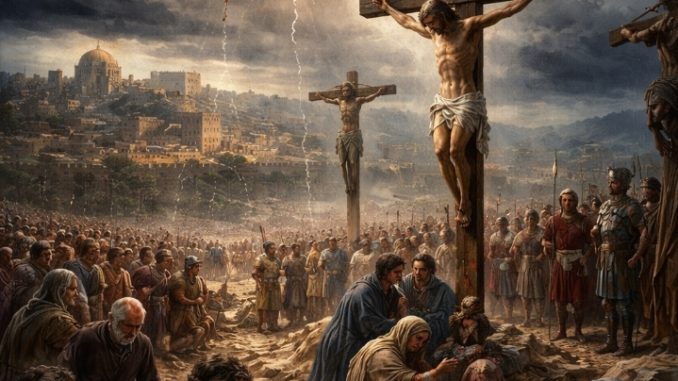
At Golgotha, Roman execution reached its climax. Crucifixion was more than death; it was public humiliation and a display of imperial power. JESUS was nailed to the cross, lifted between heaven and earth. Above Him, the inscription of His charge read, John 19:19, intended as accusation, but declaring truth.
Even in agony, JESUS spoke words of mercy. He prayed for forgiveness for those who nailed Him, Luke 23:34, extended hope to the repentant thief, Luke 23:43, and entrusted His mother to a disciple, John 19:26 to 27.
Then came the signs of a moment beyond comprehension. Darkness fell over the land, Matthew 27:45, creation itself bearing witness. JESUS cried aloud, Matthew 27:46, and finally declared the completion of His mission, John 19:30, giving up His spirit, Luke 23:46. The veil of the Temple tore from top to bottom, Matthew 27:51, symbolising the removal of the barrier between God and humanity.
Even those hardened by duty began to see. A Roman centurion, witnessing everything, declared the truth, Mark 15:39. Jerusalem remained divided. Some returned home unchanged, others struck their hearts in grief, Luke 23:48. The religious leaders believed they had secured control, Rome believed it had maintained order, yet the ultimate victory had already been accomplished through apparent defeat.
Good Friday is not merely a day of suffering. It is a day of fulfilment, substitution, and divine intention. It reveals the cost of redemption, the depth of love, and the seriousness of sin. Jerusalem carried on, yet history had shifted. What looked like the end was in fact the beginning of everything, and through JESUS’ sacrifice, the course of humanity was forever changed. Let us therefore examine our hearts, turn from all sin, and embrace repentance, so that we may fully partake in the new life He purchased for us.