By Gideon Maxwell

April 2, 2026
President Bola Ahmed Tinubu has directed Nigeria’s security agencies to immediately track down and bring to justice those responsible for the recent killings in Plateau State, declaring that the cycle of violence in the region must be decisively confronted.
The President gave the directive during a condolence and security visit to Jos, the Plateau State capital, following renewed attacks that left dozens dead and many others injured, particularly in parts of Jos North Local Government Area.
The visit, which was prioritised amid his ongoing multi-state engagements, underscored the urgency with which the federal government is responding to the deteriorating security situation in the state.
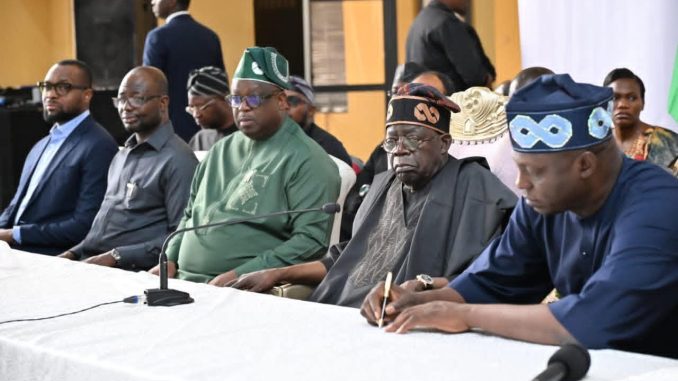
Upon arrival at the Yakubu Gowon Airport in Jos, Tinubu met with victims, bereaved families, community leaders, and key stakeholders who had been brought to the airport for the engagement.
The President used the opportunity to receive first-hand accounts of the attacks and assess the situation through direct interaction with those affected, as well as through briefings from security chiefs and Plateau State officials.
Explaining the decision to hold the engagement at the airport rather than within the affected communities, presidential aides cited a combination of operational and security constraints, including limited time, safety considerations, and the absence of night-landing facilities at the airport, which restricted movement within the available window.
ALSO READ: APC to ADC: ‘Your crisis self‑inflicted, desperation for power got you here’
Despite the constraints, the President conveyed strong condolences to families who lost loved ones and assured them of the federal government’s commitment to restoring peace and ensuring accountability.
He stated that the perpetrators of the violence would not be allowed to act with impunity, stressing that security agencies had been given clear instructions to identify, apprehend, and prosecute all those involved.
Tinubu’s directive signals a renewed emphasis on enforcement and intelligence-driven operations in Plateau, a state that has experienced recurrent ethno-religious and communal conflicts over the years.
Security agencies have consequently been tasked with intensifying intelligence gathering, expanding surveillance, and increasing the deployment of tactical units to stabilise affected areas and prevent further attacks.
Top military commanders, the leadership of the Nigeria Police Force, and other security officials were present during the engagement, reflecting a coordinated federal response aimed at addressing both the immediate crisis and its underlying security challenges.
The President also engaged traditional rulers, political leaders, and community representatives, urging cooperation with security agencies, particularly in the area of intelligence sharing and conflict prevention.
He emphasised that sustainable peace would require both decisive federal action and active local collaboration.
While the visit has drawn criticism from some opposition figures over the President’s inability to physically visit the affected communities, the Presidency has maintained that the engagement achieved its core objectives, direct interaction with victims and the issuance of firm operational directives to security agencies.
The Plateau visit forms part of a broader national itinerary that includes official engagements in other states, combining governance activities with crisis response.
However, the situation in Plateau has once again brought national attention to the complexities of managing internal security threats, particularly in regions with long-standing communal tensions.
Ultimately, the impact of the President’s visit will be measured by the effectiveness of the security response that follows.
With a clear directive now issued to track down and prosecute those responsible, attention shifts to the ability of Nigeria’s security agencies to deliver tangible results and restore confidence among affected communities.