
By Gideon Maxwell

May 13, 2026
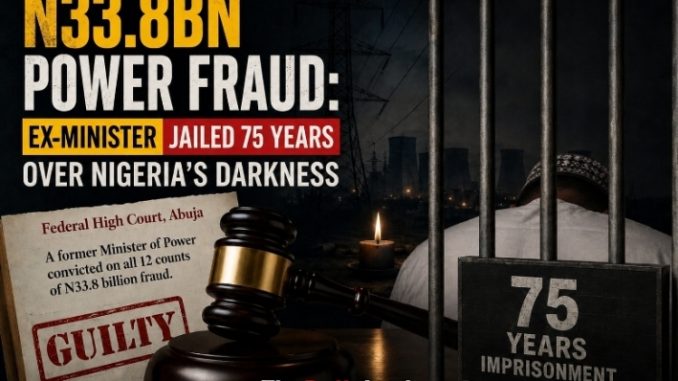
A Federal High Court in Abuja has sentenced former Minister of Power, Saleh Mamman, to 75 years imprisonment over a N33.8 billion fraud linked to major hydroelectric power projects, in a judgment that has once again drawn national attention to the deep rooted corruption crisis surrounding Nigeria’s troubled electricity sector.
Justice James Omotosho convicted Mamman on all 12 counts filed against him by the Economic and Financial Crimes Commission, EFCC, over allegations bordering on conspiracy, money laundering and diversion of public funds earmarked for the Mambilla and Zungeru hydroelectric power projects.
The court handed the former minister seven year jail terms on 10 counts, alongside separate sentences of three years and two years on counts four and five.
The judge ordered that the sentences run consecutively rather than concurrently, effectively raising the total prison term to 75 years.
Justice Omotosho ruled that the prison terms would begin from the date of Mamman’s arrest, as the former minister was absent during sentencing proceedings.
The court also directed security agencies and Interpol to ensure his arrest wherever he may be found.
ALSO READ: Africa rises against ‘high risk’ label at France Africa summit
The court further ordered the forfeiture of foreign currencies and four Abuja properties traced to the former minister.
Mamman, who served under President Muhammadu Buhari between 2019 and 2021, was accused by the EFCC of conspiring with ministry officials and private companies to divert funds meant for strategic power infrastructure projects expected to boost electricity generation in Nigeria.
The anti graft agency said the diverted funds were tied to the Zungeru and Mambilla hydroelectric projects, two projects repeatedly presented to Nigerians as critical solutions to the country’s decades long electricity crisis.
During the trial, the EFCC reportedly presented 17 witnesses and tendered 43 exhibits before the court.
The sentencing has sparked widespread public reaction because of the irony surrounding Nigeria’s persistent power failures despite billions of naira budgeted for the sector over the years.
For many Nigerians, the judgment reinforces growing concerns that corruption, rather than lack of technical expertise or investment opportunities, remains one of the biggest obstacles to stable electricity supply in the country.
Nigeria has for decades struggled with inadequate electricity generation, poor transmission infrastructure, national grid collapses and dependence on expensive alternative energy sources.
Businesses and households spend huge amounts annually on diesel and petrol generators, while industries continue to cite poor electricity supply as a major challenge to productivity and economic growth.
Against that backdrop, revelations that billions allegedly meant for power projects were diverted have intensified public frustration.
The judgment is also being viewed as one of the rare instances where a high ranking public official received cumulative jail terms ordered to run consecutively, a move legal observers say signals a tougher judicial approach to corruption related offences.
Although anti corruption convictions involving former public officials are not uncommon in Nigeria, critics have often argued that weak sentencing structures and prolonged legal delays undermine deterrence.
In this case however, the court’s decision to impose consecutive sentences instead of allowing the jail terms to run simultaneously significantly increased the total punishment.
The conviction comes amid continuing national debates over accountability in the management of public funds, particularly in sectors considered essential to economic survival and national development.
For millions of Nigerians still battling daily blackouts, rising electricity tariffs and dependence on generators, the case has become more than another corruption headline.
It has evolved into a painful symbol of how alleged diversion of public resources may have contributed directly to years of darkness across homes, hospitals, schools and industries.