
By Gideon Maxwell

May 25, 2026
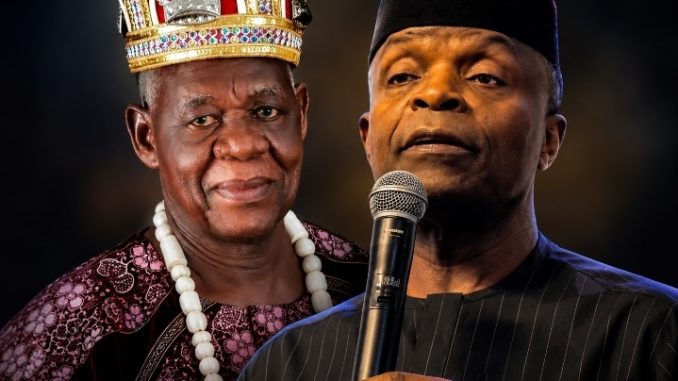
Ten years after the passing of respected Enugu traditional ruler and educationist, HRH Igwe Vincent Onyekelu Ilo, immediate past Vice President, Prof Yemi Osinbajo, SAN, GCON, has called for a shift from episodic charity to structural, systems based social transformation.
He said sustainable social impact must move beyond relief driven giving to long term investments that strengthen institutions, expand opportunity, and reduce the conditions that produce poverty.
Delivering the inaugural memorial lecture on May 19, 2026 in Enugu, titled “Charity as a Catalyst for Social Change: Moving From Philanthropy to Sustainable Social Impact,” Osinbajo said the late monarch’s life exemplified service driven leadership rooted in education, mentorship, and community development.
He described Igwe Ilo as a teacher of teachers, headmaster, mentor, and traditional ruler whose influence was built on quiet impact rather than public spectacle.
“There is a quiet nobility in a life that is defined by purpose, by integrity, by service and by commitment,” he said, adding that the monarch “shaped lives, strengthened his community and left behind a legacy of impact without noise.”
Osinbajo commended the Ilo family for transforming the memorial into what he described as a wider platform for national reflection on development, governance, and social progress.
At the centre of his address, however, was a sustained critique of charity as a standalone development tool. He defined charity as immediate relief for urgent human needs such as hunger, illness, disaster, and homelessness, stressing that while necessary, it remains limited in scope.
ALSO READ: Osinbajo commissions projects in Bayelsa, hails Diri’s performance
“Charity addresses the symptoms of social problems,” he noted, arguing that it cannot on its own resolve the structural causes of poverty.
By contrast, he explained philanthropy as long term, system oriented intervention focused on education, institutions, policy reform, entrepreneurship, innovation, and sustainable development.
He illustrated the distinction with a simple formulation: charity feeds the hungry, while philanthropy builds systems that prevent hunger.
Osinbajo warned that societies can become highly charitable without becoming more just, noting that repeated acts of relief may inadvertently leave underlying inequalities untouched.
“A society can become highly charitable without becoming substantially more just,” he said, adding that relief without reform risks normalising poverty across generations.
He further argued that moral satisfaction derived from giving can sometimes obscure the need for deeper institutional change, where “the hungry are fed, but the structures that manufacture hunger remain untouched.”
Drawing from religious traditions, he said both Christianity and Islam elevate charity as a moral duty, but cautioned that generosity alone does not equate to justice or structural fairness.
He said true development requires moving beyond vertical relationships of giver and receiver toward systems that empower individuals to become economically independent.
Osinbajo stressed that modern philanthropy must be catalytic, not symbolic, describing it as investment that strengthens systems rather than replacing them.
“The ultimate measure of compassion is not how efficiently a society distributes alms, but whether it steadily reduces the number of people who need charity at all,” he said.
He cited Nigeria’s North East humanitarian crisis as a case study, referencing the Northeast Children’s Fund established during his tenure after visiting IDP camps in Borno State in 2016. The initiative, he said, moved beyond relief to building structured educational pathways for children orphaned by insurgency.
He noted that children who once lived in displacement camps and spoke only Kanuri have since progressed into secondary schools and universities through structured educational support.
Osinbajo also referenced global institutions such as the Ford Foundation and the Gates Foundation as examples of long term philanthropic models that have reshaped justice systems, healthcare delivery, and vaccine access globally.
He highlighted the role of the Gavi Vaccine Alliance, supported by the Gates Foundation, in reducing vaccine costs by more than 90 percent through coordinated procurement systems across multiple countries.
He said such interventions demonstrate that philanthropy, when properly structured, can redesign markets, strengthen institutions, and save millions of lives.
However, he cautioned that over reliance on external funding mechanisms risks weakening state capacity.
“Philanthropy cannot last forever, so it must not pretend that it can,” he warned, noting that many African health systems remain heavily dependent on donor funding due to weak domestic financing structures.
He urged governments to prioritise sustainable public investment in healthcare, education, and infrastructure, warning that donor dependency cannot substitute for strong national systems.
Osinbajo concluded by calling for collaboration between governments, private sector actors, civil society, and faith based organisations in building resilient development ecosystems.
He said the future of social impact lies not in isolated acts of generosity but in coordinated efforts to build systems that eliminate the conditions that make charity necessary.