• Second loses, third wins

By Seyi Gesinde
July 21, 2026
History has always concealed its deepest philosophies inside ordinary spectacles.
Sometimes inside wars.
Sometimes inside elections.
Sometimes inside revolutions.
Every four years, it hides one inside football.
Billions gather before television screens believing they are merely watching twenty two players chase a ball.
History quietly smiles.
For beneath the roar of the stadium lies one of civilisation’s oldest contradictions.
The World Cup crowns the best team on earth.
It also exposes one of humanity’s oldest illusions.
That achievement and happiness are faithful companions.
They are not.
The second best team in the world walks away wearing silver, a medal objectively more precious than bronze…
…yet carrying the emotions of defeat.
The third best team walks away with bronze…
…yet carrying the emotions of victory.
No playwright could have imagined a more curious script.
The Greeks understood that irony is often history’s favourite language.
What appears irrational at first glance frequently reveals a deeper order.
The World Cup has been speaking that language for nearly a century.
The contradiction begins long before the medals are presented.
It begins with the fixtures.
FIFA creates two stages on the tournament’s final weekend.
One crowns a champion.
The other crowns a victor.
One winner becomes world champion.
The other becomes third.
One loser finishes fourth.
The other…
Finishes second.
There lies the paradox.
History records the runner up above the bronze medallist.
Human emotion often reverses the order.
Aristotle distinguished between achievement and honour.
Modern sport has quietly introduced another distinction.
Achievement and experience.
The runner up achieved more.
The bronze medallist often experienced more joy.
How extraordinary.
ALSO READ: If they stole behind Buhari
Silver is objectively higher than bronze.
Yet bronze frequently arrives wrapped in laughter.
Silver arrives wrapped in silence.
Every World Cup tells the same story.
The champions dance.
The bronze medallists embrace.
Flags rise.
Songs echo.
Children race onto the pitch.
Families celebrate.
The silver medallists applaud politely.
Some stare into empty space.
Some struggle to hold back tears.
Some remove their medals almost immediately.
The medal hanging around their neck declares them the second best football team on earth.
Their hearts whisper something entirely different.
You lost.
How remarkable.
The world congratulates one team for winning.
It consoles another for losing.
One stands higher.
The other often smiles wider.
The contradiction is not football’s alone.
It belongs to civilisation itself.
The Stoics observed that suffering rarely begins with circumstances.
It begins with comparison.
Third place compares itself with fourth.
Second place compares itself with first.
The arithmetic remains unchanged.
The psychology changes everything.
Centuries before modern neuroscience, Epictetus understood that people are disturbed less by events than by the meanings they attach to them.
The medal did not wound the runner up.
Expectation did.
Seneca warned that fortune’s cruellest trick is not denying our ambitions.
It is allowing us to approach them closely enough to taste them before taking them away.
Silver is often the taste of interrupted destiny.
Bronze is the relief of survival.
Shakespeare recognised the same pattern.
Nothing wounds quite like the crown that almost touched the head.
History simply keeps rewriting the scene with different costumes.
The candidate who narrowly loses an election often carries deeper disappointment than the rival eliminated in the first round.
The entrepreneur who almost secures the defining contract frequently suffers more than the one rejected months earlier.
The scholar who misses first place by a single mark remembers that result longer than many who finished far below.
ALSO READ: Imagine he was her father
The athlete who loses Olympic gold by the smallest margin often wrestles with the memory more intensely than the bronze medallist celebrating a place on the podium.
Civilisation has always misunderstood disappointment.
We imagine it lives at the bottom.
More often, it lives just beneath the summit.
Perhaps the heaviest word in any language has never been failure.
It has been almost.
Almost victorious.
Almost remembered.
Almost crowned.
Almost immortal.
The World Cup’s final weekend therefore becomes something greater than football.
It becomes philosophy wearing boots.
A stadium becomes an amphitheatre.
The crowd becomes a classroom.
The medal ceremony becomes a lecture on the human condition.
The champion ends with victory.
The third placed team ends with victory.
The runner up ends with defeat.
Memory has always been kinder to endings than to arithmetic.
That is why silver sometimes feels heavier than bronze.
Not because it weighs more.
But because it carries the unbearable weight of almost.
ALSO READ: Seyi was a friend
The medal table is correct.
History is correct.
Silver outranks bronze.
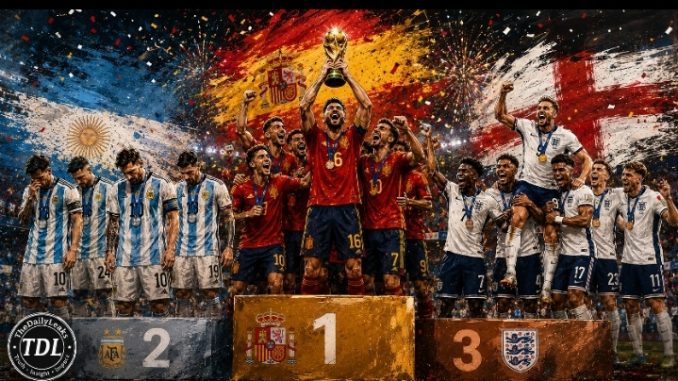
Yet photographs quietly challenge statistics.
One podium celebrates fulfilment.
Another celebrates recovery.
The middle one mourns possibility.
Perhaps that is the World Cup’s accidental paradox.
It never intended to place third above second in human celebration.
It merely created two matches.
One for a title.
One for consolation.
Human nature completed the script.
For civilisation has never celebrated rank alone.
It has always celebrated victory.
And perhaps that is the oldest satire hidden inside the beautiful game.
The world spends a lifetime chasing first place.
Yet every four years, football quietly reminds us that the happiest people on the podium are not always standing nearest the top.