By Emmanuel Babafemi

25 September 2026
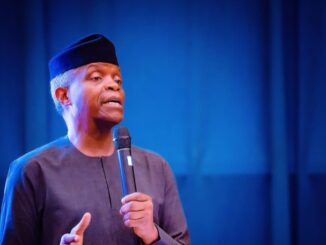
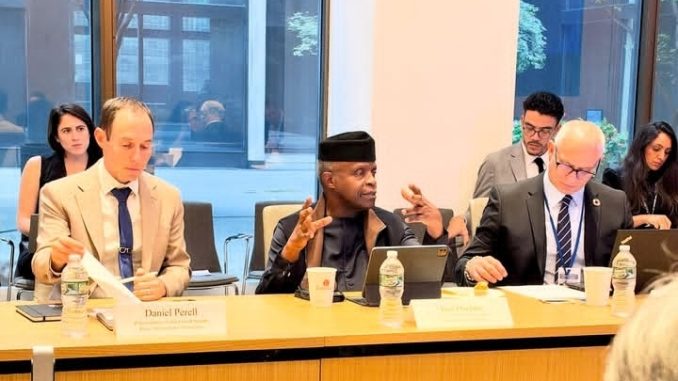
Former Nigerian Vice President Professor Yemi Osinbajo has opened a high-level roundtable on renewing multilateralism during the 81st United Nations General Assembly.
He posed a central question.
What comes after multilateralism?
Africa was not at the table when the rules-based international order was shaped after World War II.
It was also absent at the founding of the Bretton Woods institutions and their successors.
But we are here now.
And multilateralism is being re-engineered.
What should Africa be saying?
That question sat at the heart of the roundtable titled “Renewing Multilateralism: Country-led Priorities for a Changing Global System.”
The session was convened by the Africa-Europe Foundation, the Article 109 Coalition and the Future of Development Cooperation Coalition.
Osinbajo, who co-chairs the Future of Development Cooperation Coalition, gave the framing remarks to open the discussion.
The Coalition works to rethink development cooperation for a multipolar world.
It stresses that countries of the Global South are bringing their own ambitions, capital, institutions and ideas.
ALSO READ: Osinbajo urges trusted corridor to unlock diaspora capital for Africa at UNGA81
They are not waiting to be invited into someone else’s model of development.
The task of cooperation is to support that agency so they become co-authors of the rules, not simply participants within them.
The Article 109 Coalition campaigns for the invocation of Article 109 of the United Nations Charter.
This would open a formal path to review and renew the Charter itself.
The Africa-Europe Foundation focuses on strengthening the partnership between the two continents as a stabilising force for more inclusive global governance.
Participants examined how country-led priorities can shape a changing global system at a time when the postwar order is under strain.