By Seyi Gesinde

August 29, 2026
For most political office holders, stepping away from the corridors of power signals a quiet descent into the background. The sirens fade, the motorcades disappear, and the frantic pace of public life slows to a halt. Yet for Professor Yemi Osinbajo, the end of his tenure as Nigeria’s Vice President marked not an exit from service, but a transition into a deeper, more enduring form of impact. Years after leaving public office, his calendar remains remarkably full, reflecting a rare breed of leadership driven by ideas, institutional building, and genuine community engagement.
The month of August 2026 offered a clear window into this ongoing journey. Rather than retreating behind closed doors, Osinbajo maintained an energetic schedule that bridged intellectual policy formulation with grassroots environmentalism. His engagements showed a leader equally comfortable addressing the complex future of higher education in a digital age and championing the quiet, vital work of urban greening and climate resilience.
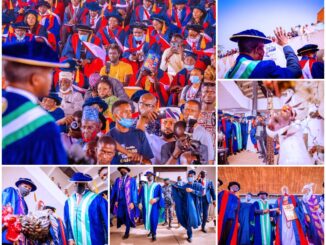
In late August, the University of Lagos became the focal point of a critical national conversation when Osinbajo chaired the fifth international colloquium of its Distance Learning Institute. Speaking to an audience of academics, administrators, and students, he addressed one of the most pressing challenges facing the country: the surging demand for university education against limited institutional capacity. With millions of candidates seeking admission every year, Osinbajo argued persuasively for a paradigm shift, championing Open and Distance Learning as an essential vehicle rather than a mere alternative. He noted that integrating artificial intelligence and modern technology into distance learning would open up unprecedented spaces for ambitious youths, ensuring that learning is no longer bound strictly by physical walls.
Days later, the tone shifted from the lecture hall to the soil, yet the underlying philosophy of sustainable legacy remained unchanged. Osinbajo lent his voice and presence as the special guest speaker at the fifth edition of the Open Day for Gardeners seminar in Victoria Island, Lagos. Speaking on the theme of leaving the earth better than we found it, he urged citizens to move beyond empty environmental intentions and embrace actionable steps toward conservation, biodiversity, and land restoration. Surrounded by plant enthusiasts, conservationists, and young entrepreneurs, his presence bridged high-level environmental policy with the everyday beauty of community action, reinforcing his commitment to ecological stewardship.
This blend of intellectual rigor and human warmth captures why Osinbajo remains deeply relevant to local and global developments. Whether he is convening international dialogues on diaspora capital or encouraging tree planting at a local exhibition, his post-office trajectory offers a refreshing template for modern African leadership. It is a posture defined by lifelong service, proving that true influence stems not from an official title, but from the consistency of one’s vision and the depth of one’s commitment to the people.
Looking closely at his address at the University of Lagos, Osinbajo laid bare the hard numerical realities facing the nation’s tertiary education system. He pointed out that with millions of young citizens applying through the Joint Admissions and Matriculation Board annually, conventional universities possess the physical capacity to absorb only a fraction of qualified candidates. By challenging stakeholders to rethink institutional frameworks, he insisted that brick and mortar expansion alone cannot solve the crisis. Instead, he advocated for robust digital integration that reaches students in remote areas, working professionals, and mature learners seeking career transformation.
ALSO READ: Osinbajo the solutionist
His intervention at the academic gathering went beyond logistics, touching deeply on the ethical and practical integration of artificial intelligence in classrooms. He challenged educators to adapt assessment methods and curriculum designs to a world where technology alters how knowledge is consumed and tested. Yet, he consistently anchored these futuristic projections to human development, reminding his audience that technological tools are only valuable if they expand human capability and opportunity. It was a quintessential display of his trademark intellectual depth, synthesizing macroeconomic realities with practical, empathetic solutions for everyday citizens.
Transitioning seamlessly from academia to environmental advocacy, his appearance at the Ecobank Pan African Centre for the Open Day for Gardeners highlighted his expanding role in ecological preservation. Serving as the lead speaker for the seminar, he underscored the urgent need for individual and collective responsibility in combating climate change. His message resonated with urban gardeners, landscape artists, and environmental activists who gathered to celebrate nature and sustainable living. By lending his voice to matters of land restoration and biodiversity, he demonstrated that environmental health is inextricably linked to human survival and national prosperity.
This active post-office posture also reflects a broader philosophy of nation-building that transcends partisan politics or government appointments. Across various engagements, Osinbajo consistently emphasizes that development is a multi stakeholder enterprise requiring the active participation of civil society, private innovators, and traditional institutions. His ability to convene diverse minds, from diaspora leaders in Addis Ababa to environmentalists in Lagos, illustrates an enduring convening power built on trust, integrity, and intellectual respect. He listens intently, engages rigorously, and offers constructive frameworks that inspire action rather than mere rhetoric.
Ultimately, Professor Yemi Osinbajo’s post-office journey serves as a powerful reminder of what leadership can achieve when anchored in purpose rather than position. Through his sustained contributions to education, climate advocacy, and economic inclusion, he continues to shape the trajectory of national development from outside the formal corridors of power. His August engagements are not isolated events, but part of a continuous, purposeful rhythm of service that redefines what it means to be an elder statesman in modern Africa.