
By Marvellous Nyang

October 23, 2026
Former Vice President Professor Yemi Osinbajo has warned that declining public trust in democratic institutions, worsening economic hardship, and systemic corruption are placing constitutional governance under severe pressure across Africa.
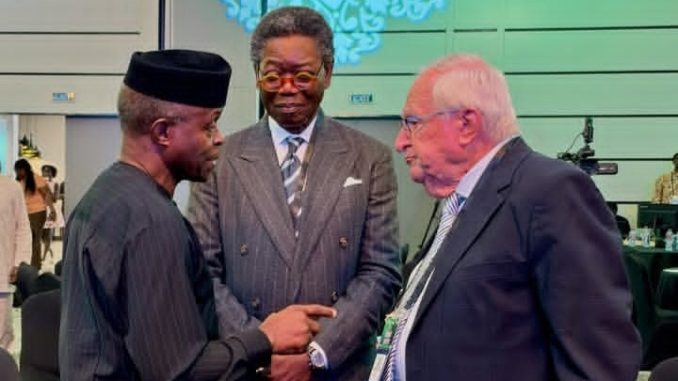
Osinbajo made the remarks while delivering the keynote address at the Good Governance Africa annual lecture on October 22 in Accra, Ghana, themed “Democracy Under Pressure: Rebuilding Trust, Accountability, and Institutional Integrity in Africa’s New Political Era”.
Speaking at the event, the former Vice President asserted that Africa’s primary governance hurdle is not a scarcity of well drafted constitutions, but the persistent failure to convert legal provisions into lived accountability.
Citing empirical data from Afrobarometer research, he revealed that while 64 per cent of Africans still favour democratic rule over alternative political arrangements, only 38 per cent report satisfaction with the practical operation of democracy in their nations.
ALSO READ: Akande dismisses Babachir Lawal’s claims on Osinbajo, Buhari, appointments as falsehoods
He drew direct attention to Nigeria, highlighting how voter participation in Africa’s most populous country has collapsed precipitously from 44 per cent in 2015 to 35 per cent in 2019, before reaching a historical low of 27 per cent during the 2023 general elections.
The former Vice President expressed deep concern over widespread economic distress, noting that 59 per cent of Africans assess their national economic conditions as poor and 51 per cent report deteriorating personal circumstances, trends that severely damage public confidence in civilian authorities.
He observed that between 2020 and 2025, Africa experienced 11 successful military takeovers across nine nations, warning that 53 per cent of citizens now express willingness to accept military intervention when elected leaders exploit political office for self enrichment.
Osinbajo cautioned against confusing voter frustration with an endorsement of military autocracy, emphasizing that elected political actors frequently weaken constitutional government themselves by manipulating electoral rules and suppressing genuine political opposition.
To re-establish public trust, he urged African governments to move beyond procedural elections and adopt citizen centred governance models that guarantee economic relief, social protection, transparent public communication, and uncompromised judicial integrity.
Recalling comprehensive legal reforms during his tenure as Attorney General of Lagos State, Osinbajo demonstrated how combining competitive judicial remuneration with rigorous anti-corruption oversight successfully eliminated corruption perception within the state’s legal framework.
He additionally backed the establishment of the proposed International Anti Corruption Court slated for 2028, stressing that it would serve as an essential global mechanism to complement domestic judiciaries in prosecuting political elites who evade local legal proceedings.
This continental call for institutional reform aligns with Osinbajo’s broader diplomatic engagements across West Africa, following high level consults with political figures intended to reinforce regional stability and constitutional order within the ECOWAS sub region.