By Seyi Gesinde

April 23, 2026
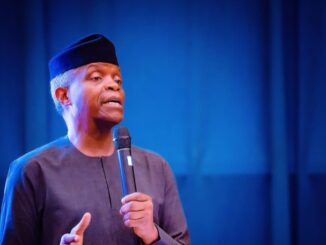
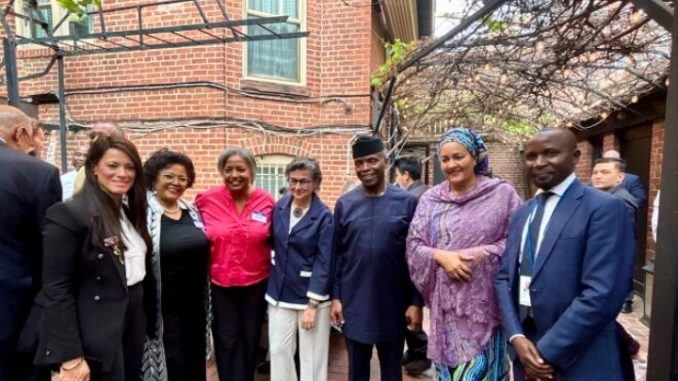
Former Nigerian Vice President, Yemi Osinbajo, emerged as a central voice in high level global development discussions during the World Bank and International Monetary Fund Spring Meetings in Washington DC.
He participated in a series of strategic engagements focused on reshaping international development cooperation, financing architecture, and Africa’s economic transformation.
His participation spanned five major platforms, bringing together global development leaders, multilateral institutions, and policymakers across Africa, Europe, and global philanthropy networks.
Advancing new direction for development cooperation
At the Future of Development Cooperation Coalition bilateral meetings, Osinbajo held discussions with African Development Bank President Sidi Ould Tah and Save the Children UK Chief Executive Officer Moazzam Malik.
He described the engagement as focused on urgency and transition in global development priorities.
ALSO READ: Oil surges past $100 as gunfire hits vessels in Hormuz, reigniting global supply fears
According to him, “The agenda, what comes next, and how we move with speed.”
The discussions centred on accelerating reforms in development cooperation frameworks and redefining partnerships beyond traditional aid structures.
Reframing development beyond aid dependency
Osinbajo also featured prominently at a DEVEX panel titled A Reset for Development Cooperation, where he joined co chair Arancha González Laya and Future of Development Cooperation Coalition Secretariat Head Alexia Latortue.
He stressed the need for structural transformation in global development thinking, stating that the discussion was “to map the terrain beyond the aid era.”
He further added that it was “not a eulogy for old models, a blueprint for what must replace them.”
The session focused on redesigning global development systems in response to shifting economic realities and financing constraints.
Health financing and country ownership in focus
At the Geoeconomics Forum, Osinbajo engaged in a policy conversation with Dr Kalpana Kochhar of the Gates Foundation on sustainable financing for health systems, particularly for women and children.
He framed the issue as a governance and accountability imperative, stating
“How do we finance what actually works for women’s and children’s health.”
He emphasised that “Country leadership must be at the centre of that answer.”
The dialogue underscored increasing calls for domestic ownership of health financing strategies across developing economies.
UNDP Africa innovation fund and domestic ownership model
Osinbajo participated in the UNDP Africa Innovation Fund, also known as timbuktoo, ministerial co financing roundtable alongside UNDP Administrator Alexander De Croo and UNDP Africa Regional Director Ahunna Eziakonwa.
The session brought together ministers and senior officials from Rwanda, Angola, Lesotho, Nigeria, and Zambia.
Reflecting on the discussion, he noted “We shared progress with ministers and senior officials.”
He further described the engagement as “a reminder of what domestic ownership looks like when it is real.”
The conversation highlighted African led innovation financing and the role of governments in shaping sustainable development ecosystems.
Africa financing its own transformation
In another high level panel titled How Can Africa Finance Its Own Transformation, Osinbajo joined Samaila Zubairu, Tidjane Thiam, Greg Guyett of the European Bank for Reconstruction and Development, and moderator Arancha González Laya.
The discussion focused on mobilising domestic capital at scale to support Africa’s economic transformation agenda.
Osinbajo delivered a firm position on the direction of change, stating
“The answer will not come from outside. It never was going to.”
The panel explored investment mobilisation, financial system reform, and the role of African institutions in driving long term growth.
A coordinated global policy presence
Across all engagements, Osinbajo’s interventions consistently aligned around three key themes: reform of global development systems, shift from aid dependency to capital mobilisation, and strengthening domestic leadership in financing development outcomes.
His participation positioned him within a broader network of global policymakers shaping post aid era development architecture during one of the most significant annual gatherings of international financial institutions.
Osinbajo’s presence at the IMF World Bank Spring Meetings in Washington DC reflected an active role in ongoing global debates on development reform, with repeated emphasis on urgency, ownership, and systemic change in financing models for emerging economies.
His contributions across multiple sessions reinforced a consistent policy position advocating a transition from traditional aid structures toward African led and domestically financed development systems.