• The disturbing social order

By Seyi Gesinde
July 5, 2026
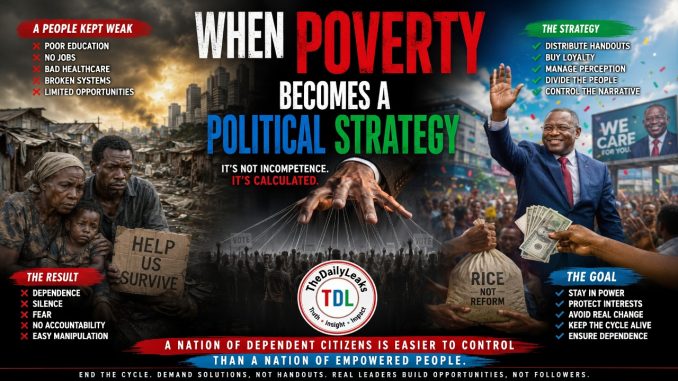
A nation should measure political success by how many people have escaped poverty. Yet, in many societies, poverty has become a valuable political asset. Instead of being treated as a national emergency to be eliminated, it is quietly preserved because it creates dependence, weakens resistance, and makes manipulation easier.
This is the strange social order: the poorer the people become, the more politically useful they can become to certain actors.
When poverty becomes a political strategy, development is no longer the priority. Dependence becomes the currency of power.
Poverty that benefits politicians
Not every government deliberately creates poverty. Economic downturns happen for many reasons. However, the real concern arises when leaders discover that widespread hardship can be politically advantageous.
A population struggling to eat today rarely has the luxury of demanding better schools, healthcare, judicial reforms, or institutional accountability. Immediate survival overshadows long term national development.
In such an environment, politicians no longer compete on ideas. They compete on relief.
The economics of dependence
Economic independence produces independent thinking.
A person with stable income is more likely to question authority, reject inducements, and vote according to conviction.
A financially desperate person often has fewer choices. Hunger compresses freedom. Every offer, however small, becomes significant.
ALSO READ: Non-existent office: The questions no disclaimer can silence
This explains why poverty can become an invisible political tool. Dependence gradually replaces citizenship.
The politics of emergency
When poverty becomes entrenched, governance shifts from solving structural problems to distributing temporary relief.
Instead of asking:
How do we create jobs?
How do we improve productivity?
How do we attract investment?
How do we strengthen education?
Public discourse revolves around:
Who distributed food?
Who paid hospital bills?
Who shared cash?
Who bought motorcycles?
Who paid school fees?
While these acts may genuinely help individuals, they should never replace policies that prevent poverty in the first place.
The psychology of gratitude
One of the most dangerous consequences is that citizens begin to confuse compassion with good governance.
People become grateful for receiving what effective governance should have made unnecessary.
A bag of rice begins to overshadow years of unemployment.
A cash donation overshadows collapsing hospitals.
Temporary kindness replaces permanent solutions.
This gradually lowers society’s expectations of leadership.
Why some leaders fear prosperity
Prosperous citizens are difficult to manipulate.
They ask questions.
They demand transparency.
They scrutinise budgets.
They insist on measurable performance.
They vote differently.
By contrast, widespread poverty often creates a population that is easier to mobilise through emotion, ethnic identity, religious identity, or material inducements.
The issue is not that poor people are less intelligent. Rather, persistent economic insecurity narrows the range of choices available to them.
Poverty weakens democracy
Democracy assumes that citizens can make relatively free political choices.
Extreme poverty weakens that freedom.
When the next meal depends on today’s political patron, independence becomes expensive.
Votes become survival tools instead of expressions of conviction.
This gradually transforms elections from contests of ideas into contests of distribution.
The business of poverty
Poverty can also sustain entire networks beyond politics.
Some contractors benefit from endless poverty alleviation programmes.
Some organisations thrive because poverty never ends.
Some middlemen profit from distributing aid rather than eliminating the conditions that require it.
In such systems, solving poverty threatens established interests.
The danger to national productivity
A nation cannot distribute itself into prosperity.
Lasting prosperity comes through productivity, innovation, enterprise, education, infrastructure, security, and the rule of law.
When political energy focuses primarily on sharing limited resources instead of expanding national wealth, poverty reproduces itself.
The silent cost
The greatest damage is not merely economic.
It destroys ambition.
Young people begin to believe that political connections matter more than competence.
Innovation declines.
Entrepreneurship weakens.
Merit loses value.
Dependence becomes normal.
Eventually, citizens stop expecting opportunity and begin competing for favour.
Breaking the cycle
Ending politically useful poverty requires structural reforms.
Governments should be evaluated less by how much relief they distribute and more by how many people permanently leave poverty.
Policies should reward enterprise rather than dependence.
Education should produce employable skills.
Small businesses should find it easier to grow.
Agriculture, manufacturing, and technology should become engines of wealth creation rather than campaign promises.
Strong institutions must replace personal patronage.
Citizens must also reject the temptation to exchange long term prosperity for short term gifts. The immediate value of a handout may be real, but it should never become the standard for judging leadership.
The final thought
A government’s greatest achievement is not feeding citizens for a day, but creating conditions in which citizens can feed themselves with dignity.
A healthy society is one where politicians become less necessary in people’s daily survival because institutions, opportunity, and economic freedom are doing the work.
The true measure of leadership is not how many poor people remain dependent on those in power, but how many no longer need them.