
April 12, 2026

They did not go to conquer land. There was no flag to plant, no territory to claim.
They went to look.
And in looking, they saw what few humans in history have ever witnessed, not just the Moon, not just the Earth, but the raw architecture of existence itself, stripped of atmosphere, stripped of illusion, stripped to what can only be described as creation, naked.
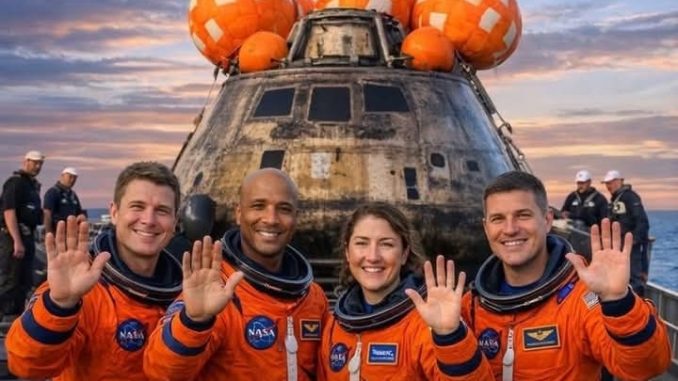
At the centre of this audacity were four human beings, Reid Wiseman, Victor Glover, Christina Koch, and Jeremy Hansen, carried aboard Orion, propelled by the Artemis II mission, farther from Earth than any human before them, beyond even the limits reached during Apollo 13.
The unbearable distance of truth
Distance in space is not just physical, it is philosophical.
At 252,756 miles from Earth, the crew crossed a boundary not marked on any map, the threshold where Earth ceases to feel permanent and begins to look fragile, suspended, almost improbable.
Christina Koch did not romanticise it. She named it with unsettling clarity.
She described Earth as a “lifeboat” in the vast darkness, a word that does not celebrate, but warns.
A lifeboat implies danger.
A lifeboat implies survival, not dominance.
From that distance, continents disappear into colour, borders dissolve, and everything humanity fights over collapses into insignificance. What remains is a small, glowing sphere, carrying every war, every prayer, every child, every ambition.
Victor Glover and the silence that speaks
Then came the silence.
As the spacecraft passed behind the Moon, communication with Earth was lost for nearly 40 minutes, no voices, no signals, no reassurance.
For most, silence is absence.
For Victor Glover, it became encounter.
ALSO READ: How to persuade people to change their behaviour
In that isolation, he turned not outward, but inward and upward, marking what has been described as a deeply spiritual moment, a pause where technology could not mediate reality.
Later, overwhelmed by the magnitude of the experience, his words were few, but heavy.
He spoke with gratitude, struggling to compress into language what space had revealed without words.
Because beyond the instruments and mission protocols, there is a confrontation that astronauts rarely fully articulate, the confrontation with scale, with origin, with the unsettling awareness that the universe does not need explanation to exist.
Reid Wiseman and the burden of command
Leadership in space is not authority, it is responsibility under conditions where failure is absolute.
Commander Reid Wiseman carried that weight, not just of navigation and execution, but of meaning.
He reflected on what this mission represents, not merely a return to the Moon, but a shift in human consciousness.
“We are there now, and we are going further,” he said, framing Artemis not as a mission, but as a generational declaration.
Yet even in that forward vision, humanity followed him into space.
In one of the most human moments of the mission, the crew paused to honour his late wife, asking for a lunar crater to bear her name, “Carroll”.
It was a quiet reminder that even at the edge of space, grief travels with us.
Love travels with us.
Jeremy Hansen and the meaning of “we”
Jeremy Hansen did not go as an individual. He carried a nation, becoming the first Canadian to journey to the Moon, but more importantly, he carried the idea that space is no longer the domain of one country.
His reflections after the mission did not centre on achievement, but on shared humanity, speaking of courage, love, and collective possibility.
Because Artemis II is not Apollo repeated.
It is something more complex, less about planting a flag, more about redefining who “we” are when we leave Earth together.
Christina Koch and the fracture of certainty
Christina Koch had already spent 328 days in space before this mission, longer than any woman in history.
But nothing in low Earth orbit prepares a human being for deep space.
Near Earth, you are still held.
Beyond it, you are released.
She spoke not of records or milestones, but of perspective, warning against focusing on “superlatives” while missing the deeper story, the discipline, the teamwork, the cost of pushing into the unknown.
What she encountered was not just distance, but detachment, from noise, from certainty, from the illusion that Earth is central.
What they truly saw
They saw Earthrise, not as a photograph, but as an event.
They saw the Moon’s surface, not as a symbol, but as a silent witness to time.
They saw darkness, not as emptiness, but as scale.
And in that seeing, something shifted.
Because when you leave Earth far enough, you do not just observe creation, you are exposed to it.
No filters.
No atmosphere.
No comforting narratives.
Just reality in its most unprocessed form.
The audacity of four humans
It is easy to celebrate technology, the rocket, the precision, the engineering.
But Artemis II is ultimately not about machines.
It is about four fragile human beings choosing to leave the only world that has ever sustained them, to travel into an environment that offers nothing, no air, no warmth, no forgiveness.
And yet they went.
Not because it is safe.
Not because it is easy.
But because there is something in the human spirit that refuses confinement, that insists on seeing, even when what it may see could unsettle everything it thought it understood.
The deeper implication
What Artemis II exposes is not just the universe.
It exposes us.
It reveals how small we are, how dependent we are, how temporary our conflicts are, and how extraordinary it is that consciousness exists at all in a universe so vast and indifferent.
Four souls went to the edge of that realisation.
And returned.
Not with conquest.
Not with possession.
But with perspective.
And perhaps that is the most dangerous knowledge of all.