By Gideon Maxwell

May 11, 2026
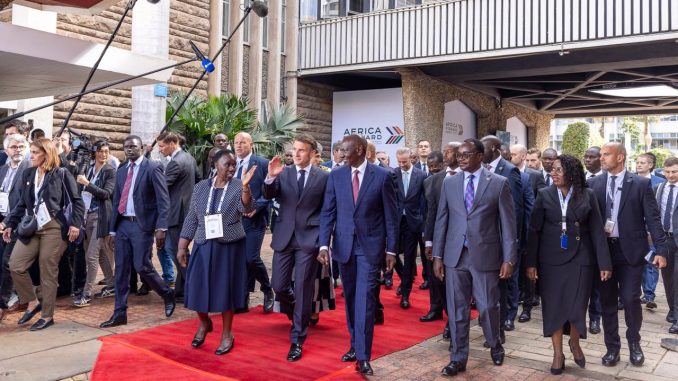
African leaders gathered in Nairobi this week for the landmark Africa Forward Summit with a unified message to global financial institutions and investors, Africa must no longer be treated as a permanent high risk destination for capital.
The summit, co hosted by William Ruto and Emmanuel Macron, has evolved into more than a diplomatic gathering.
It is becoming a direct challenge to the global financial architecture that many African governments say unfairly punishes the continent with higher borrowing costs, reduced capital access, and distorted risk assessments.
Held under the theme “Africa Forward: Africa France Partnerships for Innovation and Growth”, the summit brought together more than 30 African delegations, international lenders, development finance institutions, chief executives, and global investors at a time when African economies are under severe pressure from debt burdens, inflation, currency volatility, and slowing foreign direct investment.
The battle against Africa’s ‘risk premium‘
At the centre of the summit discussions was a long standing African grievance, that global markets systematically overprice African risk.
African governments argue that the continent is routinely classified as excessively risky regardless of economic fundamentals, forcing countries and businesses to borrow at far higher interest rates than peers in other regions.
This “Africa premium” has become one of the continent’s biggest economic frustrations.
Musalia Mudavadi, speaking ahead of the summit, said Africa had for too long been viewed through outdated assumptions shaped by conflict narratives and investor stereotypes.
According to him, global financial markets continue to treat Africa as uniformly unstable despite increasing diversification, democratic transitions, technological innovation, and expanding consumer markets across many African states.
The argument resonated strongly across the summit because African leaders believe the consequences are enormous.
ALSO READ: Tunisia’s president sacks energy minister amid deepening row over renewable energy reforms
Higher risk pricing means governments spend more servicing debt instead of investing in infrastructure, healthcare, education, industrialisation, and job creation.
Businesses face higher financing costs, while international investors often demand excessive returns before committing capital.
For African economies already struggling with inflationary shocks and post pandemic recovery pressures, leaders argued that the system effectively traps countries in cycles of dependency and underdevelopment.
A push for a new financial order
The Nairobi summit exposed growing African dissatisfaction with the current international financial system.
Across multiple sessions, leaders called for reforms in how international lenders, credit rating agencies, and multilateral institutions evaluate African economies.
One of the strongest themes was the campaign for an African credit ratings agency, a proposal gaining momentum within the African Union.
Supporters argue that dominant agencies such as Fitch, Moody’s, and S&P often apply methodologies that fail to capture Africa’s economic realities, opportunities, demographic strength, and long term growth potential.
African officials insist the result is an exaggerated perception of instability.
The issue gained further prominence earlier this year after the African Export-Import Bank severed ties with Fitch Ratings over disagreements regarding risk assessment methodologies.
For many African policymakers, the debate is no longer merely technical. It has become political, strategic, and developmental.
Several leaders at the summit framed financial reform as part of a broader struggle for economic sovereignty, arguing that Africa cannot industrialise while external institutions continue to define its economic credibility.
Macron’s strategic recalibration in Africa
For Emmanuel Macron, the summit also represented a critical geopolitical moment.
France has faced declining influence across parts of Francophone West Africa in recent years, particularly following military coups and the withdrawal of French forces from countries such as Mali, Burkina Faso, and Niger.
Anti French sentiment has expanded across sections of the Sahel, while Russia, China, Turkey, Gulf states, and other global actors deepen their presence across the continent.
Against that backdrop, hosting the summit in Kenya, a major English speaking African power with no colonial history under France, was symbolically significant.
French officials described the summit as part of a broader attempt to redefine Africa France relations around “equal partnership”, investment, innovation, and shared strategic autonomy rather than paternalistic post colonial structures.
Macron announced that approximately €23 billion in joint investments had been mobilised through the summit, including commitments from French corporations and African businesses.
Among the major announcements was a €700 million investment by shipping giant CMA CGM to modernise facilities at Kenya’s port of Mombasa, alongside additional commitments in clean energy, digital technology, artificial intelligence, and infrastructure.
Africa’s investment pitch grows louder
Beyond complaints about financial inequality, African leaders used the summit to aggressively market the continent as the next major global investment frontier.
From fintech and renewable energy to digital infrastructure, logistics, agriculture, manufacturing, and artificial intelligence, leaders argued that Africa’s youthful population and rapidly urbanising economies make the continent central to future global growth.
The summit particularly highlighted sectors seen as capable of generating mass employment and reducing Africa’s overdependence on raw commodity exports.
Discussions focused heavily on:
• Green industrialisation
• Artificial intelligence and digital competitiveness
• Energy transition
• Blue economy opportunities
• Sustainable agriculture
• Health systems and pharmaceutical production
• Cross border trade under AfCFTA
African leaders repeatedly argued that global investors often underestimate the scale of opportunity on the continent because of outdated perceptions.
Kenya positioned itself as a gateway for future Africa Europe partnerships, especially in technology, finance, and manufacturing.
President William Ruto also indicated he would continue pushing for reform of the global financial system at the upcoming G7 summit in France.
The wider geopolitical struggle
The summit also reflected a broader global contest for influence in Africa.
As Western powers attempt to rebuild partnerships on the continent, China remains deeply embedded through infrastructure financing and trade, while Russia continues expanding security relationships in parts of Africa.
Against this backdrop, African governments increasingly appear determined to negotiate from a position of greater leverage rather than dependency.
The tone in Nairobi suggested that African leaders are no longer merely asking for aid or debt relief. Instead, they are demanding structural reform, equitable capital access, and recognition of Africa as a strategic economic actor rather than a perpetual risk zone.
That shift may become one of the defining economic and geopolitical stories of the decade.
For Africa, the debate is no longer simply about borrowing costs. It is about who gets to define value, credibility, and opportunity in the global economy.