
June 7, 2026

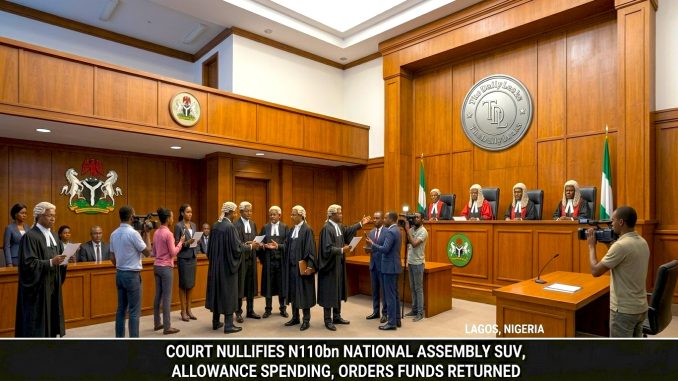
The Federal High Court in Lagos has declared the National Assembly’s controversial N110 billion expenditure on sport utility vehicles, vehicle refurbishment and lawmakers’ allowances unlawful, ruling that the spending violated constitutional provisions governing the use of public funds.
In a landmark judgment delivered on Sunday, the court held that the allocation and disbursement of the funds failed to comply with the principles of transparency, accountability and due process required under the Constitution and the nation’s public finance laws.
The suit, instituted by public interest advocates, challenged the legality of the massive expenditure, arguing that the allocation prioritised the comfort and welfare of legislators at a time of widespread economic hardship and failed to satisfy constitutional requirements for prudent management of public resources.
Agreeing with the applicants, the court ruled that public institutions are trustees of national resources and cannot deploy taxpayers’ money in a manner that is inconsistent with constitutional safeguards.
ALSO READ: Police rescue ex-power minister Adelabu’s sister, her two children after gun battle
The judge declared the N110 billion outlay on the purchase of SUVs, vehicle refurbishment and associated allowance schemes unlawful and of no legal effect, stressing that every public expenditure must be backed by the law and must serve the broader public interest.
The court further directed that appropriate steps be taken to recover or regularise the funds in accordance with the law, reinforcing the principle that no arm of government is exempt from constitutional accountability.
Legal analysts say the judgment could have significant implications for future budgetary allocations to the legislature and other public institutions, potentially strengthening judicial oversight of government spending and promoting greater fiscal discipline.
The decision is expected to reignite debate over the cost of governance in Nigeria, with many civil society organisations and transparency advocates long calling for reductions in lawmakers’ allowances and official vehicle budgets in favour of increased investment in critical sectors such as education, healthcare and infrastructure.
The ruling adds to growing demands for stricter scrutiny of public expenditure and reinforces the judiciary’s role in ensuring that government spending complies with constitutional and statutory provisions.