
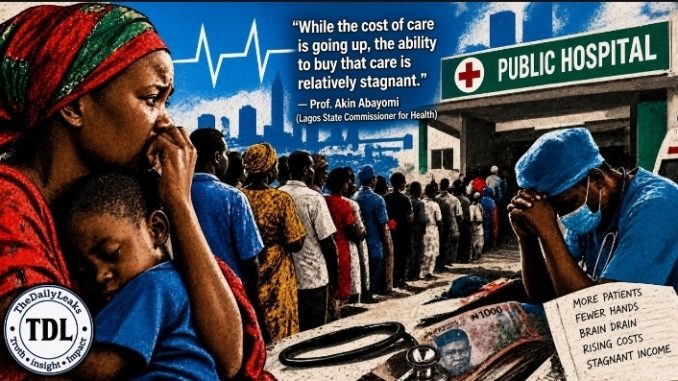
• Lagos Health Commissioner Dr Abayomi sounds alarm over overcrowded hospitals nearing breaking point

• Says outpatient attendance has doubled, with thousands visiting daily
By Seyi Gesinde
September 30, 2026
There are some statistics that should not merely be reported.
They should disturb a society.
When the Lagos State Commissioner for Health, Prof. Akin Abayomi, speaks about the state’s public hospitals, his words carry unusual weight. He is not an opposition voice searching for evidence of governmental failure, but the senior official responsible for the state’s health system. His own account of the extraordinary pressure inside public hospitals therefore makes the situation impossible to dismiss.
This time, the man responsible for the health system appears to be describing a system under extraordinary pressure.
“In the last six months, our outpatient patronage has doubled in our public health facilities.”
Doubled.
Not increased slightly.
Doubled.
And then comes another sentence that should make every Lagosian pause:
“I’ve seen thousands of patients a day.”
Thousands.
But the critical question is not simply why so many people are now turning up at public hospitals.
It is what has happened to the economy and the cost of survival that has pushed so many people towards the point where illness becomes both a health crisis and a financial crisis.
The Commissioner explains part of it:
“While the cost of care is going up, the ability to buy that care is relatively stagnant.”
ALSO READ: A new Nigeria
That may be the most devastating sentence in the entire story.
Because behind it is the Nigerian who cannot afford to fall sick.
The worker whose income has not risen with the cost of living.
The parent struggling to put food on the table as electricity, petrol, rent, school fees, transport fares, healthcare, cooking gas, children’s books, learning materials and virtually every basic necessity consume an ever larger share of the household income.
Internet data, television subscriptions, clothing, soap, detergents, toiletries, sanitary products, cooking utensils, light bulbs, batteries, recreation and even occasional social obligations are now simply out of the budgets of some families.
Countless families can no longer eat properly, rest adequately or live without the constant anxiety of wondering what they can still afford tomorrow.
The person living under relentless economic stress, knowing that even a minor illness could become a major financial burden, with the cost of consultation, medication, tests and transport potentially disrupting an already fragile household budget.
This is the economic environment in which the number of people seeking medical attention can multiply.
Economic hardship is not merely making healthcare expensive.
It is making life itself harder to sustain.
And when people can no longer comfortably afford private healthcare, they move to public hospitals.
And the public hospital, already carrying its own burdens, receives them.
Then the Commissioner says something even more frightening:
“The public are shifting from the private sector to the public sector and from the public sector to the informal sector.”
The informal sector.
The pharmacist.
The roadside drug seller.
The hawker.
Anybody who can offer something cheaper.
ALSO READ: The courage to become
The Commissioner says people can simply stop a hawker and say, “I have a headache” or “I have a fever” and obtain medication without orthodox medical care.
Think about that.
A society does not reach that point merely because its citizens suddenly become careless about their health.
It reaches that point when proper treatment becomes financially frightening.
And then there is another crisis, separate but connected to the pressure on the system, the doctors.
“Our doctors and our healthcare professionals are under a lot of stress.”
Brain drain matters.
But brain drain does not make people sick or explain the multiplication of patients.
Economic hardship does.
Brain drain becomes a second problem because fewer healthcare professionals are left to attend to the growing number of people seeking care.
More patients.
Fewer hands.
Greater pressure on those who remain.
Then Abayomi offers an image that perhaps explains the pressure better than any policy document:
“Can you imagine if they asked you to work from 6 in the morning to tomorrow 6 in the morning?”
His answer is simple.
“It would be crazy.”
Exactly.
Except that what sounds crazy in an ordinary profession can become somebody’s reality in a hospital.
But beneath the irony is a human tragedy unfolding in plain sight.
The patient cannot afford private care.
The public hospital is overwhelmed.
The doctor is exhausted.
ALSO READ: About to give birth
The specialist may have left the country.
The remaining medical worker is carrying more patients.
And somewhere between the patient’s empty pocket and the doctor’s exhausted body is a health system being asked to carry the burden of a much wider economic crisis.
It was not supposed to be this way.
A public hospital should be a place of healing, not the final refuge of citizens who have been priced out of other options.
Healthcare should never become a luxury in which the seriousness of your illness is measured against the thickness of your wallet.
The Commissioner says government is heavily subsidising public healthcare and that the state has invested substantially in facilities, personnel, equipment, training and power.
He also says public hospital charges are generally below half of comparable private sector charges.
Those investments matter.
But the deeper question remains.
What happens to the citizen when even subsidised healthcare becomes difficult to afford?
What happens when the public hospital becomes overcrowded because economic hardship has pushed too many people through its doors?
What happens when the people providing care are themselves exhausted?
And what happens when desperation pushes citizens beyond the public hospital into informal treatment?
That is no longer merely a health sector problem. It is a crisis of living.
Government can build hospitals.
But people must be able to reach them before their illnesses become emergencies.
Government can employ doctors.
But doctors must have reasons to stay.
Government can subsidise care.
But citizens must have enough purchasing power to survive the cost of being alive.
Insurance may help.
Financing may help.
Reforms may help.
But beneath all the policy language is a frightened human being asking a very basic question:
If I fall sick tomorrow, can I afford to be treated?
That should trouble every government.
It should trouble every politician.
ALSO READ: Are you that father?
It should trouble every citizen.
Because there is something profoundly unjust about a society in which people can be hardworking, responsible and law abiding and still be unable to afford the medical care required to remain alive.
The Commissioner has told us the hospitals are under pressure.
He has told us the patients have doubled.
He has told us thousands are arriving daily.
He has told us doctors are under severe stress.
He has told us people are moving into informal healthcare.
If a government health commissioner can speak this plainly about the pressure inside the system, Nigerians should listen carefully.
Not with panic.
With urgency.
Because helpless citizens should not have to become statistics before somebody notices their suffering.
May GOD help the helpless Nigerian.
May GOD give wisdom to those who govern.
May GOD strengthen the doctors who remain.
May GOD provide for the families choosing between food and treatment.
And may our leaders understand that people must not be condemned to suffer avoidable situations created or worsened by unyielding leadership.
A nation cannot call itself healthy when economic hardship makes people afraid of the price of falling sick.