
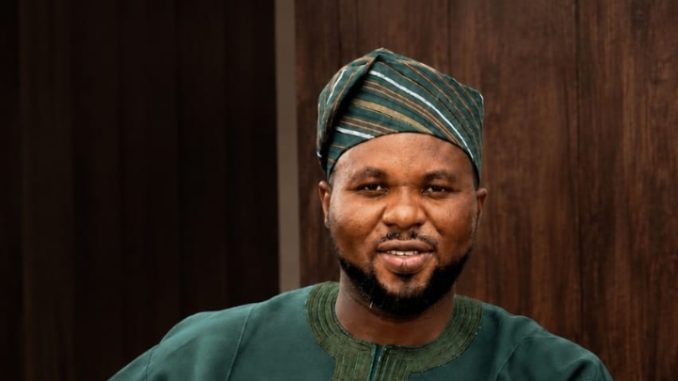
By Oluwafemi Popoola

October 18, 2026
One of the greatest luxuries in politics is having a dead man as your witness. Speaking for the dead has its advantages. They cannot interrupt your story. They can’t also challenge your evidence, or ask you to explain where you got your information. You can even read meanings into their silence, interpret body language from years ago and package your personal assumptions as historical facts. It is an enviable arrangement, especially when the person whose thoughts you claim to understand is no longer around to tell you whether you got the story right.
Babachir Lawal’s latest interview deserves more than the attention generated by its sensational claims. The former Secretary to the Government of the Federation has returned with a story about the late President Muhammadu Buhari and his supposed reservations about Professor Yemi Osinbajo’s decision to contest the APC presidential ticket in 2022. According to Lawal, Buhari considered the ambition “highly immoral and distasteful” because of his relationship with Bola Tinubu.
There is, however, a small problem with this revelation. By Lawal’s own admission, Buhari never actually told him so. What we have, therefore, is not a quotation from the late president but Lawal’s interpretation of his body language.
I must confess that this is an interesting way to conduct presidential history. We have moved from official records, documented conversations and eyewitness testimony to the sophisticated science of interpreting facial expressions. Perhaps the next generation of historians can save themselves the trouble of visiting archives. A sufficiently observant former government official may be able to reconstruct an entire administration from a raised eyebrow and an unusually long silence.
ALSO READ: Atiku’s subsidy strategy narrows 2027 race as Obi falls behind — Analyst
But jokes aside, the distinction matters. There is a world of difference between saying, “Buhari told me he disapproved of Osinbajo’s ambition,” and saying, “I suspected Buhari disapproved because of his body language.” The former is a claim about what someone said. The latter is an interpretation. Neither should be confused with independently established historical fact.
And why are we hearing this now, when Buhari is no longer alive to respond? Lawal had opportunities to discuss the alleged disagreement while the former president was alive. If Buhari genuinely held such a strong opinion, one would reasonably ask why this interpretation is only being presented now as a significant revelation. The timing does not automatically make Lawal wrong, but it certainly makes verification more important.
Fortunately, Laolu Akande, who served as Osinbajo’s spokesperson throughout the Buhari administration, has offered a different account. Unlike someone reconstructing the president’s thoughts from body language, Akande says he was present in the corridors of power and directly involved in the affairs being discussed.
In his rebuttal, Akande insists that Buhari personally offered to support Osinbajo’s presidential ambition on at least four occasions, asking him, “If I don’t support you, who will I support?” He also recalls Buhari publicly commending Osinbajo’s dignified, issues-based campaign at a Federal Executive Council meeting during the 2022 primaries.
If Akande’s account is accurate, it presents a rather different picture from the one Lawal has painted. At the very least, we now have competing accounts that should be examined against available records and the testimony of others who witnessed those events.
Then there is Lawal’s other allegation: that Osinbajo favoured members of his church in appointments to the Office of the Vice-President. Akande has rejected this claim, describing the office as an inclusive team comprising Nigerians from different regions and religious backgrounds. He also disputes the story of a memo containing more than 20 names allegedly delayed because of Buhari’s concerns about their ethnicity and religious affiliations.
Akande goes further, providing examples of Muslim officials, Northerners and other Nigerians who served in senior positions within Osinbajo’s office. He also challenges Lawal’s account of Dr Okey Enelamah’s ministerial appointment, saying the decision originated with Buhari and that the late Chief of Staff, Abba Kyari, informed Osinbajo of the president’s intention.
These are specific claims, and they deserve to be tested against appointment records, official correspondence and the accounts of people involved. But one thing is clear: a list of names, dates and procedures is considerably easier to investigate than an interpretation of somebody’s body language.
But, for this writer, the most revealing part of this controversy lies in the history between Lawal and Osinbajo.
In 2017, while Lawal was serving as SGF, allegations surrounding contracts under the Presidential Initiative for the North East, including the controversial grass-cutting contract, led to his suspension and investigation. Buhari subsequently appointed Osinbajo to head the presidential panel examining the allegations.
The panel submitted its report, and Buhari accepted its recommendation. On October 30, 2017, the president terminated Lawal’s appointment.
Let us be precise: Osinbajo did not sack Babachir Lawal. Muhammadu Buhari did.
That distinction is important because the temptation to personalise an official investigation can be powerful, particularly when its consequences are career-ending. But a panel chairman does not become the ultimate decision-maker simply because he leads an inquiry. Osinbajo was performing an assignment entrusted to him by the president. Buhari received the report and made the decision.
Akande has also recalled that the Senate and the Attorney-General’s report had raised concerns about Lawal before Osinbajo chaired the investigation. He further alleges that Lawal inadvertently provided evidence that implicated him. Those claims, too, belong to the public record for scrutiny rather than unquestioning acceptance.
Still, I find it difficult to ignore the obvious question: when a man has a history with the person he is criticising, should we not examine his account with particular care?
I am not suggesting that Lawal must forever remain silent about Osinbajo because of what happened in 2017. That would be unreasonable. Former officials have every right to tell their stories, criticise their colleagues and offer their recollections of government. But that right comes with an obligation to distinguish what they witnessed from what they inferred, and what they know from what they merely suspect.
Osinbajo’s decision to contest against Tinubu was not, in itself, an act of misconduct. He participated in the APC presidential primary under the party’s rules. Political loyalty is a legitimate subject of debate, but it does not automatically confer ownership of another person’s political future.
Besides, if contesting a presidential primary against a political ally was inherently immoral, Nigerian politics would be a very quiet profession. Ambition and friendship have collided in our political history for decades. The real question is whether the contestants obeyed the rules, not whether everyone who preferred another candidate approved of their decision.
Ultimately, I am less interested in deciding who was Buhari’s favourite political son than in establishing what Buhari actually said and did.
Lawal should be allowed to tell his story, but he must also allow Nigerians to interrogate it. If he has documentary evidence or credible witnesses to support his claims, he should present them. If what he has is an interpretation of Buhari’s body language, then that is precisely how it should be described.
After all, body language may communicate displeasure, approval or impatience. It cannot, on its own, serve as a signed presidential statement.
And perhaps that is the most amusing part of this entire affair. Years after Buhari made his decision about Lawal’s tenure, we are being invited to treat the former SGF’s interpretation of the late president’s unspoken thoughts as a definitive account of Osinbajo’s relationship with him.
I would rather see the evidence before accepting the verdict.
History is already complicated enough without turning every political grievance into a revelation from beyond the grave. And if we must reconstruct the past, we should at least insist on something more substantial than a former official telling us what a dead president supposedly felt.
Otherwise, tomorrow, somebody may tell us Buhari opposed an entire cabinet because he blinked twice during a meeting. At this rate, the presidential archives may soon need a department dedicated to interpreting eyebrows.
Oluwafemi Popoola is a Nigerian journalist, media strategist, and columnist. He can be reached via bromeo2013@gmail.com