
By Gideon Maxwell

November 12, 2026
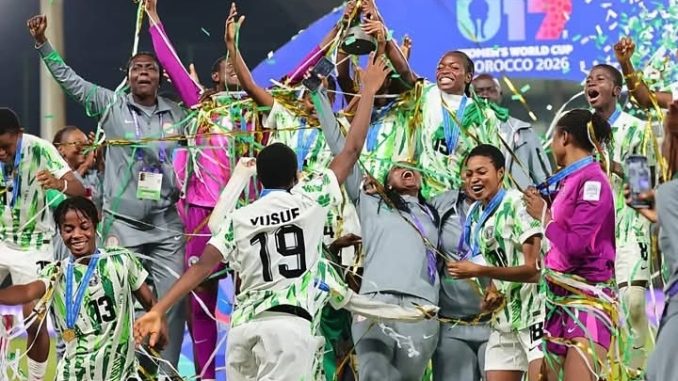
On the evening of Saturday, November 7, 2026, under the floodlights of the Mohammed VI Football Complex in Rabat, Morocco, a group of Nigerian teenagers stood in a circle on the pitch, arms linked, voices lifted in worship and gratitude. Moments earlier, the final whistle had blown on a breathless 2–1 victory over Japan. With that triumph, Nigeria’s Under-17 women’s national team, affectionately known as the Flamingos, achieved what no African women’s side at any age level had ever accomplished: they lifted a FIFA World Cup trophy.
Four days later, inside the Banquet Hall of the State House in Abuja, that sporting immortality was met with unprecedented national reward. Representing President Bola Ahmed Tinubu, First Lady Senator Oluremi Tinubu announced that every single player in the 21-woman squad would receive N100 million in Federal Government Savings Bonds, earning them a permanent moniker in Nigerian sporting folklore: The 100 million naira girls.
Yet, behind the confetti in Rabat and the ceremonial celebration in Abuja lies a deeper story of tactical reinvention, personal hardship, and an improbable recovery from the brink of early elimination.
Forged in transition: The road to Morocco
Long before they conquered the world, the 2026 Flamingos were a team built in the crucible of rapid transition. In April 2026, just seven months before the tournament kicked off, the Nigeria Football Federation (NFF) appointed Akeem Ishola Busari as head coach. Tasked with taking a programme that had previously peaked with a historic bronze medal at the 2022 edition in India and pushing them to the summit, Busari immediately instilled an identity rooted in high pressing, physical intensity, and fearless counter-attacking.
The early returns were ominous for the rest of the continent. During the African qualifying series, captain Harmony Chidi terrorised defences, finishing the qualifiers with an astonishing 12 goals to seal Nigeria’s ticket to North Africa. Shortly before departing for Morocco, the Flamingos served further notice of their readiness at the 2026 WAFU-B U-17 Girls Cup in Côte d’Ivoire, sweeping the regional tournament with five wins from five matches, scoring 17 goals and conceding just once.
Still, regional dominance rarely guarantees global survival. Drawn into Group B alongside European debutants Poland, CONCACAF newcomers Puerto Rico, and two-time defending champions North Korea (DPR Korea), Nigeria entered Morocco 2026 facing an immediate test of nerve.
Stumble in the opener, surge to the summit
If ever a championship run looked doomed at birth, it was Nigeria’s on October 17, 2026. In their opening Group B fixture, the Flamingos suffered a jarring 2–1 defeat to Poland. Set back by a first-half penalty from Poland’s Wiktoria Skrzypczak, Nigeria struggled to find rhythm. The lone bright spot came from the bench: Oluebube Umejiaku, an industrious midfielder from Aguata, Anambra State, who came on as a substitute to score Nigeria’s opening goal of the tournament.
In a 24-team tournament where margin for error is razor-thin, losing the opener meant Nigeria effectively entered knockout mode in Matchday 2. Inside the camp, players held candid, player-led meetings to steady nerves. As captain Harmony Chidi later revealed, “We talked to each other to make sure everyone was at peace and that we worked together.”
What followed was one of the greatest turnarounds in youth World Cup history, comprising six consecutive victories against elite opposition from four confederations:
The turning point of the tournament arrived on October 23 against North Korea. The Asian powerhouse entered the fixture riding an extraordinary 18-match unbeaten run in regulation time at the U-17 Women’s World Cup, a streak stretching back 2,900 days to 2018. Nigeria dismantled them. First-half strikes from Oluwakemi Adegbuyi and Oluebube Umejiaku, followed by a blistering 56th-minute free kick from Kanyinsola Yusuf, gave the Flamingos a commanding 3–0 cushion before a late consolation goal. Nigeria had not merely survived Group B; they had defeated the tournament’s reigning titan.
Depth over superstars: The tactical masterclass
Unlike youth sides reliant on a single prodigy, Busari’s Flamingos conquered Morocco through collective depth. Across their tournament run, eight different players found the back of the net, and five different Nigerians earned FIFA’s Player of the Match honours across the first six fixtures (Oluwakemi Adegbuyi, Kanyinsola Yusuf, Oluebube Umejiaku, Favour Nkwocha, and Awawu Bashiru).
In the knockout rounds, that depth proved decisive:
Against Mexico (Round of 16): Umejiaku opened the scoring in the 40th minute before midfielder Mary Dunstan doubled the lead in the 71st, allowing Nigeria to weather a frantic 100th-minute Mexican consolation goal.
Against Venezuela (Quarter-final): Locked in a gruelling tactical stalemate that looked destined for penalties, defender Azeezat Oduntan stepped up in the 89th minute to bury a high-pressure penalty.
Against Brazil (Semi-final): After a goalless first hour against the South American champions, Nigeria unleashed an offensive storm, firing 30 shots on goal. Queen Joseph broke the deadlock in the 56th minute before Awawu Bashiru, making her very first start of the tournament after logging just 73 minutes in prior games, scored a sensational brace in the 71st and 80th minutes.
The night in Rabat and the golden ball
Standing between Nigeria and immortality in the 7 November final was Japan, three-time finalists, 2014 champions, and the gold standard of technical possession and geometric passing in youth women’s football.
Coach Busari refused to let Japan dictate the rhythm. Deploying a disciplined hybrid of a mid-block and sudden high-pressing triggers, Nigeria suffocated Japan’s build-up play and attacked space in transition. In the 39th minute, Awawu Bashiru struck first to give the Flamingos a deserved half-time lead. Two minutes after the restart, Oluebube Umejiaku capped a tournament-defining performance with a delicate lob over Japanese goalkeeper Kadowaki to make it 2–0.
Japan pulled one back in the 80th minute when substitute Anri Ito nodded a corner across goal for Fuki Ito to volley home, sparking a nerve-shredding final ten minutes plus stoppage time. Nigeria held firm. Under the gaze of FIFA President Gianni Infantino and CAF President Patrice Motsepe, the Flamingos completed the unthinkable.
When the individual awards were announced, Oluebube Umejiaku, who registered a goal or an assist in every single match she played, was crowned the adidas Golden Ball winner as the tournament’s Most Valuable Player. Behind her trophy lay a deeply human story. Speaking after the triumph, the teenage star revealed that her relentless drive on the pitch was fuelled by a desire to rescue her mother from poverty and daily disrespect back home: “I can’t give up because of my mother; she has suffered a lot. I need to take her out of where she is… I always talk to God to make people know my name, so they won’t insult my mother anyhow.”
Why N100 million, and why a trust?
When the Flamingos touched down in Abuja to a hero’s welcome, the scale of their achievement prompted an extraordinary response from the Nigerian state. Following a Tuesday resolution by the Nigerian Senate approving a N100 million reward, the Presidency unveiled a landmark financial package on Wednesday, November 11:
The 21 players: N100 million each, issued as Federal Government of Nigeria (FGN) Savings Certificates and Bonds.
Head Coach Akeem Busari: N100 million in cash.
Technical crew members: N50 million each in cash.
Crucially, the government structured the players’ windfall to protect their futures rather than overwhelm them. National Sports Commission (NSC) Chairman Mallam Shehu Dikko explained that placing each player’s N100 million into a five-year FGN Savings Bond yielding 12% to 14% annual interest will generate roughly N1.1 million per month in passive income for each teenager. That monthly payout is designed to fund their education, nutrition, and athletic training while keeping the N100 million principal intact until they reach adulthood at age 20 or 21.
“I don’t think there is any father that wants to give his 15-year-old or 16-year-old N100 million at this age,” Dikko noted. “But you can invest for your 16-year-old so that at 20 they will have money to set up their life.”
From grassroots pitches across Nigeria, from Robo Queens and Heartland Queens to Bayelsa Queens and Fosla Academy, the 2026 Flamingos rewrote the ceiling for African women’s football. They arrived in Morocco as hopeful contenders, stumbled on day one, and walked away as world champions. Now financially secured for the next chapter of their lives, the 100 Million Naira Girls have ensured that for the next generation of Nigerian girls lacing up their boots, the world title is no longer a distant dream; it is a standard already set.