
By Seyi Gesinde

July 16, 2026
The oldest test of justice is not found in a courtroom.
It is found in the human heart.
Long before constitutions were written and judges wore robes, humanity had already discovered a deeper tribunal.
It was called conscience.
Long before history rendered its judgment, conscience had already begun its own.
Long before judges pronounced verdicts, fathers were already searching for truth where their children were concerned.
Long before governments defended themselves, mothers were already asking the questions every child’s life demands.
For as long as civilisation has existed, one moral temptation has persisted, for some to measure another family’s grief by a standard they would never accept for their own.
The Yoruba captured the same moral failure in a timeless proverb:
“Ọmọ ọlọ́mọ la ń rán níṣẹ́ dé t’òrù tóru.”
It means: It is another person’s child who is sent on an errand with the instruction to return, even if it is late into the night.
Yet, when it is their own child, the instruction changes.
Do not travel into the night.
If darkness falls, sleep over and return tomorrow.
Such is the enduring temptation of the human condition, to demand of another person’s child what they would never demand of their own.
That is why every civilisation has, in one form or another, been confronted by the same moral challenge.
What if it were your child?
Confucius expressed it with remarkable simplicity.
“Do not impose on others what you do not wish for yourself.”
Centuries later, Immanuel Kant transformed the same truth into moral philosophy.
“Treat humanity, whether in yourself or another, always as an end and never merely as a means.”
John Rawls invited us behind what he called the veil of ignorance, asking us to design justice without knowing whether we would emerge rich or poor, ruler or ruled, powerful or powerless.
Perhaps there is an even harder exercise.
Imagine the telephone rings.
Not in a ministry.
Not in a government residence.
Not in the office of a powerful public official.
But in your home.
A father answers.
The voice on the other end hesitates.
No one ever rushes bad news.
He is told his daughter has died.
The circumstances remain unclear.
Questions linger.
Investigations have begun.
Now remove every title.
Strip away the official convoy.
Silence the sirens.
Take away the cameras.
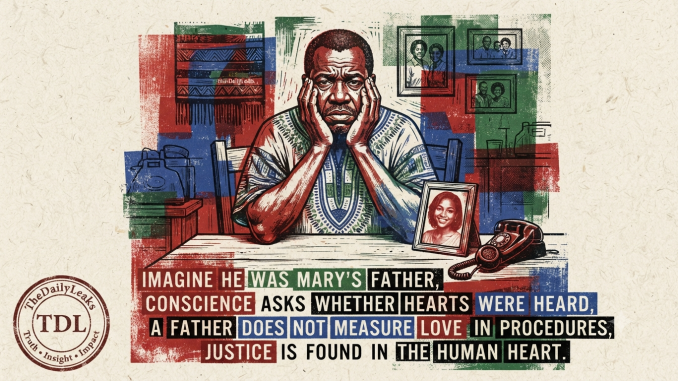
Imagine he is not a minister.
Not a governor.
Not a president.
Simply…
A father.
Would his first instinct be law?
Or love?
Would protocol comfort him?
Would procedure calm him?
Would carefully crafted statements quiet the storm within his soul?
Or would he ask the questions every grieving parent has asked since the dawn of civilisation?
What happened?
Who was with her?
Did she suffer?
Was she afraid?
Could anything have been done differently?
What has not yet been explained?
Leo Tolstoy observed that everyone thinks of changing the world, but few think of changing themselves.
ALSO READ: Seyi was a friend
Perhaps democracy demands something even harder.
Not merely to change ourselves.
But to imagine ourselves in another person’s place.
Because empathy is justice before it becomes law.
The philosopher Emmanuel Levinas argued that ethics begins the moment we encounter the face of another human being.
Not their politics.
Not their wealth.
Not their influence.
Not their usefulness.
Their humanity.
Every public controversy eventually becomes a legal matter.
Before that, it is always a human one.
The law asks whether rules were broken.
Conscience asks whether hearts were heard.
There is a reason Justice has been portrayed for centuries wearing a blindfold.
Not because she cannot see.
But because she refuses to recognise status.
The blindfold is civilisation’s declaration that titles must never outweigh tears.
Aristotle distinguished between justice and equity.
Justice applies the rule.
Equity asks whether the rule still serves humanity.
For laws are written in books.
Compassion is written in conscience.
History offers remarkable warnings.
Sophocles watched kings destroyed not because they lacked power, but because power clouded their judgment.
The Greeks gave that blindness a name.
Hubris.
The belief that authority changes moral obligation.
It never does.
Marcus Aurelius governed an empire stretching across continents.
Yet every evening he reminded himself that beneath the imperial robe he remained only a mortal man.
Power, he understood, was temporary.
Character was permanent.
The Book of Job remains one of humanity’s oldest reflections on suffering.
Curiously, Job was never condemned for asking questions.
Grief has always searched for understanding before acceptance.
A father does not measure his love in legal procedures.
He measures it in sleepless nights.
In unanswered questions.
In memories that refuse to rest.
C. S. Lewis, writing after the death of his wife, described grief as a kind of fear.
Every parent understands why.
Loss rearranges time.
Minutes become years.
Silence becomes unbearable.
Every unanswered question echoes louder than the last.
Fyodor Dostoevsky believed that the suffering of even one innocent child raises questions no philosophy can comfortably dismiss.
Perhaps that is why every civilisation eventually discovers the same truth.
Statistics never grieve.
Families do.
Albert Camus warned against the danger of becoming accustomed to human suffering.
Indifference, he believed, is the beginning of moral failure.
Perhaps that is the greatest temptation of power.
Not cruelty.
Distance.
Distance from ordinary pain.
Distance from ordinary fear.
Distance from imagining that another family’s tragedy could one day become our own.
Rabbi Jonathan Sacks once wrote that the supreme challenge of morality is to see the world through someone else’s eyes.
Democracy asks exactly the same thing.
Not merely to defend institutions.
But to preserve humanity within them.
Martin Luther King Jr. reminded the world that the arc of the moral universe bends towards justice.
History suggests something equally important.
It bends only because people continue asking difficult questions.
Questions have rarely been civilisation’s enemy.
They have often been its salvation.
Perhaps that is the deeper reflection.
Not how quickly we defend ourselves.
Not how effectively institutions respond.
Not even how history records events.
But whether people instinctively measure another family’s grief by exactly the same standard they would demand for their own.
History remembers verdicts.
Humanity remembers compassion.
And perhaps the greatest test of power has never been whether it could command obedience.
It has always been whether it could imagine life without power.
Whether it could see another person’s child…
…as though she were its own.