By Gideon Maxwell

May 30, 2026
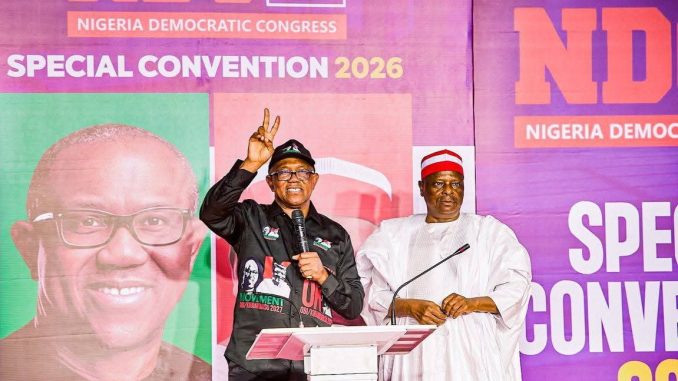
The Nigeria Democratic Congress (NDC) has formally unveiled a presidential ticket featuring Peter Obi as its flag bearer and Rabiu Musa Kwankwaso as his running mate at a highly attended national convention in Abuja.
The announcement came at the climax of the party’s special convention, where delegates gathered in large numbers from across the country to witness what organisers described as a defining moment in the party’s formation history.
The hall was filled to capacity with supporters, political stakeholders, youth groups, and representatives of emerging regional blocs aligned with the party’s growing structure.
The convention atmosphere was marked by sustained chants of unity and reform as supporters celebrated the consolidation of the two prominent political figures under a single platform.
Party leaders repeatedly framed the moment as a national reset, emphasising inclusion, institutional rebuilding, and economic restructuring as core priorities.
Peter Obi was formally confirmed as the presidential candidate through a consensus adoption process after emerging as the sole aspirant at the party’s primary stage.
Rabiu Kwankwaso was subsequently announced as the vice presidential candidate during Obi’s acceptance remarks, completing the ticket formation in a swift political sequence.
ALSO READ: Makinde clinches APM presidential ticket in Ibadan consensus vote
Observers described the development as a calculated fusion of two influential regional political networks into a single national electoral platform.
Speeches and policy direction
In his acceptance speech, Peter Obi reaffirmed his focus on governance reform, productivity driven growth, and social investment strategies.
He stated that the party would prioritise electricity expansion, job creation, and strengthened security architecture across the country.
He further positioned the NDC as a reform driven platform focused on measurable outcomes rather than political rhetoric.
Kwankwaso, in his remarks, stressed the importance of political inclusion, equity, and national stability.
He expressed support for the party’s zoning arrangement and described it as essential for balancing political interests across regions.
The convention adopted a zoning arrangement that allocates the presidential ticket to Southern Nigeria for the current electoral cycle.
Party leadership explained that the arrangement was designed to promote internal stability and reduce long standing political tensions within the organisation.
A rotational framework was also approved to ensure that the presidency alternates between regions in future electoral cycles.
The convention further confirmed the party’s interim leadership structure as a substantive governing body responsible for national coordination and mobilisation.
The emergence of the Obi Kwankwaso ticket represents a major shift in Nigeria’s opposition landscape ahead of the 2027 elections.
Both politicians previously participated in separate coalition efforts before repositioning under the NDC platform following internal disagreements within earlier alliances.
The pairing is widely seen as an attempt to consolidate fragmented voter bases across regional strongholds.
Obi maintains significant influence among urban voters and southern constituencies.
Kwankwaso commands strong political structures in Kano and parts of the broader northern region.
Strategic implications ahead of 2027
Analysts suggest that the combined ticket could significantly alter opposition calculations going into the next election cycle.
They argue that the pairing brings together complementary political strengths that could challenge dominant national party structures.
However, concerns remain about organisational depth and long term cohesion within the emerging party framework.
Questions also persist regarding the ability of the NDC to sustain momentum beyond the convention stage into a full scale national campaign.
The convention concluded with the formal presentation of the party flag to Peter Obi by senior party officials.
The symbolic gesture marked the official commencement of the NDC’s electoral campaign journey.
Delegates exited the venue in an atmosphere of celebration and renewed political enthusiasm.
Party leaders expressed confidence that the newly formed ticket represents a turning point in the country’s evolving political direction.