
By Seyi Gesinde

August 20, 2026
There are moments in Nigerian politics when a politician does not need to announce that he has become powerful. The politicians around him do the announcing.
Sometimes, it is by visiting him.
Sometimes, it is by endorsing him.
Sometimes, it is by quietly calculating what his next move could mean for their own political future.
And sometimes, it is by inviting him to Aso Rock just five days after he has won an election that was supposed to be merely about Osun State.
That is where Ademola Adeleke now finds himself.
The dancing governor has somehow entered that strange Nigerian political territory where everybody suddenly wants to know what he is thinking.
On August 15, Adeleke, now flying the flag of the Accord Party, defeated the APC candidate, Bola Oyebamiji, to secure another term as governor of Osun State. He won 19 of the state’s 30 local government areas and polled 511,067 votes against Oyebamiji’s 444,815.
The election was Osun’s election.
The consequences, however, may be considerably bigger than Osun.
And then came Thursday.
Five days after the election, President Bola Tinubu received Adeleke at the Presidential Villa for a closed door meeting. The governor arrived at about 5.20 pm and proceeded to the President’s office. The details of the discussion were not immediately made public.
ALSO READ: Until you win
Now, in Nigeria, a closed door meeting is rarely just a meeting.
It is a meeting.
It is also a rumour.
It is a political theory.
It is a WhatsApp voice note waiting to happen.
It is three political consultants suddenly becoming experts in body language.
It is one journalist asking, “What do you think they discussed?”, and another answering confidently, despite having been nowhere near the room.
Welcome to Nigerian politics.
𝗙𝗿𝗼𝗺 𝗼𝗽𝗽𝗼𝘀𝗶𝘁𝗶𝗼𝗻 𝗴𝗼𝘃𝗲𝗿𝗻𝗼𝗿 𝘁𝗼 𝗽𝗼𝗹𝗶𝘁𝗶𝗰𝗮𝗹 𝗰𝘂𝗿𝗶𝗼𝘀𝗶𝘁𝘆
Adeleke’s political journey is becoming increasingly curious because the conventional language of opposition politics does not quite explain him.
He has been described as an opposition governor because he has operated through parties outside the APC.
Yet his political posture towards Tinubu has repeatedly complicated that description.
In March, Adeleke publicly reaffirmed his endorsement of Tinubu for the 2027 presidential election, describing Tinubu as a leader who represents the South West.
The irony is delicious.
Here is a governor who belongs to an opposition political tradition, yet whose state political structure has endorsed the incumbent President for another term.
In ordinary democracies, political scientists might need a whiteboard.
In Nigeria, somebody simply says, “Politics is local.”
And everybody nods.
That famous Nigerian sentence has rescued more political contradictions than perhaps any constitutional provision.
Politics is local.
Party is negotiable.
Principle is contextual.
Friendship is strategic.
And tomorrow is always available for another explanation.
Adeleke’s own political camp has made the position clear on several occasions.
When rumours circulated that he might join the African Democratic Congress, his spokesperson rejected the speculation and said Adeleke remained in the PDP. The same statement pointed out that the Osun PDP had already endorsed Tinubu for 2027.
Then politics did what politics does.
Adeleke contested the 2026 election on the platform of Accord.
He won.
And suddenly the man who had spent months defending his political position became even more interesting to everybody else.
This is the curious part.
Adeleke did not need to win Nigeria to become relevant to Nigeria’s 2027 calculations.
He only needed to win Osun convincingly.
𝗧𝗵𝗲 𝗺𝗮𝘁𝗵𝗲𝗺𝗮𝘁𝗶𝗰𝘀 𝗼𝗳 𝗮 𝗸𝗶𝗻𝗴𝗺𝗮𝗸𝗲𝗿
Kingmakers are often misunderstood.
They do not necessarily become kings.
They decide, influence or complicate who gets close enough to wear the crown.
Adeleke’s value is therefore not simply the number of votes he controls.
It is the combination of geography, family name, political structure, electoral popularity, Yoruba politics and his relationship with a President whose political future will be decided in 2027.
Osun is not just another state.
It sits inside the South West political equation.
Tinubu is from the South West.
Osun PDP leaders have already endorsed Tinubu.
ALSO READ:
Adeleke has personally reaffirmed that endorsement.
And now Adeleke has secured another four years in office after defeating the APC in a competitive election.
That creates an unusual political asset.
He can be an opposition governor without necessarily behaving like the opposition governor that some opposition strategists want him to be.
He can sit outside the governing party while maintaining a relationship with the man who leads it.
He can fight APC politicians in Osun while supporting the APC presidential candidate nationally.
ALSO READ: When Awo was the opposition…
And he can do all this without necessarily having to explain the contradiction beyond the magic phrase, “politics is local.”
This is not necessarily hypocrisy.
It may simply be Nigerian political pragmatism.
The problem is that pragmatism becomes very difficult to distinguish from opportunism when everybody suddenly discovers that principles have regional accents.
𝗧𝗵𝗲 𝗼𝗽𝗽𝗼𝘀𝗶𝘁𝗶𝗼𝗻 𝗵𝗮𝘀 𝗮 𝘀𝗺𝗮𝗹𝗹 𝗽𝗿𝗼𝗯𝗹𝗲𝗺
The larger story is not Adeleke alone.
It is the condition of Nigeria’s opposition.
At the beginning of 2026, several governors were formally operating outside the APC, including Adeleke, Seyi Makinde, Bala Mohammed, Ahmadu Fintiri, Alex Otti, Abba Yusuf and Chukwuma Soludo.
But political analysts have observed that formal party membership no longer tells the whole story of opposition politics.
That is the real comedy.
Nigeria may have opposition parties.
It may have opposition governors.
It may even have opposition meetings.
But the opposition itself appears to have developed an allergy to the word “opposition”.
One politician is negotiating.
Another is consulting.
Another is endorsing.
Another is defecting.
Another is threatening to defect.
Another says he will never defect.
And another has already defected while explaining that he did not really defect, he merely moved in the national interest.
By the time the explanation is finished, the political party has changed address.
This is why Adeleke’s position matters.
The question is not merely whether he is in Accord, PDP, ADC or some other political arrangement.
The question is, where does Adeleke stand when the real 2027 battle begins?
And perhaps even more importantly, who will Adeleke stand with?
𝗧𝗵𝗲 𝗧𝗶𝗻𝘂𝗯𝘂 𝗺𝗲𝗲𝘁𝗶𝗻𝗴
This is where Thursday’s meeting becomes politically interesting.
There is no evidence in the public reports that the President and Adeleke agreed on a 2027 political arrangement.
There is no responsible basis for inventing what happened behind the closed doors.
But politics does not require evidence before speculation begins.
The meeting itself is enough to generate questions.
Why now?
Why five days after the Osun election?
What does Adeleke’s victory mean for the South West?
Does the President want to consolidate his regional political base?
Does Adeleke want a stronger relationship with Abuja?
ALSO READ: The courage to become
Is there a discussion about governance, federal support, party politics or 2027?
Or was it simply two politicians meeting because politicians sometimes meet?
The last possibility is the least exciting.
Therefore, naturally, it will probably receive the least attention.
The political class prefers a conspiracy to a courtesy call because conspiracy produces strategy meetings, and strategy meetings produce allowances.
𝗔𝗱𝗲𝗹𝗲𝗸𝗲 𝗵𝗮𝘀 𝗮𝗰𝗰𝗶𝗱𝗲𝗻𝘁𝗮𝗹𝗹𝘆 𝗯𝗲𝗰𝗼𝗺𝗲 𝘂𝘀𝗲𝗳𝘂𝗹
Perhaps the most interesting thing about Adeleke is that he may not need to become a national political leader to become nationally consequential.
He has already demonstrated something that political parties desperately need, the ability to win an election.
In Osun, Adeleke did not merely survive.
He defeated the APC candidate by more than 66,000 votes and won 19 of 30 local government areas.
That matters because 2027 will not be fought with speeches alone.
It will be fought with structures.
Governors.
Local government networks.
Traditional relationships.
Regional sentiment.
Party machinery.
Grassroots mobilisation.
And, naturally, an impressive quantity of people who suddenly become “stakeholders” when elections approach.
Adeleke now possesses some of those assets.
His second term gives him something even more valuable, time.
He does not have to worry about another governorship election in 2027.
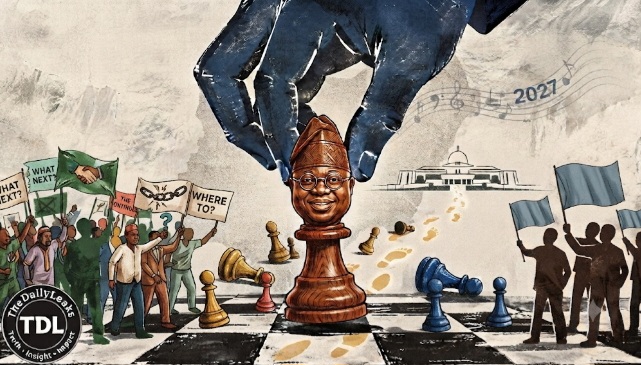
While other governors will be calculating their own succession, Adeleke can concentrate on the national chessboard.
That is the difference between being a player and being available to play kingmaker.
𝗧𝗵𝗲 𝘀𝘁𝗿𝗮𝗻𝗴𝗲 𝗯𝗲𝗮𝘂𝘁𝘆 𝗼𝗳 𝗢𝘀𝘂𝗻 𝗽𝗼𝗹𝗶𝘁𝗶𝗰𝘀
There is another layer to this story.
The Osun electorate has now produced a political outcome that complicates the national picture.
The APC wanted Osun.
The opposition wanted Osun.
Accord wanted Osun.
Adeleke wanted Osun.
The voters gave it to Adeleke.
Yet the same Adeleke has openly backed Tinubu for 2027.
So the man who defeated the APC in Osun may end up contributing to the political strength of the APC presidential candidate nationally.
This is the kind of political mathematics that would make Euclid resign.
Imagine explaining it to a political science student.
“Who did Adeleke defeat?”
“APC.”
“Who does Adeleke support for President?”
“Tinubu.”
“Which party is Tinubu?”
“APC.”
“Which party did Adeleke defeat?”
“APC.”
“Are you sure?”
“Absolutely.”
“Do you understand Nigerian politics?”
“Not anymore.”
Exactly.
𝗔𝗻𝗱 𝘁𝗵𝗲𝗻 𝘁𝗵𝗲𝗿𝗲 𝗶𝘀 𝗠𝗮𝗸𝗶𝗻𝗱𝗲
The South West calculation becomes even more interesting because Adeleke does not operate in isolation.
There is Seyi Makinde in Oyo.
There are other political actors with national ambitions.
There is the emerging opposition coalition around the ADC.
There is the APC’s increasingly formidable political machinery.
There are questions about whether the opposition can unite behind a single presidential candidate.
There is the enduring attraction of regional political calculations.
And there is the simple fact that politicians who appear to be travelling on different roads can suddenly discover that they are all heading towards Abuja.
That is where Adeleke becomes interesting.
He does not necessarily have to lead a coalition.
He may not even want to.
He could simply become the man everybody needs to speak to.
And in Nigerian politics, the man everybody needs to speak to is already halfway to becoming the man everybody calls a leader.
𝗧𝗵𝗲 𝗸𝗶𝗻𝗴𝗺𝗮𝗸𝗲𝗿 𝗱𝗼𝗲𝘀 𝗻𝗼𝘁 𝘄𝗲𝗮𝗿 𝗮 𝗰𝗿𝗼𝘄𝗻
There is a fundamental misunderstanding about political power.
People imagine power as a throne.
It is not always a throne.
Sometimes power is the telephone that everybody wants your number to answer.
Sometimes it is the governor who can speak to one camp without completely alienating another.
Sometimes it is the politician whose public endorsement matters because it carries electoral credibility.
Sometimes it is the man who has nothing personally to lose in a presidential contest because his own governorship has already been secured.
That may be Adeleke’s emerging advantage.
He has just won.
He has another term.
He has political momentum.
He has a regional identity that matters.
He has demonstrated electoral strength.
And he has a relationship with Tinubu that is now impossible for the political class to ignore.
That does not make him kingmaker automatically.
But it makes him a very interesting candidate for the job.
𝗧𝗵𝗲 𝗱𝗮𝗻𝗴𝗲𝗿 𝗼𝗳 𝗯𝗲𝗰𝗼𝗺𝗶𝗻𝗴 𝗲𝘃𝗲𝗿𝘆𝗯𝗼𝗱𝘆’𝘀 𝗳𝗿𝗶𝗲𝗻𝗱
There is, however, a danger.
A politician who becomes acceptable to everybody can eventually become trusted by nobody.
The opposition may ask whether Adeleke is genuinely committed to resisting the APC’s national dominance.
The APC may ask whether his support for Tinubu extends beyond presidential endorsement.
His own supporters may ask what exactly they are getting from all this political flexibility.
And voters, eventually, may ask the oldest question in politics.
“What is in it for us?”
Because political sophistication does not excuse poor governance.
No kingmaker can distribute political influence forever if the people who elected him feel neglected.
Adeleke therefore has another four years in Osun.
That means the 2027 question will not be his only question.
He will still have roads.
Hospitals.
Schools.
Workers.
Security.
Infrastructure.
Budgets.
And the small inconvenience of governing.
Nigeria has a remarkable tendency to make politicians forget that the presidency is not the only office requiring attention.
𝗧𝗵𝗲 𝗱𝗮𝗻𝗰𝗲 𝗯𝗲𝗳𝗼𝗿𝗲 𝘁𝗵𝗲 𝗱𝗮𝗻𝗰𝗲
Perhaps the greatest irony is that Adeleke became nationally interesting without changing his personality.
He remains the dancing governor.
But the political dance around him has changed.
Once, people watched Adeleke dance and laughed.
Now, politicians may be watching his dance steps for political direction.
Where he moves could matter.
Who he visits could matter.
Who visits him could matter.
What he says about Tinubu could matter.
What he says about the opposition could matter.
And, increasingly, what he refuses to say may matter even more.
This is how kingmakers emerge.
Not through coronation.
Through calculation.
Not through a crown.
Through relevance.
Not necessarily by commanding the largest political army.
Sometimes by becoming the person several competing armies believe they need.
𝗦𝗼, 𝗶𝘀 𝗔𝗱𝗲𝗹𝗲𝗸𝗲 𝗿𝗲𝗮𝗹𝗹𝘆 𝗮 𝟮𝟬𝟮𝟳 𝗸𝗶𝗻𝗴𝗺𝗮𝗸𝗲𝗿?
Not yet.
The title is a provocation, not a coronation.
The 2027 presidential contest is still developing, and nobody can responsibly say today that Adeleke will determine its outcome.
But he has acquired the ingredients that make the label plausible.
He has won re election.
He has demonstrated electoral strength.
He sits in the South West.
He has publicly backed Tinubu.
He has maintained political relevance despite the rearrangement of opposition structures around him.
And, five days after his electoral victory, he sat behind closed doors with the President at Aso Rock.
The room may have contained nothing more than two politicians discussing governance.
Or it may have contained the first conversation in a much larger political calculation.
We do not know.
And that is precisely why the story is interesting.
Because in Nigerian politics, sometimes the most powerful sentence is not what a politician says.
It is what everybody else begins to imagine he might say.
Adeleke has now reached that point.
He is no longer merely the governor who wants Osun.
He is the governor whose next political move people across Nigeria will watch.
And that is a curious place to find oneself.
A politician can spend years trying to become powerful.
Adeleke may have discovered the Nigerian shortcut.
Win your election.
Then let everybody else decide what your victory means.
The dancing governor has entered the ballroom.
The music for 2027 has started.
And suddenly, everybody wants to know whether Adeleke is dancing for himself, for Tinubu, for the opposition, for the South West, or simply because Adeleke has always enjoyed dancing.
That, perhaps, is the most Nigerian part of the whole story.
Everybody is searching for the political meaning of the dance.
The dancer may simply be enjoying the music.