
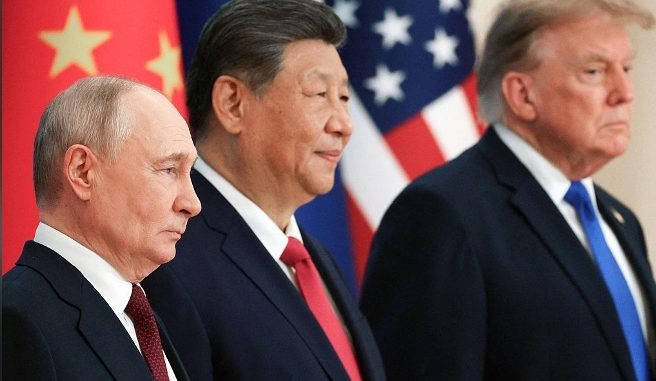
United States President Donald Trump, Russian President Vladimir Putin, and Chinese President Xi Jinping have signed a landmark trilateral peace declaration following their first ever three way summit at Kylin Villa on the sidelines of the Asia Pacific Economic Cooperation gathering in Shenzhen.

The historic meeting marked the first occasion in modern diplomacy that the heads of state of the world’s three foremost nuclear and military powers convened together for formal trilateral negotiations.
Addressing reporters before the doors closed, Trump declared that the three leaders were making history and insisted that no peace was ever forged by declining opportunities for direct engagement.
Xi welcomed the gathering as a positive and constructive milestone, stating that when major powers live in harmony the world enjoys peace, whereas rivalry among them plunges the international order into turmoil.
Putin echoed the historic significance of the talks, noting that the three countries share common ground on safeguarding global stability while praising Shenzhen as a symbol of a changing world order.
ALSO READ: ANC close in on rivals to lock Democratic Alliance out of power in South Africa
In the official four point Heads of State Declaration toward Peace released simultaneously by the White House, Beijing, and Moscow, the three permanent members of the United Nations Security Council pledged to pursue comprehensive United Nations reform so the institution can respond more effectively to global challenges.
The trio also reaffirmed the core nuclear doctrine that a nuclear war cannot be won and must never be fought, committing their governments to structured dialogue aimed at reducing nuclear risks and preventing weapons proliferation.
During the private discussions, Xi proposed rules of coexistence for major powers that include working toward the eventual elimination of all nuclear weapons, though the final communiqué stopped short of announcing a binding new arms control treaty.
On global energy security, the three leaders agreed to increase the production and supply of refined petroleum products for the benefit of all nations, underscoring the necessity of stable energy flows amid international market disruptions.
In a sharp rebuke to international judicial institutions, the declaration asserted that state consent and the diplomatic immunity of state officials are of paramount importance, warning that the International Criminal Court and similar bodies must not abuse their jurisdiction.
That clause carries major geopolitical weight given that the International Criminal Court issued an arrest warrant for Putin over the conflict in Ukraine, while Washington has repeatedly accused the court of jurisdictional overreach.
Despite the sweeping diplomatic language, the joint statement notably omitted any direct mention of the wars in Ukraine and Iran, even though Trump held a separate forty minute bilateral meeting with Putin beforehand to discuss the Ukrainian conflict.
Trump also held bilateral talks with Xi on the margins of the summit, where the two leaders agreed on the need for artificial intelligence guardrails while navigating ongoing friction over trade and technology.
Putin further revealed that he is considering attending next month’s Group of Twenty summit in Miami after discussing the invitation with Trump during their talks in Shenzhen.
Foreign policy analysts and European observers cautioned that while the summit granted Moscow a high profile diplomatic rehabilitation, the omission of concrete peace terms for Ukraine signals that deep strategic divides remain beneath the historic optics.