
By Seyi Gesinde

July 17, 2026
History has often asked the wrong question of people of faith who enter public office.
Not whether they governed justly.
But whether they favoured their own.
The ancient Greek philosopher Aristotle taught that the purpose of politics is the pursuit of the common good.
The Kingdom of GOD begins somewhere else.
It begins with the command to love your neighbour.
Not merely your fellow believer.
When some Christians insist that they benefitted nothing from Yemi Osinbajo’s eight years as Nigeria’s Vice President, perhaps the first question is not what Osinbajo gave Christians.
Perhaps it is what Christians expected him to give.
Privileges?
Appointments?
Preferential treatment?
Political dominance?
St Augustine drew a distinction between the City of GOD and the City of Man.
The City of GOD is never advanced by political patronage.
It is advanced by faithful witness.
More than a thousand years later, John Locke argued that the principal task of civil government is the preservation of civil interests, not the advancement of one religious community above another. Though writing from different traditions, Augustine and Locke converge on a profound truth, political authority has limits, while the Kingdom of GOD does not depend upon the machinery of the state.
Suppose Joseph had become Prime Minister of Egypt only to enrich Hebrews.
Would Pharaoh have trusted him?
Suppose Daniel had governed Babylon only for the Jews.
Would kings have sought his counsel?
Suppose Esther had used the palace merely to secure comfort for her own household.
Would history remember her courage?
The greatest servants of GOD in government never governed only for the people of GOD.
They governed in such a way that even those outside the covenant recognised the wisdom of GOD.
Dietrich Bonhoeffer warned that the Church is only truly the Church when it exists for others.
That principle applies equally to Christians in public office.
A Christian who governs only for Christians has misunderstood both Christianity and government.
That did not mean indifference to Christians.
Just as a good father does not cease caring for his own family because he loves his neighbours, Osinbajo never ceased identifying with the Christian community while faithfully serving a religiously diverse nation.
ALSO READ: Osinbajo the solutionist
Within the constitutional limits of his office as Vice President, not the Commander in Chief, he consistently spoke against attacks on Christian communities, condemned violence against people of other faiths, defended every Nigerian’s right to worship freely, encouraged peaceful coexistence, and stood for the security and dignity of people of every faith.
As there are two sides to every society, moments of joy and moments of grief, Osinbajo identified with the pains and hopes of Nigerians wherever they were found.
That is true leadership.
He did not protect Christians by denying justice to others.
He protected the rights of Christians by defending the rights guaranteed to all.
It is also the pattern Christ left behind.
He loved His followers without limiting His compassion to His own.
He cared for those who loved Him without withholding mercy from those who did not.
He never allowed love for His own to become indifference towards others.
As a pastor, Osinbajo loved his flock.
As Vice President, he served the nation.
He never confused the responsibilities of the pulpit with the obligations of the Constitution.
In doing so, he honoured both.
Abraham Kuyper famously declared:
“There is not a square inch in the whole domain of our human existence over which Christ, who is Sovereign over all, does not cry: ‘Mine!'”
Kuyper did not exempt government.
Or commerce.
Or education.
Or only Christian communities.
He claimed every sphere of human responsibility.
Including government.
If that is true, then a Christian statesman honours CHRIST not by building religious empires.
But by administering justice without partiality.
During Osinbajo’s years in office, millions of Nigerians benefitted from programmes that never asked beneficiaries whether they attended church or mosque.
The Social Investment Programmes, TraderMoni, MarketMoni, FarmerMoni, school feeding initiatives, and conditional cash transfers reached citizens as Nigerians, not as members of one faith.
Some Christians complain that this was not a Christian benefit.
Perhaps they have forgotten the Parable of the Good Samaritan.
JESUS deliberately made the neighbour a man from the wrong religious community.
The lesson was unmistakable.
Compassion loses its soul the moment it begins demanding identity cards.
C. S. Lewis famously wrote, “Aim at Heaven and you will get earth ‘thrown in’: aim at earth and you will get neither.” His point reaches beyond personal devotion. Christians who pursue political influence as an end in itself risk sacrificing the very witness that gives Christianity its moral authority.
ALSO READ: Osinbajo, the newest face of peace icon in Africa
John Stott consistently argued that Christians are called to exercise influence through faithful witness rather than the pursuit of worldly power.
Perhaps that is precisely what Osinbajo offered.
Not a Christian government.
But the public example of a Christian in government.
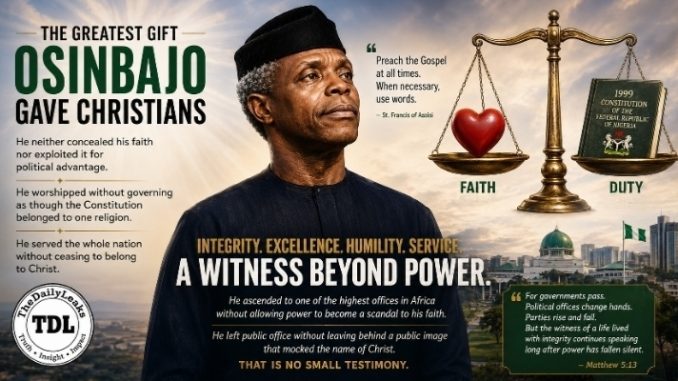
He neither concealed his faith nor exploited it for political advantage.
He quoted Scripture without turning it into political theatre.
He worshipped without governing as though the Constitution belonged to one religion.
That vision leaves no room for a divided life.
A Christian is called to be faithful in the sanctuary.
And faithful in the senate.
In private devotion.
And in public duty.
Osinbajo’s public life reflected that conviction.
He demonstrated that deep conviction need not become coercion.
In an age when religious identity is often deployed as a political instrument, restraint may itself be a profound testimony.
There were no public scandals of personal enrichment attached to his name.
No palaces built in celebration of office.
No spectacle of extravagant living becoming the defining image of his public service.
Rather, he showed that intellectual excellence, constitutionalism, humility, and visible Christian conviction could coexist in high office.
That is not a small inheritance.
Thomas More, who chose death rather than betray his conscience, understood that public office is temporary.
Character is permanent.
Perhaps Christians expected Osinbajo to leave behind monuments built of political privilege.
Instead, he left something less visible.
The credibility that a Christian can serve the whole nation without ceasing to belong to Christ.
History also remembers the opposite.
Across the centuries, Christianity has sometimes suffered its deepest wounds, not from its enemies, but from those who carried its banner while betraying its teachings.
St Francis of Assisi is often credited with saying,
“Preach the Gospel at all times. When necessary, use words.”
Whether or not those exact words were his, they capture an enduring Christian truth.
The most persuasive sermon has never been delivered from a pulpit.
It has been lived.
Perhaps that is the greatest offering Yemi Osinbajo gave not only to Christians, but to the Church itself.
He ascended to one of the highest offices in Africa without allowing power to become a scandal to his faith.
He left public office without leaving behind a public image that mocked the name of Christ.
That is no small testimony.
In an age when public trust is easily broken, he demonstrated that Christian conviction and public responsibility need not be adversaries.
His life preached long before his lips did.
It spoke of integrity without self righteousness.
Of excellence without arrogance.
Of faith without bigotry.
Of influence without intimidation.
Of humility without weakness.
Even those who do not share his faith have often spoken of him with respect.
ALSO READ: Seyi was a friend
There are moments when character becomes a language understood beyond religion.
Perhaps this is one of them.
The Apostle Paul urged believers to be “living epistles… known and read by all men.”
Some sermons end when the preacher leaves the pulpit.
A life of integrity continues preaching long after the office has changed hands.
Perhaps that is why JESUS called His followers the salt of the earth.
Salt preserves everything it touches.
It does not preserve only itself.
The world never thanks salt for preserving the meal.
It simply notices that decay did not prevail.
Perhaps that is the quiet vocation of every Christian in public office, not to preserve the interests of Christians alone, but to preserve the moral fabric of the society entrusted to them.
If that calling is fulfilled, the Church gains something greater than political advantage.
It gains credibility.
It gains a witness that no election can confer and no election can take away.
History will continue to debate the Buhari administration.
It will continue to debate the successes and failures of those who served within it.
That is the work of historians.
But perhaps Christians should ask themselves a different question.
If the greatest thing they expected from a Christian in power was advantage for Christians, did they expect too little from Christianity itself?
For governments pass.
Political offices change hands.
Parties rise and fall.
But the witness of a life lived with integrity continues speaking long after power has fallen silent.
A life that quietly reflects Christ becomes a witness that outlives every administration.
Perhaps that was Osinbajo’s greatest gift to Christians.
Not privilege.
But credibility.
Whether one agreed with his politics or disagreed with them, he left behind something far more enduring than political patronage.
He left an example that a Christian can rise to one of the highest offices in a deeply plural society without abandoning conviction, without weaponising faith, and without diminishing the name of Christ through personal scandal.
That is an inheritance no policy document can record.
It is a testimony that will continue to speak wherever integrity is valued above influence, character above office, and service above self.
And perhaps that was an even greater gift to Nigeria, to people of every faith, and to humanity itself, for integrity needs no denomination before it becomes a blessing to the world.
For the greatest gift a Christian can leave the Church is not privilege.
It is a life that makes Christ more believable.