• Call-up letter should not be a beautifully printed invitation to danger

By Seyi Gesinde
October 2, 2026
There is a strange Nigerian examination that nobody writes on paper.
After spending four or more years surviving lectures, examinations, projects, strikes, poor facilities and the general drama of obtaining a degree in Nigeria, the graduate faces one final test.
Getting safely to NYSC camp.
It is almost as if the nation says: “Congratulations on graduating. Now let us see whether you can survive the road.”
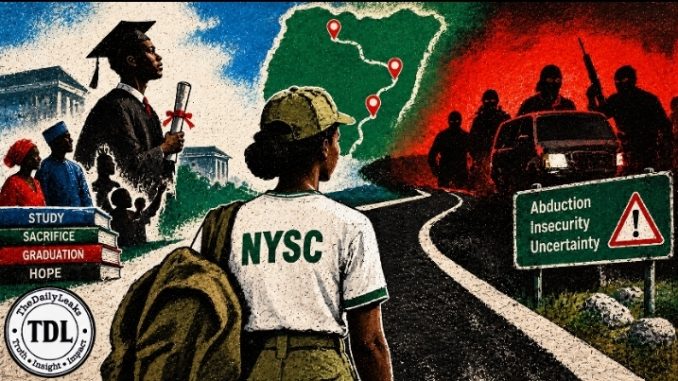
On October 1, while Nigerians were marking Independence Day, two buses carrying prospective NYSC corps members and other passengers from Ibadan towards orientation camps in Akwa Ibom and Abia were attacked around 6:30am near Umunoha on the Owerri-Onitsha Road in Imo State.
The police confirmed that corps members were among those abducted and said 10 victims had been rescued, while the exact number still missing was being verified.
ALSO READ: A new Nigeria
For the families, however, there is nothing funny about the statistics.
Somebody’s child left home to serve Nigeria.
Somebody’s mother was expecting a phone call from camp.
Somebody’s father was probably thinking about the next expense.
Instead, the family was waiting for news from a kidnapping scene.
And this is where the NYSC story becomes difficult to explain.
This was not the first warning.
In August, corps members travelling from Bayelsa towards Abuja were among passengers abducted along the Aloma-Egane Expressway in Kogi State. Eleven victims were subsequently rescued after a joint security operation.
In July, 18 corps members whose vehicle broke down at night in a known crime-prone area in Ogun State had to call the police for rescue. They were safely evacuated.
So what exactly are we testing?
Patriotism?
Courage?
Geographical knowledge?
Or the ability of a young graduate to identify a kidnapping corridor before the kidnappers identify him?
The irony is painful.
NYSC was created after the civil war to promote national unity and rebuild common ties among Nigerian youths. Its official objectives include national consciousness, discipline, collective responsibility and preparation for national service.
ALSO READ: About to give birth
But national unity should not require a young Nigerian to cross a known danger zone in a commercial bus and hope that Providence arrives before the kidnappers.
There is an even more uncomfortable question.
Why should a national programme designed and administered by the Federal Government depend so heavily on individual families to solve the logistics of getting their children safely to the point where government wants them to serve?
NYSC’s own structure assigns responsibilities for the welfare of corps members, including accommodation, boarding and transportation, while its Deployment and Relocation Division is responsible for posting graduates across the federation. The current Director-General has also identified enhanced security and welfare of corps members as a central policy priority.
This should mean something.
If government knows that Route A has become dangerous, why is Route A still treated as merely Route A?
It should become a security variable.
If a road has become a kidnapping corridor, posting young graduates through it should trigger a different arrangement: escorted movement, coordinated transportation, alternative routes, temporary suspension or local deployment.
The call-up letter should not be a beautifully printed invitation to danger.
And perhaps it is time to reconsider the meaning of “national spread”.
Must national service always mean sending a graduate hundreds of kilometres away from the place where he or she has lived, studied and built social networks?
Other countries have taken different approaches.
Ghana operates a mandatory National Service Authority for graduates and deploys personnel across public and private sectors.
France’s Service Civique is voluntary and provides an organised framework involving training, tutoring, financial support and state-backed social protection.
Germany’s Bundesfreiwilligendienst similarly provides structured placements, insurance and, where applicable, accommodation, food or mobility support.
Singapore’s compulsory National Service is a different model because it is primarily military, police and civil-defence service, but even there deployment is tied to operational and manpower requirements, medical fitness and suitability, with systems for managing welfare and transport claims.
The lesson for Nigeria is not that we should copy France, Germany, Ghana or Singapore.
It is simpler.
National service should be organised around service.
Not survival.
If NYSC must remain compulsory, government should develop a permanent security risk map for every major route used by prospective corps members.
ALSO READ: Are you that father?
High-risk corridors should trigger automatic alternative arrangements.
Where feasible, graduates should be offered meaningful local or regional deployment, particularly where their skills are urgently needed.
And when government requires a young person to travel into a high-risk area for a compulsory national programme, safe transportation should be a government responsibility, not a burden quietly transferred to parents.
These are not asking for luxury.
They are asking for common sense.
A parent has already paid for years of education.
The child has already paid in sleepless nights, examinations, failed plans, financial pressure and the determination required to graduate in Nigeria.
ALSO READ: The courage to become
The reward for finally finishing should not be a journey in which the family begins counting hours without a phone call.
The nation asked these young people to serve.
The least the nation can do is make sure they arrive alive.
Let the khaki represent service, not sorrow.
Let national integration mean meeting fellow Nigerians, not meeting kidnappers on a highway.
Let the journey to serve Nigeria be one that parents can make without kneeling beside their phones in fear.
And for those still missing, the immediate responsibility is not bureaucracy.
It is rescue.
Bring them home.
GOD help the helpless families.
GOD protect the young Nigerians who have been asked to serve their country.
And may those entrusted with the leadership of this nation remember that patriotism should never be measured by how much danger an innocent citizen can survive.