By Seyi Gesinde

July 23, 2026
History possesses a wicked sense of humour.
It enjoys humiliating certainty.
Boethius imagined Fortune as a wheel that lifted rulers one day and cast them down the next. History has spent centuries proving him right.
The Greek historian Polybius believed political history moved in recurring cycles rather than along a straight line. Kingdoms rose, republics declined, reputations perished, only to be resurrected by the failures of those who followed. Nearly two thousand years later, Niccolò Machiavelli returned to the same theme from another direction. He urged republics to learn from history because human nature changes far less than the costumes of politics. History, it seems, delights in proving philosophers right long after politicians believe they have written the final chapter.
Every generation believes it has delivered the final judgement on its leaders, only for time to quietly reopen the case file. What was once dismissed as failure is reconsidered. What was once celebrated as triumph is subjected to fresh cross examination. The verdict of the crowd, history repeatedly reminds us, is often only an interim ruling.
Aristotle believed that reason, not passion, should guide political judgement. Edmund Burke, writing after the French Revolution, warned that societies frequently discover the value of institutions only after they have dismantled or discarded them. Between the Greek polis and eighteenth century Britain lies the same uncomfortable lesson, public opinion is often the quickest verdict, but rarely the final one.
ALSO READ: The courage to become
The Romans knew this. The Florentines witnessed it. The French perfected it. Napoleon was buried politically before he returned from Elba to reclaim an empire, if only for a hundred days. Winston Churchill was discarded by the very nation he had helped preserve, only to be summoned back to Downing Street years later. Charles de Gaulle walked away from power as though history had finished with him, until France discovered history had not finished with him.
Power has always been a revolving door disguised as a throne.
Boethius, writing from prison in the sixth century, imagined Fortune as a giant wheel. It lifts rulers to astonishing heights only to cast them down without warning. Yet the wheel never truly stops. Those at the bottom sometimes rise again, while those celebrating at the top eventually discover that permanence is the greatest illusion in politics.
Nigeria, it appears, is discovering the same lesson.
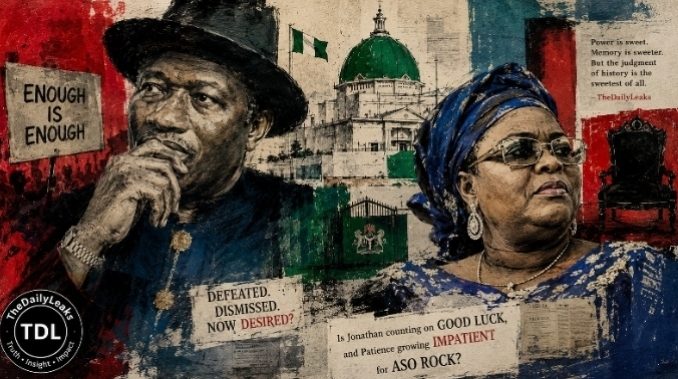
There was a time when Goodluck Jonathan’s political obituary had already been written. Not merely because he lost power, but because he lost something even more valuable, the confidence of a significant portion of the electorate. He became the first sitting Nigerian President to be defeated by an opposition candidate in a presidential election. That was no ordinary electoral event. It was treated as a national rebuke.
The streets were not draped in mourning.
They breathed relief.
The verdict was merciless. Too slow. Too hesitant. Too accommodating. Too detached from the urgency of governing. His critics did not merely reject his policies, they rejected the very temperament with which he exercised power.
Nations rarely dismiss leaders they desperately wish to keep.
That is why the present fascination with Jonathan deserves more than applause.
It deserves examination.
Has Jonathan changed?
Or has Nigeria changed?
Or has comparison quietly rewritten memory?
There is an important difference.
The fourteenth century historian Ibn Khaldun argued that political communities constantly reassess authority as their own circumstances evolve. Often, the ruler remains the same. It is the nation’s experience that changes.
ALSO READ: Imagine he was her father
Sometimes a man does not become taller.
The people around him merely discover they have been sinking.
The human mind is a poor historian. It does not preserve the past. It constantly renegotiates it. Every fresh disappointment edits yesterday’s memories until old discomfort begins to resemble lost comfort.
The bread once condemned for being too small suddenly becomes a feast after famine arrives.
Perhaps that is Jonathan’s greatest political strategist.
Not consultants.
Not loyalists.
Time.
Time has a habit of laundering reputations that seemed permanently stained.
Charles de Gaulle once remarked that history teaches lessons to those willing to learn them. History itself rarely changes. Perspective does.
One wonders.
If those who filled the streets in protest during Jonathan’s presidency had possessed the privilege of seeing a decade into the future, would they have marched with equal enthusiasm?
Would they still have called those years unbearable?
Or would they have called them affordable suffering?
History repeatedly demonstrates that societies rarely appreciate an age while living inside it. Civilisations often understand an era only after they have left it behind.
Hegel famously wrote that the Owl of Minerva spreads its wings only with the falling of dusk. Wisdom arrives late. Nations seldom understand the age they are living through. They understand it only after another age has exposed its true proportions.
That is why nostalgia should never be mistaken for historical accuracy.
Then comes another irony.
The same political class that once portrayed Jonathan as lacking decisiveness now speaks his name with unexpected tenderness. The same public conversation that once asked him to leave increasingly wonders whether he should return.
Politics is full of strange conversions.
Not all of them are born of conviction.
Some are born of comparison.
Others are born of calculation.
Still others are born because disappointment has lowered the qualification for greatness.
Then there is Jonathan himself.
The rumours multiply.
The analyses deepen.
The invitations grow louder.
The denials remain absent.
Silence has always been politics’ most eloquent language.
ALSO READ: If they stole behind Buhari
Every listener hears in it the answer he already wishes to believe.
A man who has absolutely no interest in becoming the subject of national speculation usually possesses the simplest instrument for ending it, his own voice.
Yet silence continues to feed interpretation.
Perhaps deliberately.
Perhaps innocently.
History will eventually decide.
And then there is Aso Rock.
Lord Acton warned that power corrupts. Yet corruption may not be its only temptation.
No philosopher has fully exhausted the psychology of power. Machiavelli examined how it is acquired and preserved. Hobbes feared the chaos created by its absence. Lord Acton warned of its corrupting tendency. Yet there remains another dimension that philosophers only hinted at, the irresistible pull of remembered power.
The presidential convoy that empties highways.
The security cordon that suspends ordinary life.
The doors that open before arrival.
The telephones that answer themselves.
The applause that becomes routine.
Power does not merely occupy an office.
It slowly occupies the imagination.
Very few people leave such an experience entirely untouched.
It would hardly be surprising if memory occasionally wandered back through those corridors.
Shakespeare asked whether a rose by any other name would smell as sweet. Politics, however, has always loved the poetry of names more than literature itself.
One is tempted to smile at the poetry of names.
Goodluck.
Patience.
Is Goodluck quietly trusting that good luck may yet smile again?
Has Patience, after years away from the Villa, become just a little impatient?
Only they can answer.
The larger question belongs to Nigeria.
When a nation begins searching yesterday for tomorrow’s answers, is it celebrating the forgotten virtues of an old leader?
Or confessing the failures of its present choices?
That is the cruel joke history never tires of telling.
Sometimes the loudest applause for yesterday is not really about yesterday at all.
It is an indictment of today.
Polybius would probably recognise another turn of the political cycle.
Burke might see a society rediscovering value through loss.
Hegel would simply remind us that understanding arrives only in hindsight.
History’s cruellest joke has never been that leaders are forgotten.
It is that some are remembered only after those who replaced them have taught a nation the true cost of its own impatience.