
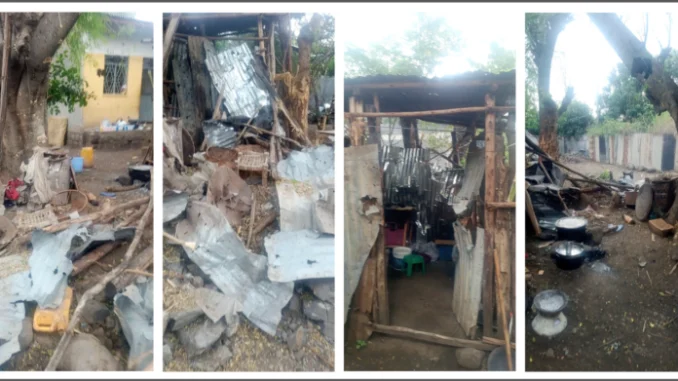
Amnesty calls for war crimes probe over deadly Ethiopia shelling in Tigray town

Amnesty International has called for a war crimes investigation into deadly artillery strikes carried out by Ethiopian federal troops and an allied militia on residential neighbourhoods in the southern Tigray town of Alamata.
The human rights organisation said the bombardment killed at least 14 civilians, including three children, and constituted indiscriminate attacks in violation of international humanitarian law.
The human rights organisation also accused the rebel Tigray People’s Liberation Front of unlawfully endangering non combatants during the late September battle for the city.
Investigators found the group embedded fighters inside civilian neighbourhoods and converted local schools into military bases.
The findings examine a three day bombardment between September 26 and September 28, 2026.
During the assault, the Ethiopian National Defence Force and the pro government Tigray Peace Force pounded Alamata before seizing the town.
Alamata is a commercial hub of roughly 80,000 people.
For three consecutive days, the ENDF and TPF repeatedly shelled Alamata in total disregard of the lives of its 80,000 inhabitants, said Yasmine Ahmed, Amnesty International’s senior director for regional human rights impact.
Indiscriminate attacks violate the rules of international humanitarian law, and these strikes must be investigated as war crimes, she added.
Anatomy of a three day bombardment
Using satellite imagery, verified video footage, munitions fragment analysis, and interviews with survivors, medical workers, and military sources, Amnesty reconstructed four major shelling incidents across densely populated areas of Alamata.
Sources with direct knowledge of troop movements told investigators that ENDF and TPF units fired the artillery from positions around Waja Ena Tumuga.
That area lies approximately 13 kilometres south of the city.
A medical worker on duty at Alamata Hospital between September 26 and September 28 reported that nearly all casualties admitted during the bombardment were civilians.
Patients arrived suffering from shrapnel wounds caused by explosive munitions.
On September 26 around 11:00 a.m., an artillery shell struck the Nigus Shimoy bar at the entrance of a crowded market bordering residential blocks, killing at least three people.
The attack occurred as residents gathered in large numbers to celebrate Demera, the eve of the Ethiopian Orthodox Meskel holiday.
The deadliest single incident occurred at dawn on September 27 in Kebele 04, a densely packed residential quarter dominated by single family homes and two multi storey apartment blocks.
Shelling hit five houses and killed seven civilians.
Those killed included a 26 year old mother, Meron Sewasew, her eight year old son, Markon Girmahiwot, and her 33 year old brother, Tewekel Sewasew.
Four members of a neighbouring family were also killed, while four other people were wounded.
They were staying in the house because it was supposed to be safe from the war, Meron’s husband, Girmahiwot Negash, told researchers.
She was my high school love, and our story ended too soon, he said.
Another artillery round struck a residence in Kebele 02 on September 27, instantly killing 55 year old Deyima Rebso.
The strike severely wounded her 62 year old husband, Ararse Yasin, their two children, and their 10 year old grandson.
Amnesty’s weapons experts identified shrapnel recovered from the home as consistent with artillery munitions fired by the ENDF and its allies.
Witnesses confirmed no military activity was taking place near the house.
While Amnesty independently verified 14 civilian deaths across those four strikes, residents and hospital sources previously told international media that the true death toll from the battle for Alamata exceeded 50.
Rebel military deployments in civilian areas
Amnesty’s investigation also scrutinised the conduct of TPLF fighters defending the city.
Researchers concluded the group failed to take legally required precautions to protect civilians under its control.
Six witnesses told researchers that TPLF forces had occupied nearly every school in Alamata as military bases in the months leading up to the September flare up.
Satellite imagery analysed by Amnesty showed scorched vegetation around a local preparatory school following clashes on September 23.
During the height of the shelling on September 26, eyewitnesses also reported seeing armed TPLF fighters stationed atop tall buildings.
Witnesses said fighters also stayed at the Werknesh Hotel, located immediately adjacent to the Kebele 04 residential compound hit the following morning.
Amnesty emphasised that the presence of rebel fighters near residential blocks does not absolve attacking forces of their obligations under the laws of war.
Under international humanitarian law, using wide area explosive artillery in densely populated urban centres is inherently indiscriminate.
The presence of enemy combatants does not nullify the duty to distinguish between military objectives and civilians.
Denials and demands for accountability
Neither federal authorities in Addis Ababa nor the military responded to requests for comment regarding the findings.
A spokesperson for the pro government Tigrayan militia denied involvement in the shelling.
The spokesperson claimed TPF fighters were not positioned on the front lines during the Alamata battle.
In a four page written response to Amnesty, the TPLF dismissed the accusations that it endangered civilians as unfounded.
The group called for an independent, impartial investigation before responsibility is assigned.
A fragile peace shattered
The battle for Alamata marked a critical turning point in Ethiopia’s renewed northern conflict.
The fighting shattered the fragile 2022 Pretoria peace accord that had ended the devastating 2020 to 2022 Tigray war.
The African Union estimated that earlier conflict killed roughly 600,000 people.
Following months of mounting political friction over demobilisation and contested territories, full scale hostilities erupted in late September 2026.
Initially, the TPLF, fighting alongside a broader coalition of anti government armed groups, seized strategic towns and airports across Tigray and neighbouring Amhara and Afar regions.
Backed by heavy artillery and drone strikes, federal forces and the TPF launched a rapid counteroffensive.
After capturing Alamata on September 28, federal troops pushed north along the A2 highway.
Federal forces retook Tigray’s regional capital, Mekelle, less than a week later.
Ethiopia is now simultaneously fighting armed insurgencies across multiple regions.
Reports of fresh troop buildups along the nearby Eritrean border have also sparked fears of a wider regional war.
Amnesty warned that ongoing government restrictions on journalists and independent human rights monitors threaten to shield grave abuses from scrutiny.