
By Seyi Gesinde

May 31, 2026
→ Identity is built through repetition
→ Readiness is produced, not waited for
→ Clarity determines progress
→ Discipline creates freedom
→ Environment shapes behaviour
→ Feedback accelerates growth
→ Resilience sustains progress
There is a quiet truth about human potential that modern psychology, neuroscience, and behavioural science consistently confirm. People do not transform through sudden bursts of motivation. They change through repeated actions that gradually reshape identity, habits, and perception. This is supported by neuroplasticity research, which shows that the brain reorganises itself in response to repeated behaviour and experience.
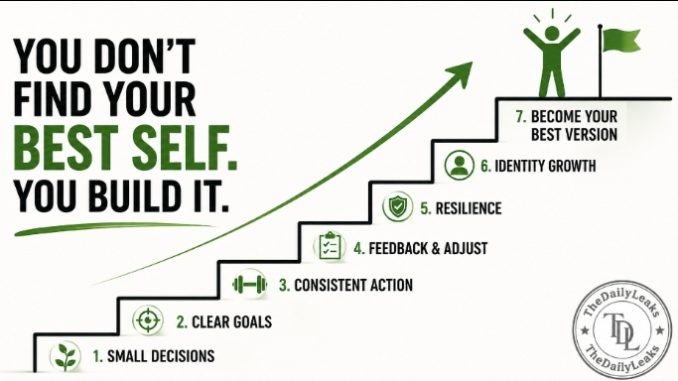
The best version of yourself is not a destination. It is a system you build and maintain. As James Clear explains in habit science, you do not rise to the level of your goals, you fall to the level of your systems.
Identity is built through repetition
Identity follows behaviour. You do not act well because you feel confident. You become confident because you repeatedly act well.
This reflects modern habit science, where repeated behaviour strengthens automatic patterns until actions become part of identity.
You become what you repeatedly do, not what you occasionally intend.
Readiness is produced, not waited for
Readiness is not a starting point. It is a result of action.
ALSO READ: How to master maths like a prodigy: 14-year-old ‘human calculator’ shatters 6 Guinness World Records
Ecclesiastes 11:4, “whoever watches the wind will not plant, whoever looks at the clouds will not reap.”
Progress begins when action replaces delay.
Clarity determines progress
Without clarity, effort becomes scattered and inefficient.
Edwin Locke’s Goal Setting Theory shows that specific and challenging goals consistently outperform vague intentions.
Proverbs 29:18, “where there is no vision, the people perish.”
Clear direction transforms activity into meaningful progress.
Discipline creates freedom
Discipline reduces internal conflict and preserves mental energy for execution.
Research in self regulation psychology, widely associated with Roy Baumeister, shows that structured habits and reduced decision fatigue improve consistency and performance.
Freedom is not the absence of structure, it is the presence of controlled structure.
Environment shapes behaviour
Behaviour is strongly influenced by context, not just intention.
BJ Fogg’s Behaviour Model explains that behaviour occurs through the interaction of motivation, ability, and environmental triggers.
1 Corinthians 15:33, “bad company corrupts good character.”
Your surroundings either reinforce growth or resist it.
Feedback accelerates growth
Improvement depends on honest reflection, not emotional avoidance.
Carol Dweck’s Growth Mindset research shows that individuals who treat failure as information improve faster than those who treat it as identity.
Feedback is a tool for refinement, not a verdict on worth.
Resilience sustains progress
Setbacks are not conclusions, they are adjustments.
Angela Duckworth’s Grit research shows that sustained effort over time is a stronger predictor of success than talent alone.
Philippians 3:13 to 14, “forgetting what is behind and straining toward what is ahead, I press on toward the goal.”
Persistence is what converts effort into outcome.
Final principle
You become what you repeatedly do. Identity is formed through accumulation, not isolated effort.
The best version of yourself is built, not discovered.