By Seyi Gesinde

August 5, 2026
There is something fascinating about human conversation.
People rarely seek permission before they speak.
Inside a commercial bus, strangers become temporary neighbours.
For a few minutes, the vehicle becomes a moving community.
Ideas travel as freely as the passengers.
Inside a bus:
Someone discusses football.
Someone discusses politics.
Someone markets herbal medicine.
Someone advertises land.
Someone answers a loud phone call.
Someone quarrels.
Someone flirts.
Someone tells jokes.
Someone debates the economy.
Nobody proposes legislation against conversation itself.
If a trader may sell soap…
If an estate agent may sell land…
If politicians may sell promises…
If everyone may freely sell opinions…
Once the subject becomes JESUS CHRIST, however, the law suddenly remembers its voice.
Long before constitutions were written, civilisation itself advanced through conversation.
ALSO READ: About to give birth
Ideas travelled because people travelled.
The Greek philosopher Socrates turned ordinary conversation into humanity’s search for truth.
He asked questions in public places until Athens concluded that the conversation itself had become dangerous.
The city silenced the man.
History preserved the conversation.
Centuries later, John Stuart Mill, in On Liberty, argued that liberty survives only when ideas are allowed to compete freely. Truth, he insisted, becomes stronger after surviving disagreement, not after eliminating it.
Modern democracy eventually embraced that principle.
Nigeria’s Constitution guarantees freedom of expression under Section 39.
It guarantees freedom of thought, conscience and religion under Section 38.
Article 18 of the Universal Declaration of Human Rights says the same.
So does Article 9 of the African Charter on Human and Peoples’ Rights.
None of these freedoms is absolute.
Restrictions may exist.
But only when they are lawful, necessary and proportionate.
Mill therefore leaves every free society with one enduring question.
The issue is not,
Is somebody preaching?
The issue is,
Is somebody causing demonstrable harm?
The difficulty is that the Founder of Christianity left an instruction that appears remarkably uncomplicated.
The last recorded command of JESUS was not,
Build churches.
It was,
“Go ye therefore, and teach all nations…” Matthew 28:19.
The command begins with Go.
Not Wait.
Not Invite them.
Not Remain inside the sanctuary.
Go.
A bus is full of people.
A market is full of people.
A train is full of people.
A street is full of people.
The Gospel has always travelled wherever people gathered.
ALSO READ: When Awo was the opposition…
The early Church had no cathedrals.
Its first sanctuary was human presence.
The Apostle Paul preached in marketplaces.
By riversides.
Inside homes.
On ships.
In prisons.
In public squares.
Sometimes to welcoming listeners.
Sometimes to hostile crowds.
Sometimes to people who never expected to hear him.
When the authorities ordered the apostles to stop speaking publicly, their reply was disarmingly simple:
“We cannot but speak the things which we have seen and heard.” Acts 4:20.
Christianity did not spread because it remained inside buildings.
It spread because it refused to.
The Roman Empire eventually discovered that the Gospel was unusually difficult to regulate.
It crossed borders.
It crossed cultures.
It crossed languages.
It crossed social classes.
Now, after two thousand years of travelling wherever people gather, someone appears to have discovered that CHRIST should remain inside church walls.
Apparently, football may travel.
Politics may travel.
Commerce may travel.
Even rumours may travel.
Only the Gospel must remain seated.
History has seen governments become uncomfortable with many things.
Some feared books.
Some feared newspapers.
Some feared universities.
Some feared public debate.
Some feared inconvenient questions.
Ideas have always made authority nervous.
Not because ideas carry weapons.
But because they carry consequences.
Perhaps Nigeria has finally discovered the nation’s most dangerous weapon.
Not the AK, 47.
Not explosives.
Not ransom notes.
Not the kidnapper’s telephone.
Not the terrorist’s rifle.
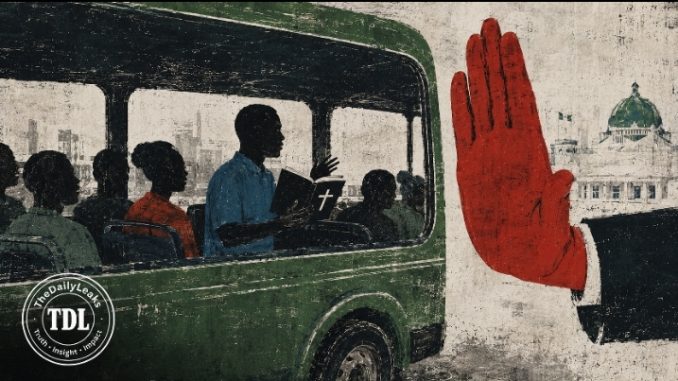
A Bible inside a commercial bus.
That observation is not an invitation to disorder.
Every civilised society requires order.
Drivers should not be distracted.
Passengers deserve courtesy.
Public spaces deserve reasonable regulation.
Those principles are beyond argument.
But every regulation also invites another question.
Does it address a genuine danger?
Or does it merely create a new controversy where none previously existed?
There is a profound difference.
For laws do more than regulate conduct.
They quietly reveal a nation’s priorities.
Sometimes they also reveal its anxieties.
ALSO READ: You are only religious, that doesn’t move GOD
And history has never judged nations merely by the laws they enacted.
It has judged them by the problems they considered most urgent to solve.
That may explain why this conversation no longer ends inside a commercial bus.
It quietly enters the conscience of the nation.
At a time when families worry about kidnapping…
When farmers fear entering their own fields…
When businesses struggle beneath economic uncertainty…
When millions of young people search for work…
When violent crime continues to challenge communities…
There is another irony that deserves attention.
The very voices some now seek to regulate are often the same voices preventing despair from becoming desperation.
They speak hope to the hopeless.
Comfort to the broken.
Love to the rejected.
Forgiveness to the wounded.
Compassion where bitterness threatens to take root.
Restraint where anger seeks expression.
In a nation where many daily carry burdens too heavy for words, the Gospel has remained one of the few messages reminding ordinary people that tomorrow need not look like today.
Many who might have vented their frustrations against society…
Against their neighbours…
Against the government…
Have instead found consolation in the words of CHRIST.
The Founder of Christianity Himself extended that invitation:
“Come unto me, all ye that labour and are heavy laden, and I will give you rest. Take my yoke upon you, and learn of me; for I am meek and lowly in heart: and ye shall find rest unto your souls. For my yoke is easy, and my burden is light.” Matthew 11:28 to 30.
One might therefore imagine that those faithfully carrying such a message wherever people gather would be regarded, not as a public inconvenience, but as quiet partners in preserving hope within society.
For when hope disappears, anger rarely remains unemployed.
Yet Nigeria has found itself passionately debating whether the Gospel has become too mobile.
Jesus once rebuked the religious leaders of His day with words that have echoed through history:
“Ye blind guides, which strain at a gnat, and swallow a camel.” Matthew 23:24.
The warning was never about insects.
Nor was it about animals.
It was about proportion.
About the curious human tendency to become meticulous over minor concerns while quietly accommodating far greater ones.
Perhaps the real issue was never the bus.
The bus merely exposed a larger question.
When did an ordinary conversation become a public concern simply because its subject is CHRIST?
History has seen governments fear armies.
History has seen governments fear revolutions.
History has seen governments fear ideas.
The answer they eventually gave to those fears became part of their legacy.
Nigeria’s answer to this question will become part of hers.