
By Seyi Gesinde

September 19, 2026
There is a dangerous temptation in difficult times: to look at the enormous weight of what is broken and conclude that your contribution is too small to matter.
Look at Nigeria.
Look at public governance, corruption, insecurity, weak institutions, failing infrastructure, unemployment, poverty and the daily frustrations that make even responsible citizens wonder whether anything can really change.
Then comes the question:
What difference can one person possibly make?
Quite a lot.
Because societies do not collapse only when bad people become powerful. They also deteriorate when good people become convinced that their individual responsibility is insignificant.
Great nations are not built by spectators.
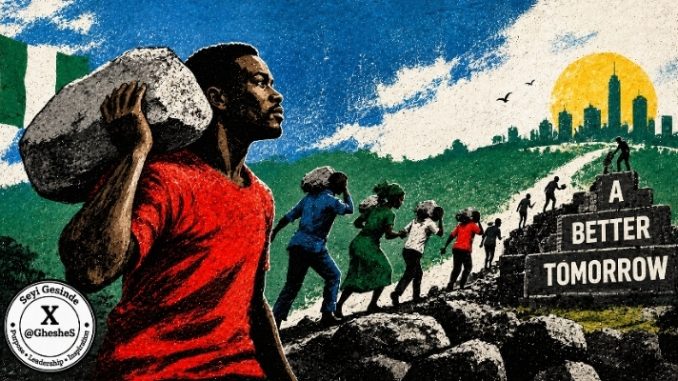
They are built by people carrying their own stones.
ALSO READ: A new Nigeria
Your stone may be honesty when dishonesty is profitable.
It may be speaking the truth when silence is safer.
It may be refusing to pay a bribe.
It may be holding power accountable.
It may be raising children who understand responsibility, compassion and integrity.
It may be teaching a child to read.
Mentoring a young person.
Building an honest business.
Creating employment.
Defending justice.
Serving your community.
Protecting the environment.
Doing your professional work properly when nobody is watching.
Voting thoughtfully.
Rejecting ethnic prejudice.
Refusing religious hatred.
Standing against injustice even when the victim is not one of your own.
These things may appear small.
They are not.
A stone can become part of a foundation.
A foundation can become a school.
A school can produce teachers, doctors, engineers, journalists, scientists, entrepreneurs, judges and leaders.
ALSO READ: Until you win
A stone can become part of a hospital.
A road.
A bridge.
A home.
A library.
A courtroom.
A business.
An institution.
A community.
A culture.
A democracy.
A nation.
And sometimes, the most important structure your stone builds is invisible.
Trust.
Character.
Courage.
Responsibility.
Hope.
The problem is that we often want to see the entire building before we are willing to carry our stone.
We want immediate results.
We want applause.
We want evidence that our sacrifice is working.
But history rarely gives builders that luxury.
The people who built enduring institutions did not always live long enough to see what those institutions became.
Parents raise children without knowing exactly who those children will become.
Teachers plant knowledge in minds without knowing whose life their lesson will eventually transform.
ALSO READ: Imagine he was her father
Writers publish truths without knowing which reader will find courage in their words.
Reformers challenge injustice without knowing whether they will live to witness the reform.
That is how civilisation advances.
One person carries one stone.
Another carries another.
Eventually, what looked like isolated acts becomes a structure.
And this is where the Nigerian problem becomes uncomfortable.
We often complain about the system while participating in the very habits that keep the system broken.
We condemn corruption, then offer a bribe to escape a queue.
We demand accountability from leaders while refusing accountability in our own responsibilities.
We complain about bad governance while celebrating people who manipulate the system for personal advantage.
We demand justice when we are victims, then become silent when somebody else is wronged.
We want a better country while waiting for somebody else to build it.
But a nation cannot become better through spectatorship.
You cannot outsource your stone.
The system may indeed be banking on your exhaustion.
It benefits when the honest person becomes cynical.
It benefits when the journalist stops asking questions.
When the professional stops caring.
When the voter stops thinking.
When the teacher stops teaching with conviction.
When the parent stops modelling character.
When the citizen says, “Everybody does it.”
That sentence has buried more societies than many bad leaders ever could.
Because every time somebody refuses responsibility, the collective foundation becomes weaker.
Your stone matters precisely because you are not responsible for carrying everybody else’s stone.
You are responsible for yours.
You may not control government.
But you control your integrity.
You may not control the entire economy.
But you can create value.
You may not control the political class.
But you can refuse to surrender your conscience.
You may not control the future of Nigeria.
But you can influence the future of the people within your reach.
That is not small.
That is citizenship.
So stop asking whether your contribution is large enough.
Ask whether you have carried it.
Have you spoken the truth you were capable of speaking?
Have you done the good you were capable of doing?
Have you corrected what you were capable of correcting?
Have you helped the person you were capable of helping?
Have you built what you were capable of building?
ALSO READ: Are you that father?
Have you refused what you were capable of refusing?
Because perhaps the greatest deception of difficult times is convincing ordinary people that only extraordinary people can make a difference.
They cannot.
Every extraordinary society is ultimately an accumulation of ordinary people doing extraordinary things with ordinary opportunities.
Your stone may not build the entire cathedral.
It does not have to.
It only has to be carried.
Carry it into your family.
Carry it into your profession.
Carry it into your community.
Carry it into public life.
Carry it into your faith.
Carry it into your relationships.
Carry it wherever your influence reaches.
Someone else will carry theirs.
And perhaps, long after we are gone, people will stand inside the structure we helped build and wonder how it became possible.
They may never know our names.
They may never know which stone belonged to us.
That should not matter.
Because the work was never about being seen carrying the stone.
It was about making sure there was a stone to build with.
Carry yours.
Your part of the work matters.