By Seyi Gesinde

June 13, 2026
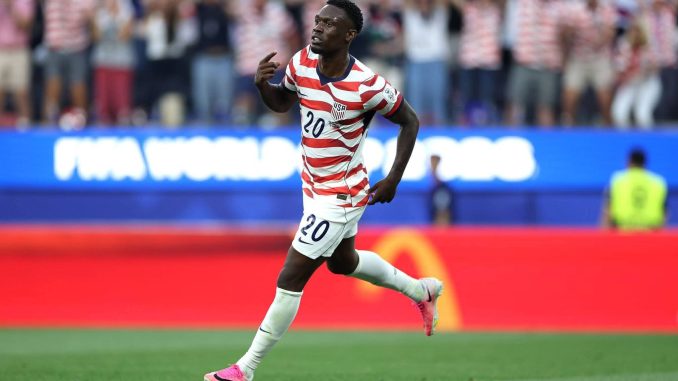
Folarin Balogun has etched his name into United States World Cup history with a decisive two goal performance in a 4 to 1 win over Paraguay, a milestone that carries both statistical rarity and symbolic weight in the evolution of American football on the global stage.
Born in Brooklyn to Nigerian parents, raised in London, and eligible to represent Nigeria, England, or the United States, Balogun embodies a modern football identity shaped by transnational pathways. His commitment to the US national team has now been validated in emphatic fashion through a record that had stood untouched for nearly a century.
A 96 year scoring gap finally broken
Balogun’s brace makes him the first US player in 96 years to score twice in a single World Cup match, a feat last achieved in the inaugural 1930 tournament. That early US side, which reached the semi finals, remains a foundational reference point in American football history, but individual attacking output of that magnitude had not been replicated since.
His performance therefore resets a long standing statistical ceiling, placing him in a rare category of players who directly alter historical benchmarks rather than merely contribute to them.
Historic night for US attacking output
The significance of the match extends beyond individual achievement. The United States scored four goals in a World Cup match for the first time in its history, marking a collective offensive breakthrough that amplifies Balogun’s contribution.
In this context, his brace functions as the decisive factor in a broader team milestone, transforming the match into a reference point for future US World Cup campaigns.
Identity shaped across three football cultures
Balogun’s background adds narrative depth to the record. His development across the United States, England, and Nigeria places him within a rare category of players whose international eligibility reflects global football migration patterns.
ALSO READ: World Cup dawns as global football power shift begins
Choosing to represent the US, he has now become central to one of its most notable World Cup attacking milestones, linking personal identity with national football history in a direct and measurable way.
Historical continuity from 1930 to present day
The reference to 1930 is not incidental. It anchors Balogun’s achievement within the earliest chapter of US World Cup participation, creating a narrative bridge between the sport’s formative era and its modern incarnation.
Nearly 100 years later, his brace restores a level of individual scoring impact that had been absent from US World Cup records, reaffirming a long interrupted statistical legacy on football’s biggest stage.
A defining tournament moment
Taken together, the performance stands as both a record breaking achievement and a symbolic turning point. Balogun’s brace does not merely add to US World Cup history, it repositions it, reconnecting present day performances with the nation’s earliest global football milestones while setting a new benchmark for future generations.