July 19, 2026

Spain are champions of the world once again.
After 120 minutes of relentless intensity, tactical brilliance and unwavering determination, La Roja defeated defending champions Argentina 1-0 after extra time on Sunday to lift the 2026 FIFA World Cup before a packed crowd at New York New Jersey Stadium in East Rutherford, New Jersey.
The victory ended Spain’s 16 year wait for football’s biggest prize, adding a second World Cup title to the one they won in South Africa in 2010.
From the opening whistle, Spain dictated the tempo.
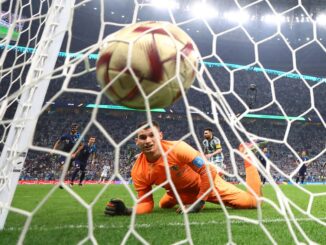
Luis de la Fuente’s side dominated possession, stretched Argentina across the width of the pitch and repeatedly tested Emiliano Martinez, who produced a string of outstanding saves to keep the holders alive.
Argentina, seeking back to back World Cup triumphs after their 2022 success in Qatar, relied on quick counter attacks orchestrated by Lionel Messi and Julian Alvarez.
However, Spain’s organised defence, marshalled by Pau Cubarsi and Robin Le Normand, denied the South Americans clear scoring opportunities.
The first half ended goalless, but not without drama.
Spain came closest through Nico Williams and Lamine Yamal, whose efforts forced Martinez into spectacular saves, while Argentina appealed unsuccessfully for a penalty after a challenge inside the box.
The second half produced even greater tension.
Spain continued to press, with Pedri, Rodri and Fabian Ruiz controlling midfield, while Argentina gradually grew into the contest as Messi began finding spaces between the lines.
Both goalkeepers delivered world class performances.
Unai Simon denied Alvarez with a crucial save, moments after Martinez had kept out Ferran Torres from close range.
As normal time expired without a goal, the final entered extra time for only the ninth time in FIFA World Cup history.
ALSO READ: England edge France in World Cup classic to claim historic third place
The breakthrough finally arrived in the 106th minute.
Following sustained Spanish pressure, Ferran Torres latched onto a perfectly weighted pass inside the penalty area before calmly beating Martinez to spark wild celebrations among the Spanish players and thousands of travelling supporters.
Argentina’s task became even more difficult when Enzo Fernandez was sent off during extra time, reducing the defending champions to 10 men.
Despite the numerical disadvantage, Lionel Scaloni’s side launched one final assault.
Messi tried to inspire another remarkable comeback, but Spain’s defence stood firm, repelling every attack as the clock ticked towards full time.
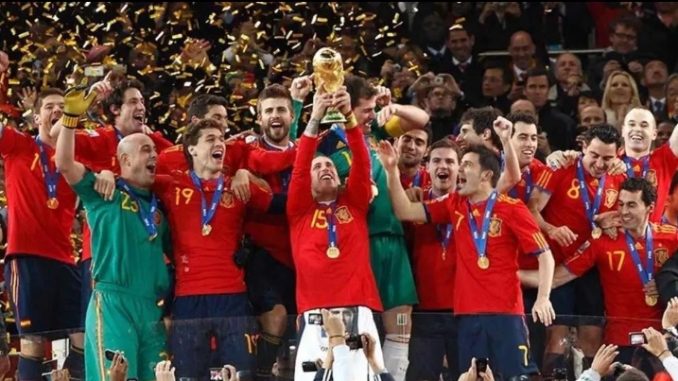
When the final whistle sounded, Spanish players and coaching staff flooded the pitch in celebration, embracing one another before gathering beneath a shower of confetti to lift the iconic FIFA World Cup trophy.
Captain Alvaro Morata became the second Spanish captain to raise the World Cup after Iker Casillas achieved the feat in 2010.
The triumph crowned a remarkable tournament for Spain, who remained unbeaten throughout the competition and combined disciplined defending with fluid attacking football to overcome some of the world’s strongest teams.
For Argentina, defeat brought an end to their reign as world champions.
Although they fell short of retaining the title, Lionel Messi and his teammates exited the tournament having once again demonstrated the resilience and quality that carried them to global glory four years earlier.
The 2026 edition also closed a historic chapter for the FIFA World Cup.
It was the first tournament to feature 48 nations and the first to be jointly hosted by the United States, Canada and Mexico, setting new attendance records and ushering in a new era for the world’s biggest sporting event.