By Seyi Gesinde

October 1, 2026
At 66, Nigeria should be old enough to know what it wants to become.
Instead, the Giant of Africa is still carrying its potential around like an unfinished project, spending an extraordinary amount of time explaining why it has not yet become one.
Perhaps that is the real Nigerian paradox.
We have never lacked resources.
We have lacked conversion.
Money into infrastructure.
Oil into prosperity.
Budgets into results.
Promises into things Nigerians can actually touch.
ALSO READ: NYSC: Don’t let serving Nigeria mean surviving its kidnappers
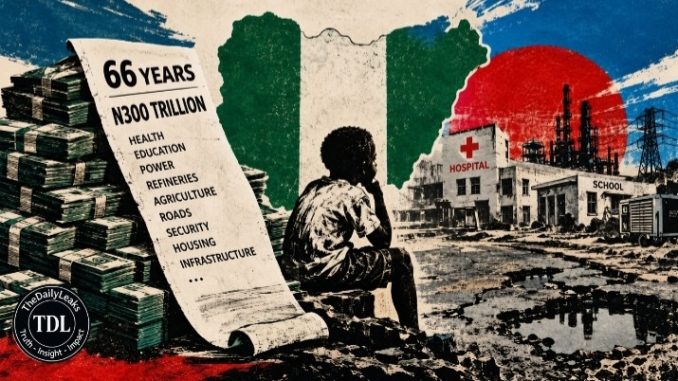
A reconstruction of available federal expenditure and budget records from puts Nigeria’s nominal public spending envelope from independence in 1960 through 2026 at roughly N300 trillion.
Three hundred trillion naira, even more.
Not projected money.
Not what Nigeria needs by 2050.
Not the estimated $40 billion in annual infrastructure spending projected by reports like PwC’s Global Infrastructure Outlook to sustain baseline competitiveness by mid-century, nor the upwards of $100 billion annually that long-term economic models calculate Nigeria requires to achieve its ambitious per capita GDP and national transformation targets by 2050.
But talking of money that passed through the public system while infrastructure was still being promised, appropriated, awarded, rehabilitated and reappropriated.
The question is brutally simple.
What did Nigeria build with it?
Health, where the money did not build confidence
Nigeria has spent trillions on health.
Between 2016 and 2021 alone, the Federal Ministry of Health received about N2.3 trillion, while the State House Medical Centre received N6.2 billion in appropriations.
Yet, successive Nigerian leaders have travelled abroad for medical care.
The point is what decades of public spending have produced.
Hospitals still lack essential equipment.
Specialist care remains scarce.
Patients travel abroad.
And the country that cannot reliably provide the best care for its leaders still produces doctors good enough to work in the hospitals where those leaders seek treatment abroad.
In 2022, another N21.97 billion was allocated for the presidential wing of the State House Medical Centre.
After 66 years, Nigeria could fund presidential healthcare repeatedly without producing a public hospital Nigerians could point to as a national medical institution.
Power, where billions produced dependence on generators
Nigeria’s power story is perhaps the cleanest evidence of expenditure without transformation.
Bismarck Rewane has put Nigeria’s power sector spending over 26 years at about $30 billion, while generation moved only marginally from roughly 4,500MW in 1999 to about 5,000MW in 2025.
Then look at Dubai.
In 2025, Dubai, with an estimated population of 4.58 million residents, (roughly equivalent to a single Nigerian state like Ogun), recorded a peak electricity system demand of 11,391 MW supported by a massive installed generation capacity of 17,979 MW.
Conversely, Nigeria is an energy giant on paper, home to over 200 million people and sitting on Africa’s largest proven oil and gas reserves.
ALSO READ: The courage to become
Yet, its national grid routinely struggles to distribute more than 4,000 to 5,000 MW of operational power to its entire population.
But, Dubai, the smaller oil rich emirate operates a power system several times larger than Nigeria’s actual dependable generation.
Nigeria spent billions.
The generator survived.
Refineries, where an oil producer could not keep its own plants alive
Nigeria has four government owned refinery facilities, centred on Port Harcourt, Warri and Kaduna.
In 2021, the Federal Executive Council approved about $3.14 billion for their rehabilitation, including $1.5 billion for Port Harcourt, $897.6 million for Warri and $740.67 million for Kaduna.
Port Harcourt briefly resumed operations in 2024 before shutting down again in May 2025.
By 2026, questions were still being raised about rehabilitation expenditure and the plants’ financial performance.
Meanwhile, a private Nigerian refinery was built by Industrialist Aliko Dangote with capacity to process 650,000 barrels of crude daily.
The country had the crude.
It had the refineries.
It had the appropriations.
What it repeatedly failed to produce was dependable public refining.
Education, where appropriation did not become learning
Education has consumed billions across generations.
Yet UNICEF reported in September 2026 that 86 per cent of Junior Secondary 2 pupils assessed in 2022 failed to reach minimum proficiency in mathematics.
Government education spending as a share of total expenditure fell from 9.3 per cent in 2015 to 3.6 per cent in 2023.
The question therefore is not merely whether education was budgeted.
It is what survived between appropriation and the classroom.
Security, where the budget rises and fear remains
The 2026 budget allocated N5.41 trillion to defence and security.
Yet farmers still calculate whether it is safe to reach their farms.
Travellers calculate the risks of roads.
ALSO READ: Are you that father?
Families worry about kidnapping.
Communities organise their own protection.
A security budget is measured in naira.
Security itself is measured by whether citizens can live without fear.
Agriculture, where the land is rich and the food bill is not
Nigeria has land, water, farmers and decades of agricultural intervention programmes.
Yet FAO estimates that about 36.3 million Nigerians faced severe acute food insecurity during the June to August 2026 lean season.
Billions have gone into fertiliser, mechanisation, irrigation, credit, seedlings, food security programmes and agricultural interventions.
Yet the farmer struggles to produce cheaply.
The consumer struggles to buy cheaply.
Somewhere between appropriation and harvest, value keeps disappearing.
Roads, where projects became permanent budget items
Nigeria has spent enormous sums on roads.
Yet in December 2025, the ICPC and Federal Ministry of Works began auditing 760 federal road projects worth more than N36 trillion.
N36 trillion in road contracts alone.
The figure is almost an argument by itself.
Roads are awarded.
Roads are funded.
Roads are rehabilitated.
Roads are reconstructed.
Roads are abandoned.
Then they return to the budget.
At some point, the question stops being how much more Nigeria needs to spend.
It becomes what happened to what Nigeria already spent.
Other countries built with what they had
This is not an argument that infrastructure costs nothing.
ALSO READ: A new Nigeria
It is an argument about what disciplined expenditure can produce.
Singapore’s first Development Plan, launched in 1961, was an $871 million programme to kick start industrialisation and economic development. The country later borrowed to finance major infrastructure including Changi Airport and its first MRT lines.
Its first MRT system was eventually approved in 1982 with a budget of $5.3 billion.
South Korea emerged from the Korean War with only 2.4 per cent of its roads paved.
Its 1960s and 1970s development strategy deliberately prioritised power plants, expressways, ports and industrial infrastructure.
By 1980, transport investment alone was 1.38 per cent of GDP and electricity investment 2.67 per cent.
They spent.
They built.
They maintained.
They expanded.
Nigeria also spent.
The difference is visible.
The N300 trillion question
Nigeria’s tragedy is not that money was unavailable.
It is that money repeatedly became expenditure without becoming proportionate public value.
The country has spent on hospitals without building a health system Nigerians trust.
It has spent on power without ending dependence on generators.
It has spent on refineries without securing dependable public refining.
It has spent on education without securing basic learning.
It has spent on security without eliminating fear.
It has spent on agriculture without securing affordable food.
It has spent on roads without securing durable connectivity.
And after 66 years, another appropriation arrives to repair what previous appropriations were supposed to have built.
The Giant of Africa does not need another celebration of its potential.
It needs to account for its past.
Because N300 trillion is not a promise about tomorrow.
It is the price of yesterday.
And the country Nigerians can touch today must answer for what happened to it.
Happy Independence Day, Nigeria.