
June 10, 2026

By Seyi Gesinde
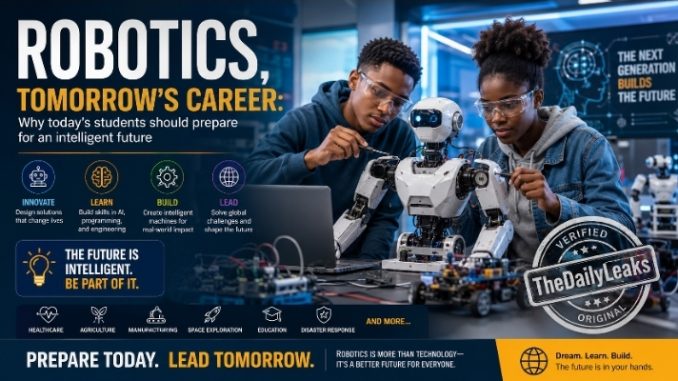
The world is experiencing one of the greatest technological revolutions in history, and at the centre of this transformation is robotics. Once limited to science fiction movies and research laboratories, robots are now performing surgeries, exploring space, assembling vehicles, delivering packages, assisting farmers, teaching children, and even supporting emergency rescue operations.
For today’s students, robotics is no longer a distant concept. It is becoming one of the most promising career paths of the twenty first century.
What is robotics?
Robotics is an interdisciplinary field that combines engineering, computer science, artificial intelligence, electronics, mathematics, and design to create machines capable of performing tasks either autonomously or with human guidance.
Modern robots are equipped with sensors, cameras, processors, and intelligent software that enable them to interact with their environment, learn from experience, and make decisions.
Why robotics matters
The demand for automation is growing rapidly across every sector of the global economy. Industries are searching for faster, safer, and more efficient ways to perform tasks, making robotics an indispensable part of modern development.
From manufacturing plants in Asia to hospitals in Europe, from smart farms in Africa to space missions in the United States, robotics is shaping the future of work and innovation.
ALSO READ: Germany earmarks 20 billion euros in subsidies for chip industry
Countries investing heavily in robotics are creating new industries, generating high paying jobs, and improving productivity.
Career opportunities in robotics
Students who develop robotics skills can pursue careers as:
Robotics Engineer
Artificial Intelligence Developer
Automation Specialist
Mechatronics Engineer
Machine Learning Engineer
Drone Technology Expert
Medical Robotics Designer
Space Robotics Scientist
Agricultural Robotics Consultant
Industrial Automation Manager
Software Developer
Cybersecurity Specialist for autonomous systems
Robotics Research Scientist
Many of these careers rank among the fastest growing and highest paying professions globally.
Skills every student should develop
Students interested in robotics should focus on building strong foundations in:
Mathematics
Physics
Computer Programming
Electronics
Mechanical Design
Artificial Intelligence
Critical Thinking
Problem Solving
Creativity
Teamwork
Programming languages such as Python and C++ are particularly valuable because they are widely used in robotics development.
The future belongs to problem solvers
The next generation of robots will not simply replace repetitive tasks. They will collaborate with humans in hospitals, schools, construction sites, disaster zones, and homes.
Students who understand robotics will become innovators capable of solving complex problems, improving healthcare, increasing food production, enhancing transportation, and protecting the environment.
Opportunities for African students
Africa presents enormous opportunities for robotics innovation.
Robots can help improve agriculture through precision farming, support healthcare delivery in remote communities, inspect infrastructure, monitor security, clean polluted environments, and provide educational assistance.
Young Africans who acquire robotics skills today could become founders of technology companies that create solutions specifically designed for local challenges.
Rather than importing technology, the continent has the potential to become a producer and exporter of robotic solutions.
Challenges to overcome
While robotics offers exciting prospects, students must recognise that success requires dedication and continuous learning.
Technology evolves rapidly, making lifelong education essential. Ethical issues surrounding artificial intelligence, privacy, employment, and safety will also require responsible professionals who understand both technology and humanity.
Preparing for the future
Students can begin their robotics journey by joining robotics clubs, participating in coding competitions, learning programming online, building simple electronic projects, studying mathematics diligently, and experimenting with affordable robotics kits.
Every small project builds practical experience that can open doors to scholarships, internships, research opportunities, and international careers.
The future will belong not only to those who use technology but also to those who create it. Robotics represents the intersection of imagination and engineering, offering students an opportunity to shape industries, improve lives, and solve global challenges.
For young people willing to embrace curiosity, innovation, and continuous learning, robotics is more than a career choice. It is a gateway to becoming architects of the intelligent world that is rapidly emerging.
The robots of tomorrow are being imagined by the students of today. Those who prepare now will not simply witness the future, they will build it.