
By Marvellous Nyang

February 24, 2026
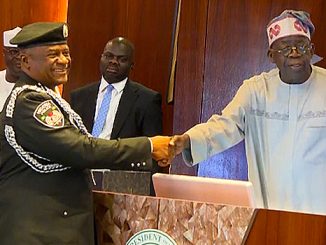
President Bola Tinubu has removed Kayode Egbetokun as Inspector General of Police, bringing to an end a tenure that was overshadowed by legal controversy, public backlash and sustained criticism from civil society actors.
Presidency sources said the decision followed a meeting between the President and Egbetokun at the Presidential Villa on Monday, where the police chief was asked to step down.
Although there has been no formal public statement detailing the circumstances of his exit, senior officials confirmed that arrangements for a leadership transition at the Nigeria Police Force were immediately initiated.
Egbetokun, who was appointed in October 2023, attained the mandatory retirement age of 60 in September 2024.
Under conventional public service rules, that milestone would ordinarily have marked the end of his service.
However, the National Assembly amended the Police Act to provide a fixed four year tenure for an Inspector General of Police, calculated from the date of appointment and not subject to age or years of service limitations.
ALSO READ: How to persuade people to change their behaviour
President Tinubu assented to the amendment, effectively extending Egbetokun’s stay in office beyond his 60th birthday.
The move triggered intense public debate.
Senior lawyers, retired police officers and civil society organisations argued that the extension undermined established retirement principles within the public service and disrupted succession planning within the force.
Supporters of the amendment maintained that continuity in leadership was necessary to stabilise policing reforms and security coordination.
The legal and constitutional arguments over the amendment lingered in public discourse, with suits filed seeking judicial interpretation of whether the revised Police Act could override age based retirement thresholds embedded in public service norms.
One of the most prominent critics of Egbetokun’s continued stay in office was activist and former presidential candidate . Sowore repeatedly described the police chief as occupying the office unlawfully, insisting that he should have retired upon clocking 60.
The dispute escalated into legal action when the police initiated criminal proceedings against Sowore over his public characterisation of the IGP.
The development amplified scrutiny of the police leadership and widened the debate to include concerns about freedom of expression and the optics of a serving Inspector General engaging a vocal critic through criminal litigation.
The controversy kept Egbetokun at the centre of national discourse, at a time when the police were grappling with broader challenges including violent crime, kidnapping and questions over internal discipline.
Beyond public criticism, Egbetokun’s extended tenure reportedly generated unease within segments of the force.
Senior officers approaching retirement and those in line for top command positions were said to have been affected by the altered succession timeline.
Analysts observed that uncertainty over leadership continuity can affect morale and strategic planning within a hierarchical security institution.
While Egbetokun defended his stewardship and oversaw operational deployments across various theatres of insecurity, the legitimacy debate remained a persistent shadow over his administration.
Although no official successor has been announced, senior security sources indicate that Tunji Disu is among the leading officers being considered to take over the role.
Disu is regarded within policing circles as an experienced operative with a background in intelligence and criminal investigations.
The leadership change closes a contentious chapter in the force’s recent history. It also underscores the delicate balance between legislative reform, executive authority and long standing civil service norms in Nigeria’s governance architecture.
Attention will now shift to who the President formally appoints as the next Inspector General of Police and how the incoming leadership will consolidate internal stability within the force while addressing Nigeria’s evolving security threats.