
By Seyi Gesinde

July 29, 2026
History rarely announces the decline of a civilisation with the collapse of its monuments.
It begins with something far more ordinary.
The ordinary journey.
Long before empires disappeared from maps, travellers had already begun avoiding their roads.
Merchants took longer routes.
Farmers travelled in groups.
Families delayed their journeys until daylight.
Commerce learnt to negotiate with fear.
History has never mistaken that negotiation for progress.
History has watched this pattern often enough to recognise it.
The story is older than modern governments.
It is older than democracy.
It is older than the nation state itself.
One of the earliest descriptions appears, not in an economics textbook or a political treatise, but in Scripture.
The Song of Deborah laments a time of national insecurity with remarkable simplicity:
“In the days of Shamgar son of Anath, in the days of Jael, the highways were abandoned, and travellers kept to the byways.” — Judges 5:6.
Few ancient texts describe the anatomy of insecurity with such haunting economy.
The roads still existed.
People still travelled.
ALSO READ: Is Jonathan counting on good luck, and Patience growing impatient for Aso Rock?
But fear had redesigned the map.
More than three thousand years later, that ancient lament echoes with disturbing familiarity in Nigeria.
Across many of the nation’s highways, journeys that should unite communities increasingly divide them between courage and caution.
Bandits lie in wait.
Kidnappers turn forests into businesses.
Armed terrorists transform roads built for commerce into corridors of fear.
Families no longer ask only, “What time will you arrive?”
They first ask,
“Which route are you taking?”
Some journeys begin with prayer.
Some end in ransom.
Some never end at all.
The tragedy extends beyond those directly attacked.
Farmers hesitate before travelling to distant farms.
Transporters calculate risk before fuel.
Parents think twice before sending children across states for education.
Businesses factor insecurity into the price of every journey.
Even celebrations are quietly rearranged.
A wedding invitation.
A burial ceremony.
A family reunion.
Each now carries another question.
Is the road safe?
History has seen societies endure such anxieties before.
The difference is that many of them endured them because civilisation had not yet equipped them with the tools we possess today.
The traveller in the days of Deborah had no satellite watching the highway.
The Roman merchant had no aerial surveillance.
The medieval kingdom possessed neither drones nor thermal imaging.
There was no forensic science.
No real time intelligence network.
No emergency communications.
No helicopters.
No digital mapping.
No artificial intelligence.
Many of history’s greatest civilisations confronted insecurity while struggling against the limits of their own age.
Modern Nigeria confronts it in an age where those limits have largely been conquered.
That distinction matters.
Nigeria attained independence in 1960.
It did not inherit a world waiting to invent the motor car.
Or electricity.
Or the aeroplane.
Or radio.
Or radar.
Or the telephone.
Or the computer.
Or satellites.
Or the internet.
Or drones.
Or modern forensic science.
Or artificial intelligence.
Those inventions had already entered human civilisation.
Nigeria inherited them.
Not because it created them.
But because generations before had already paid the price of discovery.
Scientists spent centuries expanding the frontiers of knowledge.
Engineers transformed impossible ideas into ordinary realities.
ALSO READ: The greatest gift Osinbajo gave Christians
Inventors endured failure so that later generations might enjoy convenience.
Civilisation laboured so posterity could suffer less.
That is why history offers modern governments fewer excuses than it offered ancient kingdoms.
Every invention inherited enlarges responsibility.
Every technological breakthrough raises the standard by which leadership is judged.
No modern government can plead the limitations of antiquity while possessing the advantages of modernity.
That is the enduring lesson history insists upon teaching.
It is not enough to inherit civilisation.
One must govern with it.
History records these lessons not merely to honour the past.
It records them to prevent its repetition.
The Roman Empire understood that roads were more than engineering projects.
They were instruments of order.
They carried soldiers, certainly.
But they also carried merchants.
Farmers.
Physicians.
Teachers.
Pilgrims.
Ideas.
Commerce moved because confidence moved with it.
Yet history also records what followed when that confidence weakened.
Following the sack of Rome in AD 410 by the Visigoths under Alaric I, and the eventual deposition of the last Western Roman emperor, Romulus Augustulus, in AD 476, the Western Roman Empire gradually fragmented.
Many of its magnificent roads remained.
The authority that secured them steadily diminished in many regions.
Trade became more uncertain.
Travellers became more vulnerable.
Communities grew more isolated.
History quietly reached a conclusion every generation must eventually confront.
Roads may outlive governments.
Confidence rarely does.
That is why the Nigerian experience should trouble far more than Nigerians alone.
It represents a question civilisation thought it had already answered.
Why should citizens of the twenty first century fear highways in ways that remind humanity of antiquity?
Aristotle argued in Politics that the political community exists, not merely that people may live, but that they may live well.
There is profound wisdom in that distinction.
A nation where citizens survive but cannot travel with confidence has achieved existence.
It has not yet achieved flourishing.
The highway is therefore more than a road.
It is where government fulfils one of its oldest promises.
The promise that ordinary people may pursue ordinary lives without extraordinary fear.
When that promise weakens, insecurity refuses to remain on the highway.
It travels.
It reaches the farm before dawn.
It enters the market before sunrise.
It follows the transporter to the loading bay.
It accompanies the student to the university.
It sits beside the entrepreneur considering expansion.
It waits with the tourist planning a visit.
It quietly enters every conversation where opportunity is weighed against danger.
That is why insecurity never remains a security problem.
ALSO READ: Imagine he was her father
It becomes an agricultural problem.
Farmers abandon fertile lands because harvest is meaningless if it cannot safely reach the market.
It becomes an inflation problem.
Food becomes more expensive because danger has imposed another cost on transportation.
It becomes an investment problem.
Capital has never loved uncertainty.
Investors rarely commit resources where confidence has become scarce.
It becomes an educational problem.
Parents increasingly ask whether the journey to knowledge is worth the risk.
It becomes a tourism problem.
No destination, however beautiful, flourishes where fear becomes part of the itinerary.
It becomes a productivity problem.
Hours that should produce wealth are instead spent planning safer routes, travelling in convoys, waiting for daylight, or postponing movement altogether.
Eventually, it becomes a national economic problem.
Gross Domestic Product does not decline in isolation.
It often follows confidence.
When confidence retreats, prosperity usually follows.
The bandit holding a rifle on a lonely highway therefore steals far more than money.
The kidnapper demanding ransom takes more than freedom.
The terrorist occupying a forest attacks more than travellers.
Each quietly wages war against agriculture.
Against commerce.
Against education.
Against investment.
Against tourism.
Against productivity.
Against national prosperity itself.
That is why the responsibility of the state cannot end with reacting after tragedy.
Civilisation has progressed beyond that.
The measure of modern governance is not merely its ability to investigate crime.
It is its ability to prevent citizens from living as though they still inhabit an age before the tools of modern civilisation existed.
Thomas Hobbes, in Leviathan, argued that one of the principal reasons people establish government is to escape the insecurity of the state of nature and enjoy the peace made possible by civil authority.
More than three centuries later, that proposition still confronts every nation.
For the first test of government is not the eloquence of its speeches.
Or the ambition of its budgets.
Or the grandeur of its infrastructure.
It is whether ordinary citizens can live ordinary lives without extraordinary fear.
John Locke approached the same question from another direction.
In his Second Treatise of Government, he argued that people unite under government for the preservation of their lives, liberties, and estates.
The social contract, therefore, is not an abstract philosophical idea.
It is encountered every day on the highway.
Each citizen setting out on a journey silently assumes that the state has not surrendered the road to those who recognise no law except violence.
When that assumption begins to disappear, something deeper than confidence is lost.
Trust itself begins to fracture.
The irony is difficult to ignore.
Nigeria did not begin its national journey in 1960 by clearing forests to invent civilisation.
It inherited civilisation.
It inherited the motor car.
It inherited aviation.
It inherited modern policing.
It inherited telecommunications.
It inherited radar.
It inherited forensic science.
It inherited computers.
It inherited satellites.
It inherited decades of military advancement.
Today, it inherits drones.
Artificial intelligence.
Digital surveillance.
Satellite imagery.
Real time intelligence gathering.
Technologies that ancient kingdoms, medieval rulers, and even the founders of modern states could scarcely have imagined.
History asks an uncomfortable question.
What is the value of inheriting civilisation if citizens continue enduring the fears civilisation was created to overcome?
Generations before us wrestled with darkness until they discovered electricity.
They crossed dangerous rivers until they built bridges.
They travelled for months until they invented railways, motor vehicles, and aircraft.
They struggled to communicate across continents until they harnessed radio, telephones, satellites, and the internet.
Every invention represented humanity’s refusal to surrender to yesterday’s limitations.
Each generation paid a price so the next would not have to.
The inventors of the wheel never imagined the motor car.
The pioneers of aviation never imagined unmanned aircraft.
The scientists who first harnessed electricity never imagined artificial intelligence.
Yet every breakthrough became another gift handed to posterity.
That inheritance imposes an obligation.
Civilisation does not merely transfer technology.
It transfers responsibility.
A government that possesses the instruments of the twenty first century cannot be measured by the standards of the fifth.
It cannot plead the helplessness of antiquity while commanding the advantages of modernity.
If highways remain under the shadow of bandits, kidnappers, and terrorists despite the unprecedented tools available to modern states, history is entitled to ask difficult questions.
Not because previous generations knew more.
But because they possessed far less.
Leadership has never been judged by the number of tools it owns.
It has always been judged by how faithfully it uses them.
That is why the Nigerian highway has become more than a transport corridor.
It has become a report card.
Every successful journey strengthens confidence.
Every abandoned journey weakens it.
Every kidnapping announces the audacity of criminality.
Every secure rescue reaffirms the authority of the state.
Every road reclaimed from terror restores more than movement.
It restores faith that government remains stronger than those who seek to replace law with fear.
Yet perhaps the deepest injury insecurity inflicts upon a nation is not what it takes.
It is what it teaches.
It teaches citizens to lower their expectations.
To celebrate safe arrival as though it were an extraordinary achievement.
To regard an uneventful journey as good fortune rather than normality.
To believe that fear is simply part of national life.
History has always resisted such surrender.
No civilisation ever became great by normalising what should have been unacceptable.
The abandoned highway should never become ordinary.
The ransom note should never become routine.
The convoy should never become the condition for safe travel.
The citizen should never have to choose between opportunity and survival.
Yet that is the quiet choice confronting many Nigerians.
The farmer asks whether another planting season is worth the danger.
The trader asks whether another journey is worth the risk.
The manufacturer asks whether expanding production is worth the uncertainty.
The investor asks whether capital is safer elsewhere.
The graduate asks whether home still offers a future.
Even foreign observers begin asking a question no nation should comfortably hear.
Is it safe?
That single question reaches far beyond security.
It enters commerce.
Investment.
Tourism.
Diplomacy.
National reputation.
For reputation, like confidence, is earned slowly.
But it can be diminished quickly.
Adam Smith observed in his Lectures on Jurisprudence that little else is required to carry a state to the highest degree of prosperity than peace, easy taxes, and a tolerable administration of justice.
It is remarkable that peace comes first.
Not because wealth matters less.
But because wealth rarely survives where peace has departed.
The market cannot flourish where the merchant fears the road.
Agriculture cannot feed a nation if farmers fear their farms more than the weather.
Industry cannot expand if raw materials and finished products must travel under the shadow of violence.
Universities cannot fully fulfil their mission if students and lecturers calculate danger before distance.
Hospitals cannot serve every citizen if reaching them becomes a hazardous undertaking.
The consequences eventually appear everywhere.
In inflation.
In unemployment.
In slowing investment.
In declining productivity.
In weakened growth.
Economists describe these as indicators.
History describes them as symptoms.
The disease lies elsewhere.
It begins the moment fear becomes stronger than confidence.
Perhaps that is why the title of this reflection is not merely a literary device.
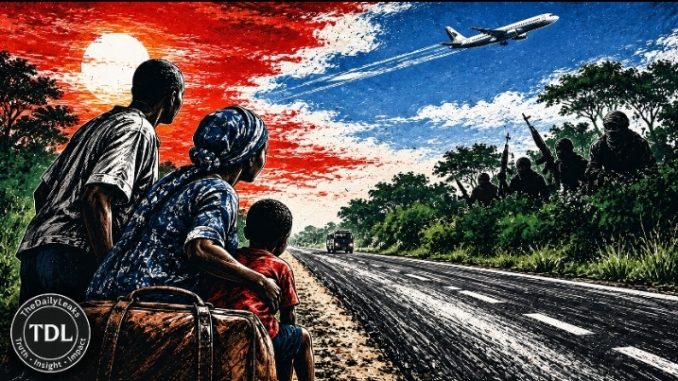
When highways become fearways, not everyone can fly.
Those with means may choose the skies.
They bypass dangerous stretches.
They shorten uncertainty.
They purchase alternatives.
But civilisation is never judged by the comfort of those who possess options.
It is judged by the security of those who do not.
The market woman cannot charter an aircraft to sell tomatoes.
The livestock trader cannot fly every herd to market.
The teacher cannot conduct daily lessons from the clouds.
The commercial driver cannot abandon the highway.
The artisan cannot carry his tools by air.
The ordinary Nigerian remains where every government must ultimately prove its authority.
On the road.
That is where the state meets the citizen.
Not in the capital.
Not in official ceremonies.
Not in carefully prepared speeches.
But on the lonely stretch of highway where a traveller expects the law to arrive before the criminal does.
That expectation is one of civilisation’s oldest promises.
It must never become one of its greatest disappointments.
History is patient.
It records.
It compares.
It remembers.
It remembers the kingdoms that allowed highways to become hunting grounds.
It also remembers the nations that reclaimed them.
The difference was rarely destiny.
It was resolve.
Civilisations have never been defined by the absence of challenges.
They have been defined by the quality of their response.
Arnold J. Toynbee, in A Study of History, argued that civilisations rise or fall according to how they respond to the challenges confronting them.
Challenges, therefore, are not the final verdict.
Responses are.
Nigeria’s challenge is neither unique nor unprecedented.
History has seen organised violence before.
It has seen marauders disrupt commerce.
It has seen highways abandoned.
It has seen fear dictate movement.
What history has also seen is governments refusing to surrender civilisation to lawlessness.
That remains the enduring expectation of every modern state.
Not because perfection is attainable.
But because abdication is unacceptable.
The question before Nigeria is therefore larger than security.
It is civilisational.
Will the nation permit fear to redraw its geography?
Will fertile lands remain uncultivated because farmers cannot safely reach them?
Will highways designed to unite the federation continue serving as invisible borders between confidence and anxiety?
Will parents continue praying more for the journey than for the purpose of the journey?
Will investors continue calculating danger before opportunity?
Will ordinary citizens continue adjusting their lives to accommodate criminals instead of expecting criminals to adjust to the law?
Those are not merely security questions.
They are questions about the very purpose of government.
For government is not simply an administrator of territory.
It is the guardian of public confidence.
Every kilometre reclaimed from bandits strengthens the economy.
Every kidnapping prevented preserves more than one life.
It preserves confidence.
Every terrorist camp dismantled restores more than security.
It restores freedom.
Every highway made safe announces that the authority of the state is greater than the audacity of criminality.
Perhaps that is why history’s oldest lament still refuses to grow old.
“The highways were abandoned.”
Judges 5:6.
It is a sentence no modern nation should read with comfort.
It should read it with determination.
And perhaps that is the greatest irony of all.
A nation may possess satellites above its skies.
Drones in its armoury.
Artificial intelligence in its laboratories.
Powerful weapons in its arsenals.
Yet if the ordinary citizen still approaches an ordinary highway with extraordinary fear, history will ask only one question.
What became of civilisation?
For when highways become fearways, and not everyone can fly, the journey in greatest danger is no longer the traveller’s alone.
It is the nation’s journey towards the civilisation it inherited, and the future it owes generations yet unborn.
For humanity did not spend thousands of years advancing from the wheel to artificial intelligence merely to leave ordinary citizens fearing ordinary roads.
That would not merely be a failure of security.
It would be a failure of civilisation.
The purpose of progress has never been to invent better machines.
It has always been to create better lives.
Otherwise, invention becomes exhibition.
Technology becomes decoration.
Civilisation becomes memory.
And government becomes little more than the custodian of unrealised possibilities.
Perhaps history will not ask how many highways a nation constructed.
It will ask how many its citizens could travel without fear.
It will not ask how many drones it purchased.
It will ask whether they secured the innocent.
It will not ask how much technology a nation possessed.
It will ask how wisely it was used.
It will ask whether that inheritance was translated into safety for ordinary people.
For when highways become fearways, and not everyone can fly, the greatest tragedy is not merely that criminals have grown bolder.
It is that the state has allowed civilisation to fall short of one of its oldest promises.
That every generation should leave the next safer than the one it inherited.
When highways become fearways, and not everyone can fly
By Seyi Gesinde
History rarely announces the decline of a civilisation with the collapse of its monuments.
It begins with something far more ordinary.
The ordinary journey.
Long before empires disappeared from maps, travellers had already begun avoiding their roads.
Merchants took longer routes.
Farmers travelled in groups.
Families delayed their journeys until daylight.
Commerce learnt to negotiate with fear.
History has never mistaken that negotiation for progress.
History has watched this pattern often enough to recognise it.
The story is older than modern governments.
It is older than democracy.
It is older than the nation state itself.
One of the earliest descriptions appears, not in an economics textbook or a political treatise, but in Scripture.
The Song of Deborah laments a time of national insecurity with remarkable simplicity:
“In the days of Shamgar son of Anath, in the days of Jael, the highways were abandoned, and travellers kept to the byways.”
Judges 5:6.
Few ancient texts describe the anatomy of insecurity with such haunting economy.
The roads still existed.
People still travelled.
But fear had redesigned the map.
More than three thousand years later, that ancient lament echoes with disturbing familiarity in Nigeria.
Across many of the nation’s highways, journeys that should unite communities increasingly divide them between courage and caution.
Bandits lie in wait.
Kidnappers turn forests into businesses.
Armed terrorists transform roads built for commerce into corridors of fear.
Families no longer ask only, “What time will you arrive?”
They first ask,
“Which route are you taking?”
Some journeys begin with prayer.
Some end in ransom.
Some never end at all.
The tragedy extends beyond those directly attacked.
Farmers hesitate before travelling to distant farms.
Transporters calculate risk before fuel.
Parents think twice before sending children across states for education.
Businesses factor insecurity into the price of every journey.
Even celebrations are quietly rearranged.
A wedding invitation.
A burial ceremony.
A family reunion.
Each now carries another question.
Is the road safe?
History has seen societies endure such anxieties before.
The difference is that many of them endured them because civilisation had not yet equipped them with the tools we possess today.
The traveller in the days of Deborah had no satellite watching the highway.
The Roman merchant had no aerial surveillance.
The medieval kingdom possessed neither drones nor thermal imaging.
There was no forensic science.
No real time intelligence network.
No emergency communications.
No helicopters.
No digital mapping.
No artificial intelligence.
Many of history’s greatest civilisations confronted insecurity while struggling against the limits of their own age.
Modern Nigeria confronts it in an age where those limits have largely been conquered.
That distinction matters.
Nigeria attained independence in 1960.
It did not inherit a world waiting to invent the motor car.
Or electricity.
Or the aeroplane.
Or radio.
Or radar.
Or the telephone.
Or the computer.
Or satellites.
Or the internet.
Or drones.
Or modern forensic science.
Or artificial intelligence.
Those inventions had already entered human civilisation.
Nigeria inherited them.
Not because it created them.
But because generations before had already paid the price of discovery.
Scientists spent centuries expanding the frontiers of knowledge.
Engineers transformed impossible ideas into ordinary realities.
Inventors endured failure so that later generations might enjoy convenience.
Civilisation laboured so posterity could suffer less.
That is why history offers modern governments fewer excuses than it offered ancient kingdoms.
Every invention inherited enlarges responsibility.
Every technological breakthrough raises the standard by which leadership is judged.
No modern government can plead the limitations of antiquity while possessing the advantages of modernity.
That is the enduring lesson history insists upon teaching.
It is not enough to inherit civilisation.
One must govern with it.
History records these lessons not merely to honour the past.
It records them to prevent its repetition.
The Roman Empire understood that roads were more than engineering projects.
They were instruments of order.
They carried soldiers, certainly.
But they also carried merchants.
Farmers.
Physicians.
Teachers.
Pilgrims.
Ideas.
Commerce moved because confidence moved with it.
Yet history also records what followed when that confidence weakened.
Following the sack of Rome in AD 410 by the Visigoths under Alaric I, and the eventual deposition of the last Western Roman emperor, Romulus Augustulus, in AD 476, the Western Roman Empire gradually fragmented.
Many of its magnificent roads remained.
The authority that secured them steadily diminished in many regions.
Trade became more uncertain.
Travellers became more vulnerable.
Communities grew more isolated.
History quietly reached a conclusion every generation must eventually confront.
Roads may outlive governments.
Confidence rarely does.
That is why the Nigerian experience should trouble far more than Nigerians alone.
It represents a question civilisation thought it had already answered.
Why should citizens of the twenty first century fear highways in ways that remind humanity of antiquity?
Aristotle argued in Politics that the political community exists, not merely that people may live, but that they may live well.
There is profound wisdom in that distinction.
A nation where citizens survive but cannot travel with confidence has achieved existence.
It has not yet achieved flourishing.
The highway is therefore more than a road.
It is where government fulfils one of its oldest promises.
The promise that ordinary people may pursue ordinary lives without extraordinary fear.
When that promise weakens, insecurity refuses to remain on the highway.
It travels.
It reaches the farm before dawn.
It enters the market before sunrise.
It follows the transporter to the loading bay.
It accompanies the student to the university.
It sits beside the entrepreneur considering expansion.
It waits with the tourist planning a visit.
It quietly enters every conversation where opportunity is weighed against danger.
That is why insecurity never remains a security problem.
It becomes an agricultural problem.
Farmers abandon fertile lands because harvest is meaningless if it cannot safely reach the market.
It becomes an inflation problem.
Food becomes more expensive because danger has imposed another cost on transportation.
It becomes an investment problem.
Capital has never loved uncertainty.
Investors rarely commit resources where confidence has become scarce.
It becomes an educational problem.
Parents increasingly ask whether the journey to knowledge is worth the risk.
It becomes a tourism problem.
No destination, however beautiful, flourishes where fear becomes part of the itinerary.
It becomes a productivity problem.
Hours that should produce wealth are instead spent planning safer routes, travelling in convoys, waiting for daylight, or postponing movement altogether.
Eventually, it becomes a national economic problem.
Gross Domestic Product does not decline in isolation.
It often follows confidence.
When confidence retreats, prosperity usually follows.
The bandit holding a rifle on a lonely highway therefore steals far more than money.
The kidnapper demanding ransom takes more than freedom.
The terrorist occupying a forest attacks more than travellers.
Each quietly wages war against agriculture.
Against commerce.
Against education.
Against investment.
Against tourism.
Against productivity.
Against national prosperity itself.
That is why the responsibility of the state cannot end with reacting after tragedy.
Civilisation has progressed beyond that.
The measure of modern governance is not merely its ability to investigate crime.
It is its ability to prevent citizens from living as though they still inhabit an age before the tools of modern civilisation existed.
Thomas Hobbes, in Leviathan, argued that one of the principal reasons people establish government is to escape the insecurity of the state of nature and enjoy the peace made possible by civil authority.
More than three centuries later, that proposition still confronts every nation.
For the first test of government is not the eloquence of its speeches.
Or the ambition of its budgets.
Or the grandeur of its infrastructure.
It is whether ordinary citizens can live ordinary lives without extraordinary fear.
John Locke approached the same question from another direction.
In his Second Treatise of Government, he argued that people unite under government for the preservation of their lives, liberties, and estates.
The social contract, therefore, is not an abstract philosophical idea.
It is encountered every day on the highway.
Each citizen setting out on a journey silently assumes that the state has not surrendered the road to those who recognise no law except violence.
When that assumption begins to disappear, something deeper than confidence is lost.
Trust itself begins to fracture.
The irony is difficult to ignore.
Nigeria did not begin its national journey in 1960 by clearing forests to invent civilisation.
It inherited civilisation.
It inherited the motor car.
It inherited aviation.
It inherited modern policing.
It inherited telecommunications.
It inherited radar.
It inherited forensic science.
It inherited computers.
It inherited satellites.
It inherited decades of military advancement.
Today, it inherits drones.
Artificial intelligence.
Digital surveillance.
Satellite imagery.
Real time intelligence gathering.
Technologies that ancient kingdoms, medieval rulers, and even the founders of modern states could scarcely have imagined.
History asks an uncomfortable question.
What is the value of inheriting civilisation if citizens continue enduring the fears civilisation was created to overcome?
Generations before us wrestled with darkness until they discovered electricity.
They crossed dangerous rivers until they built bridges.
They travelled for months until they invented railways, motor vehicles, and aircraft.
They struggled to communicate across continents until they harnessed radio, telephones, satellites, and the internet.
Every invention represented humanity’s refusal to surrender to yesterday’s limitations.
Each generation paid a price so the next would not have to.
The inventors of the wheel never imagined the motor car.
The pioneers of aviation never imagined unmanned aircraft.
The scientists who first harnessed electricity never imagined artificial intelligence.
Yet every breakthrough became another gift handed to posterity.
That inheritance imposes an obligation.
Civilisation does not merely transfer technology.
It transfers responsibility.
A government that possesses the instruments of the twenty first century cannot be measured by the standards of the fifth.
It cannot plead the helplessness of antiquity while commanding the advantages of modernity.
If highways remain under the shadow of bandits, kidnappers, and terrorists despite the unprecedented tools available to modern states, history is entitled to ask difficult questions.
Not because previous generations knew more.
But because they possessed far less.
Leadership has never been judged by the number of tools it owns.
It has always been judged by how faithfully it uses them.
That is why the Nigerian highway has become more than a transport corridor.
It has become a report card.
Every successful journey strengthens confidence.
Every abandoned journey weakens it.
Every kidnapping announces the audacity of criminality.
Every secure rescue reaffirms the authority of the state.
Every road reclaimed from terror restores more than movement.
It restores faith that government remains stronger than those who seek to replace law with fear.
Yet perhaps the deepest injury insecurity inflicts upon a nation is not what it takes.
It is what it teaches.
It teaches citizens to lower their expectations.
To celebrate safe arrival as though it were an extraordinary achievement.
To regard an uneventful journey as good fortune rather than normality.
To believe that fear is simply part of national life.
History has always resisted such surrender.
No civilisation ever became great by normalising what should have been unacceptable.
The abandoned highway should never become ordinary.
The ransom note should never become routine.
The convoy should never become the condition for safe travel.
The citizen should never have to choose between opportunity and survival.
Yet that is the quiet choice confronting many Nigerians.
The farmer asks whether another planting season is worth the danger.
The trader asks whether another journey is worth the risk.
The manufacturer asks whether expanding production is worth the uncertainty.
The investor asks whether capital is safer elsewhere.
The graduate asks whether home still offers a future.
Even foreign observers begin asking a question no nation should comfortably hear.
Is it safe?
That single question reaches far beyond security.
It enters commerce.
Investment.
Tourism.
Diplomacy.
National reputation.
For reputation, like confidence, is earned slowly.
But it can be diminished quickly.
Adam Smith observed in his Lectures on Jurisprudence that little else is required to carry a state to the highest degree of prosperity than peace, easy taxes, and a tolerable administration of justice.
It is remarkable that peace comes first.
Not because wealth matters less.
But because wealth rarely survives where peace has departed.
The market cannot flourish where the merchant fears the road.
Agriculture cannot feed a nation if farmers fear their farms more than the weather.
Industry cannot expand if raw materials and finished products must travel under the shadow of violence.
Universities cannot fully fulfil their mission if students and lecturers calculate danger before distance.
Hospitals cannot serve every citizen if reaching them becomes a hazardous undertaking.
The consequences eventually appear everywhere.
In inflation.
In unemployment.
In slowing investment.
In declining productivity.
In weakened growth.
Economists describe these as indicators.
History describes them as symptoms.
The disease lies elsewhere.
It begins the moment fear becomes stronger than confidence.
Perhaps that is why the title of this reflection is not merely a literary device.
When highways become fearways, not everyone can fly.
Those with means may choose the skies.
They bypass dangerous stretches.
They shorten uncertainty.
They purchase alternatives.
But civilisation is never judged by the comfort of those who possess options.
It is judged by the security of those who do not.
The market woman cannot charter an aircraft to sell tomatoes.
The livestock trader cannot fly every herd to market.
The teacher cannot conduct daily lessons from the clouds.
The commercial driver cannot abandon the highway.
The artisan cannot carry his tools by air.
The ordinary Nigerian remains where every government must ultimately prove its authority.
On the road.
That is where the state meets the citizen.
Not in the capital.
Not in official ceremonies.
Not in carefully prepared speeches.
But on the lonely stretch of highway where a traveller expects the law to arrive before the criminal does.
That expectation is one of civilisation’s oldest promises.
It must never become one of its greatest disappointments.
History is patient.
It records.
It compares.
It remembers.
It remembers the kingdoms that allowed highways to become hunting grounds.
It also remembers the nations that reclaimed them.
The difference was rarely destiny.
It was resolve.
Civilisations have never been defined by the absence of challenges.
They have been defined by the quality of their response.
Arnold J. Toynbee, in A Study of History, argued that civilisations rise or fall according to how they respond to the challenges confronting them.
Challenges, therefore, are not the final verdict.
Responses are.
Nigeria’s challenge is neither unique nor unprecedented.
History has seen organised violence before.
It has seen marauders disrupt commerce.
It has seen highways abandoned.
It has seen fear dictate movement.
What history has also seen is governments refusing to surrender civilisation to lawlessness.
That remains the enduring expectation of every modern state.
Not because perfection is attainable.
But because abdication is unacceptable.
The question before Nigeria is therefore larger than security.
It is civilisational.
Will the nation permit fear to redraw its geography?
Will fertile lands remain uncultivated because farmers cannot safely reach them?
Will highways designed to unite the federation continue serving as invisible borders between confidence and anxiety?
Will parents continue praying more for the journey than for the purpose of the journey?
Will investors continue calculating danger before opportunity?
Will ordinary citizens continue adjusting their lives to accommodate criminals instead of expecting criminals to adjust to the law?
Those are not merely security questions.
They are questions about the very purpose of government.
For government is not simply an administrator of territory.
It is the guardian of public confidence.
Every kilometre reclaimed from bandits strengthens the economy.
Every kidnapping prevented preserves more than one life.
It preserves confidence.
Every terrorist camp dismantled restores more than security.
It restores freedom.
Every highway made safe announces that the authority of the state is greater than the audacity of criminality.
Perhaps that is why history’s oldest lament still refuses to grow old.
“The highways were abandoned.”
Judges 5:6.
It is a sentence no modern nation should read with comfort.
It should read it with determination.
And perhaps that is the greatest irony of all.
A nation may possess satellites above its skies.
Drones in its armoury.
Artificial intelligence in its laboratories.
Powerful weapons in its arsenals.
Yet if the ordinary citizen still approaches an ordinary highway with extraordinary fear, history will ask only one question.
What became of civilisation?
For when highways become fearways, and not everyone can fly, the journey in greatest danger is no longer the traveller’s alone.
It is the nation’s journey towards the civilisation it inherited, and the future it owes generations yet unborn.
For humanity did not spend thousands of years advancing from the wheel to artificial intelligence merely to leave ordinary citizens fearing ordinary roads.
That would not merely be a failure of security.
It would be a failure of civilisation.
The purpose of progress has never been to invent better machines.
It has always been to create better lives.
Otherwise, invention becomes exhibition.
Technology becomes decoration.
Civilisation becomes memory.
And government becomes little more than the custodian of unrealised possibilities.
Perhaps history will not ask how many highways a nation constructed.
It will ask how many its citizens could travel without fear.
It will not ask how many drones it purchased.
It will ask whether they secured the innocent.
It will not ask how much technology a nation possessed.
It will ask how wisely it was used.
It will ask whether that inheritance was translated into safety for ordinary people.
For when highways become fearways, and not everyone can fly, the greatest tragedy is not merely that criminals have grown bolder.
It is that the state has allowed civilisation to fall short of one of its oldest promises.
That every generation should leave the next safer than the one it inherited.