By Seyi Gesinde

July 3, 2026
The unfolding controversy over the so called Presidential Foreign Intervention Promotion Council has moved beyond the personality of its alleged Director General.
The more fundamental issue is what it reveals about the strength, or weakness, of Nigeria’s public institutions.
The Presidency has declared the agency fictitious, insisted its head forged appointment documents, and disclosed that criminal charges are already before the court.
Those are serious allegations, and the courts must determine the individual’s criminal liability.
Yet, that official explanation raises even bigger institutional questions.
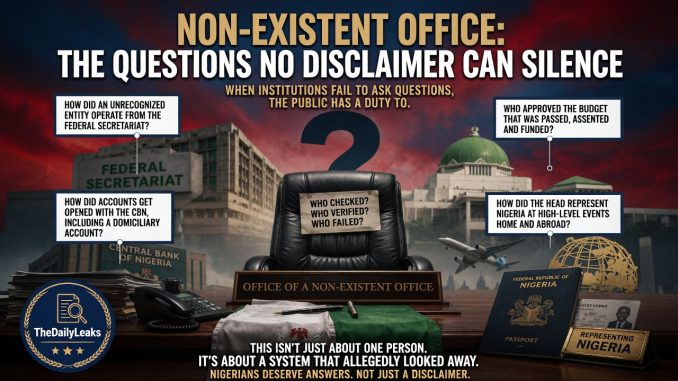
If an agency was truly non existent, how did it reportedly operate from office space inside the Federal Secretariat?
How did it allegedly secure a Central Bank of Nigeria account through official government processes?
How did its name reportedly appear in the 2026 Appropriation Act after passing through budget preparation, scrutiny by the National Assembly, and presidential assent?
How did its leadership reportedly participate in official engagements with diplomats and represent Nigeria at high level events without triggering immediate alarms across the bureaucracy?
These are not questions of politics.
They are questions of governance.
Every one of those milestones ordinarily requires multiple layers of verification, documentation, approvals, and oversight.
They involve ministries, departments, agencies, security checks, financial controls, and administrative procedures. None should depend solely on the word of one individual.
If all those institutional gates were crossed before anyone discovered that the agency allegedly never existed, then Nigerians deserve to know precisely where the safeguards failed.
If, on the other hand, every approval was lawfully obtained, then the public equally deserves a clear explanation of how an agency that moved through official government channels later became described as fictitious.
This is why dismissing public concern with a simple disclaimer cannot be enough.
A disclaimer answers who the Presidency says is responsible.
It does not answer how the system itself functioned.
ALSO READ: Are you that father?
The official who signed the disclaimer should perhaps be asking the same questions every thoughtful Nigerian is asking today.
How was office accommodation obtained?
Who approved it?
Who processed the documentation?
Who authenticated the records?
Who facilitated interactions with other government institutions?
Who allowed diplomatic engagements?
Who validated representations made in the name of the Federal Republic of Nigeria?
Who processed the budget line?
Who failed to detect what the Presidency now describes as an elaborate impersonation?
These questions are not an attack on government.
They are an investment in better government.
Silence would send an even more dangerous message, that anyone sufficiently determined could acquire office space inside the Federal Secretariat, navigate government processes, obtain official financial access, interact with public institutions, and operate in the name of Nigeria until someone eventually notices.
Surely, that cannot be the lesson.
A nation is not judged only by its ability to expose an alleged impostor.
It is judged by its willingness to examine how its institutions allegedly enabled the imposture in the first place.
If this episode ends with only one individual standing in the dock while every institutional lapse escapes scrutiny, Nigeria would have treated the symptom while leaving the disease untouched.
The country deserves more than a disclaimer.
It deserves answers.