By Seyi Gesinde

August 16, 2026
There is a peculiar transaction at the heart of Nigerian politics.
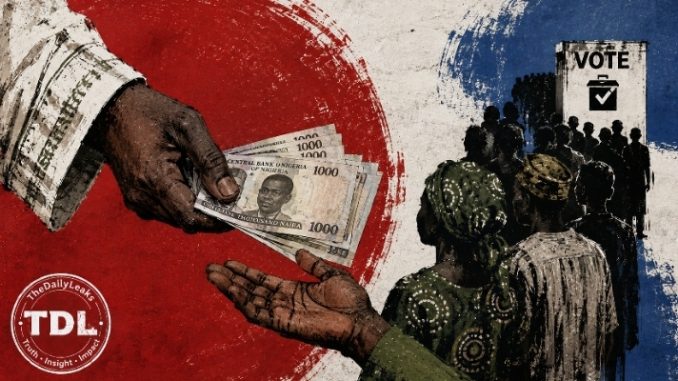
A politician arrives with money.
A voter receives it.
Hands exchange cash.
The transaction is completed.
Then the politician leaves.
The voter remains.
Four years remain too.
That is where the mathematics becomes interesting.
If N20,000 is offered for your vote, what exactly has been purchased?
A vote?
Or four years of political power?
Because the ballot is not a loaf of bread.
It is not consumed that afternoon.
It is a four year instrument.
A citizen casts it once.
The consequences can last thousands of days.
So perhaps the simplest question is also the most uncomfortable.
Can N20,000 survive four years?
Divide N20,000 across 48 months.
It is about N417 a month.
Roughly N14 a day.
That is the price of four years of political representation if the vote is treated as a transaction.
And when the N20,000 is gone, what remains?
The government remains.
The policies remain.
The taxes remain.
The roads remain.
The hospitals remain.
The schools remain.
The insecurity remains.
The unemployment remains.
The cost of living remains.
And so does the person you elected.
This is where selling a vote becomes much more expensive than the cash received.
You are not merely selling your vote.
You may be selling your future.
You may be selling your children’s future.
You may be surrendering your strongest instrument for demanding accountability from the very person who bought your silence.
ALSO READ: When poverty becomes a political strategy
How do you confront an elected official over poor performance when you collected money to put him there?
How do you demand better roads?
Better schools?
Better healthcare?
Better security?
More jobs?
Greater transparency?
How do you say, you have failed us, when the foundation of the relationship was a transaction?
You helped turn your constitutional right into a receipt.
John Locke’s social contract offers a useful way of understanding what has been lost.
Government derives its legitimacy from the consent of the governed.
The citizen does not surrender political power permanently.
The citizen entrusts it.
That distinction matters.
Your vote is not a gift to a politician.
It is a temporary transfer of authority.
When you sell it, you are not merely collecting money.
You are allowing somebody to purchase a portion of the authority that belongs to you as a citizen.
Jean Jacques Rousseau went further, placing sovereignty in the people themselves.
The people are not spectators in government.
They are the source of its legitimacy.
So what happens when that sovereignty is placed inside an envelope?
What happens when the power of a citizen is reduced to the highest bidder?
And there is something even more disturbing.
Do not imagine that the politician who gives you N20,000 is doing it because he loves you.
He knows exactly what he is doing.
He knows that your vote is worth more.
He knows that public office is worth more.
ALSO READ: Until you win
He knows that N20,000 is insignificant compared with the power attached to the office he seeks.
And he knows something else.
He knows you were willing to sell.
That knowledge can follow you long after Election Day.
Because what does a politician think when he buys your vote?
Does he see a trusted citizen?
Or does he see someone whose loyalty has a price?
And if another politician offers more next time, what prevents you from changing sides?
The politician who bought you knows that.
He cannot completely trust you.
You have demonstrated that your political commitment can be purchased.
You have shown him your price.
And what a ridiculous price it is.
N20,000.
Four years of power exchanged for money that can disappear in days.
Aristotle considered politics the pursuit of the common good.
That idea becomes almost painfully relevant here.
If public office exists to serve the commonwealth, then buying votes transforms public service into a private investment.
The politician spends money to acquire power.
Power then becomes something from which he expects a return.
And the public office that should serve everyone begins to look like an asset purchased from desperate citizens.
You are not necessarily becoming valuable to the politician by accepting the money.
You may be advertising yourself as desperate.
As vulnerable.
As someone whose conscience can be rented.
As someone whose vote can be redirected by whoever arrives with the higher envelope.
ALSO READ: Are you that father?
That is not how a citizen should be valued.
Your vote should be valuable because you are valuable.
Your conscience should not have a price tag.
Your children’s future should not be negotiated at a roadside rally.
Your community’s future should not fit inside an envelope.
John Stuart Mill’s defence of representative government also reminds us that political participation is supposed to connect citizens with government that serves their interests, not reduce citizenship to periodic transactions.
The vote is supposed to give the citizen influence over government.
Vote buying reverses that relationship.
The politician does not merely ask for your support.
He attempts to purchase your silence before he has even received your mandate.
And there is another danger.
The politician who buys your vote has already shown you what he thinks democracy is worth.
If he is prepared to spend money to acquire power, what will he do with the public resources that come with that power?
Perhaps the most expensive part of vote buying is what happens after the buying is complete.
The money disappears.
The political office remains.
The consequences begin.
Contracts may be awarded.
Budgets may be implemented.
Appointments may be made.
Public resources may be controlled.
Policies may be enacted.
And the person who sold the vote discovers that he has surrendered his leverage.
He cannot easily complain about the government he helped install.
He cannot pretend he was merely an innocent observer.
He participated in the transaction.
But poverty complicates the morality.
Let us be honest.
N20,000 can mean something to a struggling household.
It can buy food.
Pay transport.
Purchase medicine.
Support a child.
Settle an urgent bill.
That desperation is real.
But that is precisely why vote buying is so dangerous.
It exploits immediate suffering to acquire long term power.
It takes today’s hunger and uses it to purchase tomorrow’s government.
The voter thinks he is receiving N20,000.
The politician is acquiring access to an office that controls far more.
That is not an equal transaction.
It is desperation being converted into political capital.
And perhaps the greatest victim is not even the voter.
It is the child sitting at home while the parent sells away a future the child will have to live in.
The child will not remember the N20,000.
The child may remember the school that failed.
The hospital that could not treat them.
The road that remained broken.
The job that never came.
The insecurity that forced the family to live in fear.
The rising cost of living.
The opportunities that disappeared.
The parent may have collected N20,000.
The child may pay for it for years.
So the next time someone arrives with cash for your vote, do not ask only,
How much are you offering?
Ask,
What will this decision cost me?
Ask what it will cost your family.
Ask what it will cost your community.
Ask what it will cost your children.
Ask what it will cost your dignity.
Ask what it will cost your right to complain.
Because the vote is one of the few things an ordinary citizen possesses that can make a powerful person come back and ask for permission.
Do not surrender that power cheaply.
You can take the money and still vote according to your conscience, some may argue.
But the deeper question remains.
Why allow yourself to become part of a system in which your democratic right is treated as merchandise?
Why advertise your desperation?
Why reduce your integrity to an envelope?
Why allow somebody seeking public power to teach you that your citizenship has a price?
A politician who truly respects you should want your vote because you believe in his vision.
Not because he can buy your hunger.
And a citizen who truly understands his power should know that the ballot is not cash in disguise.
It is leverage.
It is accountability.
It is representation.
It is the future.
It is the voice of your children before they are old enough to use their own.
So, can you spend N20,000 for four years?
Of course you can.
But you cannot spend N20,000 and expect it to cover four years of bad government.
You cannot eat N20,000 and call it four years of representation.
You cannot collect N20,000 and purchase back the future you helped sell.
The money will finish.
The politician may remain.
The consequences may remain even longer.
And when the government fails, the hardest question may not be,
Why did they fail us?
It may be,
Why did we sell them the opportunity to fail us?
Your vote has a price.
But it should never be N20,000.