
By Seyi Gesinde

July 31, 2026
There are tragedies that happen to people.
And there are tragedies people walk towards with their eyes open.
The second kind is perhaps the hardest to explain.
Perhaps humanity’s oldest problem is not that opportunities never come, but that we sometimes recognise their value only after they have disappeared.
Nigeria, meanwhile, has taught its people something about survival that no textbook could adequately teach.
We have survived fuel scarcity and fuel subsidy.
We have survived queues for petrol and queues for everything else.
We have survived blackouts in a country where darkness can sometimes feel more reliable than electricity.
We have survived bad roads, collapsed roads, unfinished roads and roads that seem to have been abandoned immediately after commissioning.
We have survived insecurity, terrorism, banditry, kidnapping and the daily mathematics of deciding which road is safe enough to travel.
We have survived inflation that turns yesterday’s salary into today’s apology.
We have survived unemployment, underemployment and the peculiar Nigerian ingenuity of calling three jobs a person’s side hustle.
We have survived hospitals where illness can become a financial emergency.
We have survived schools struggling with overcrowding, strikes and inadequate facilities.
We have survived corruption, bureaucracy, power cuts, water shortages, rising rents, unpaid salaries and the endless national promise that things will soon get better.
We have survived elections that produce hope, arguments, disappointment and another election.
ALSO READ: When highways become fearways, and not everyone can fly
We have survived ethnic suspicion, religious tension, political propaganda and the remarkable Nigerian talent for quarrelling over everything except the problem itself.
We have survived the humiliation of having to know somebody before something that should be ordinary becomes possible.
We have survived generators becoming household members.
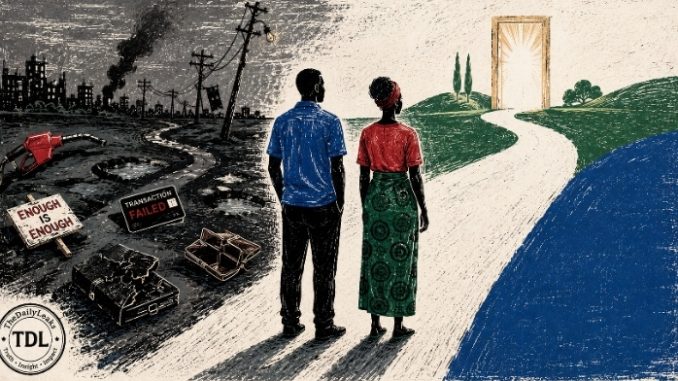
We have survived internet outages, network failure, bank failures, failed transactions and the spiritual discipline required to see, “Transaction failed,” after money has already disappeared from the account.
We have survived the Nigerian waiting room.
We have waited for jobs.
Waited for electricity.
Waited for justice.
Waited for roads.
Waited for security.
Waited for leaders to fulfil promises.
Waited for tomorrow.
And somehow, tomorrow keeps arriving with another tomorrow inside it.
We have survived a civil war.
We have survived Ali Must Go.
We have survived the Anti SAP protests.
We have survived June 12, 1993.
We have survived End SARS.
Different generations.
Different governments.
Different grievances.
Different streets.
Yet beneath them all echoed the same Nigerian question.
How much more must we endure before the promised better future finally arrives?
We protested.
We marched.
We demanded justice.
We demanded accountability.
We demanded a future worthy of the sacrifices we were already making in the present.
Somehow, we kept surviving.
Perhaps that is Nigeria’s greatest paradox.
We have become remarkably good at surviving what should have been changed.
We endure today because we believe tomorrow will be better.
ALSO READ: Is Jonathan counting on good luck, and Patience growing impatient for Aso Rock?
We sacrifice the present because we trust the future will justify it.
Yet there is one future that no one can postpone.
Eternity.
Yet history has seen another kind of human tragedy, the tragedy of exchanging something permanent for something temporary because the temporary thing happens to be painful or attractive in the present.
Esau came home exhausted from the field and found Jacob preparing food. He was hungry. Before him stood a birthright representing a future of enormous consequence. Before him also stood a meal offering immediate relief. He chose the meal. He traded the permanent for the temporary. Genesis 25:29–34.
At that moment, hunger was immediate.
The future was distant.
The food was visible.
The inheritance was not.
The meal disappeared.
The consequence remained.
Years later, when Esau sought the blessing, Scripture records that he sought it “with tears”. Hebrews 12:17.
He had discovered one of humanity’s most painful lessons, a temporary problem can make a permanent inheritance look worthless.
The lesson is bigger than Esau.
It is a philosophy of human behaviour.
We often sacrifice what matters ultimately for what relieves us immediately.
We choose the visible over the invisible.
The immediate over the ultimate.
The temporary over the permanent.
The hungry man thinks about food.
The frightened man thinks about escape.
The desperate man thinks about relief.
The tired man thinks about rest.
The future can wait.
Until one day, it cannot.
Publilius Syrus, the Roman writer of the first century BC, expressed the danger with a striking observation, “A good opportunity is seldom presented and is easily lost.”
Cicero’s philosophy repeatedly returned to the larger question of how human beings should live, how they should face suffering and how they should order their lives in pursuit of what is genuinely good. His Tusculan Disputations especially examines death, pain, grief and the conditions of a good life.
Pascal would later give the question another dimension, arguing that when eternity is at stake, treating the question casually is itself an enormous gamble.
Nigeria has made us experts at preparing for temporary destinations.
ALSO READ: Imagine he was her father
We prepare for university admission.
We prepare for job interviews.
We prepare for visa appointments.
We prepare for journeys.
We prepare for retirement.
Some even prepare to leave Nigeria altogether.
We save.
We plan.
We queue.
We fast.
We pray.
We obtain documents.
We ask questions.
We check the weather.
We check the exchange rate.
We check everything.
We save to relocate.
We plan to escape insecurity.
We change cities for opportunity.
We change countries for a better future.
We understand that destinations matter.
We understand that where we end up matters.
We understand that some journeys are too important to begin without knowing where they lead.
Yet eternity, the destination from which there is no return journey, is sometimes treated as though it requires no preparation at all.
We can spend months preparing for a journey that lasts six hours, yet scarcely prepare for an eternity that has no return ticket.
We can worry about whether our names will appear on a visa list, yet neglect whether our names are written in the Book of Life.
We can ask, “Where will I stay when I get there?”
But scarcely ask, “Where will I spend eternity when I leave here?”
That is the irony.
After all that, imagine finally reaching eternity and discovering that the suffering you endured on earth was not the end of the story.
It was only the part you had already survived.
That is why it will be a self-inflicted tragedy if, after surviving Nigeria, you still go to hell.
Lest the metaphor be misunderstood, Nigeria is not the subject on trial.
Here, Nigeria serves as a literary lens, representing the whole human experience, since no single article could speak of every nation.
It is not suggested that Nigeria is uniquely defined by hardship, for every nation has its own triumphs and its own trials. Rather, the Nigerian experience is used to illuminate a universal truth, that no earthly society, however prosperous or troubled, can ever become humanity’s final home.
Every nation knows moments of joy and moments of sorrow.
Every people have their own story of survival.
The question, therefore, is not ultimately about Nigeria.
It is about where every human being will spend eternity.
But let us be intellectually honest.
Nigeria is not hell.
Poverty is not hell.
Insecurity is not hell.
Inflation is not hell.
Political disappointment is not hell.
No earthly suffering, however terrible, should casually be equated with eternal separation from GOD.
That distinction matters.
Because the Christian hope is not that Nigerians have suffered enough to earn heaven.
Nobody earns salvation by suffering.
Heaven is not compensation for surviving Nigeria.
It is the promise of GOD’s grace through JESUS CHRIST.
Yet heaven must never become an excuse for accepting hellish conditions on earth.
The Christian cannot say, “Nigeria is terrible, but heaven is coming,” and therefore stop demanding justice, good governance, security, functional institutions and human dignity.
CHRIST taught His followers to pray,
“Thy kingdom come. Thy will be done in earth, as it is in heaven.” Matthew 6:10.
The hope of heaven should make us better citizens of earth, not passive spectators of its destruction.
JESUS CHRIST did not merely tell His followers to endure this world.
He promised them another.
“In my Father’s house are many mansions: if it were not so, I would have told you. I go to prepare a place for you.” John 14:2.
Many rooms.
A prepared place.
A Father’s house.
And Revelation gives the promise even more plainly,
“And God shall wipe away all tears from their eyes, and there shall be no more death, neither sorrow, nor crying, neither shall there be any more pain…” Revelation 21:4.
No more tears.
No more death.
No more sorrow.
No more crying.
No more pain.
For people who have spent a lifetime negotiating with suffering, that is not a small promise.
It is the ultimate destination.
But this promise is not automatic because someone has suffered.
It is received through CHRIST.
JESUS CHRIST gave the first clue Himself.
Speaking to Nicodemus, a deeply religious man, He said,
“Except a man be born again, he cannot see the kingdom of God.” John 3:3.
Born again.
Not merely religious.
Not merely moral.
Not merely respectable.
Not merely a churchgoer.
Born again.
Paul then removes the mystery.
“That if thou shalt confess with thy mouth the Lord Jesus, and shalt believe in thine heart that God hath raised him from the dead, thou shalt be saved.” Romans 10:9.
Then he explains what happens within the person who truly believes,
“For with the heart man believeth unto righteousness, and with the mouth confession is made unto salvation.” Romans 10:10.
And then comes the invitation without ethnic, social or geographical restriction,
“For whosoever shall call upon the name of the Lord shall be saved.” Romans 10:13.
There is no Nigerian exception.
No ethnic exception.
No political exception.
No economic exception.
No religious title that substitutes for the new birth.
The invitation is still open.
The opportunity is still here.
The decision is still yours.
And perhaps that is the most frightening part.
We know how to prepare for destinations that last a few hours.
We know how to sacrifice today for a better tomorrow.
We know how to endure hardship because we believe something better lies ahead.
We know how to leave one country because we believe another country offers a better future.
Yet some people may endure an entire lifetime of suffering and still neglect the destination that lasts forever.
Esau discovered the cost of choosing the immediate over the eternal.
Publilius Syrus warned that opportunity can be easily lost.
Cicero challenged humanity to think seriously about death, suffering and the good life.
Pascal warned against treating eternity as though its consequences were insignificant.
And Scripture gives the Christian something more than philosophy.
It gives a promise.
It gives a Saviour.
It gives a prepared place.
It gives an open invitation.
So after surviving Nigeria, after everything we have endured, after all the tomorrow we have waited for, why deliberately gamble with eternity?
One day, the queue will end.
The journey will end.
The generator will stop.
The bank account will become irrelevant.
The political argument will become history.
The passport will no longer matter.
And tomorrow will finally stop arriving with another tomorrow inside it.
There will simply be eternity.
The question is not whether you survived Nigeria.
You probably did.
The question is where you will spend the eternity that follows.
You have survived enough.
Do not miss heaven.