By Seyi Gesinde

July 30, 2026
Humanity has built magnificent temples across the centuries.
Too often, however, it has left them exactly as it entered them.
Perhaps that explains one of religion’s oldest paradoxes.
People often become more devoted to worship than to what worship was meant to produce.
Nothing illustrates this contradiction better than the life of JESUS CHRIST.
He never came to establish a religion.
He came to restore a relationship.
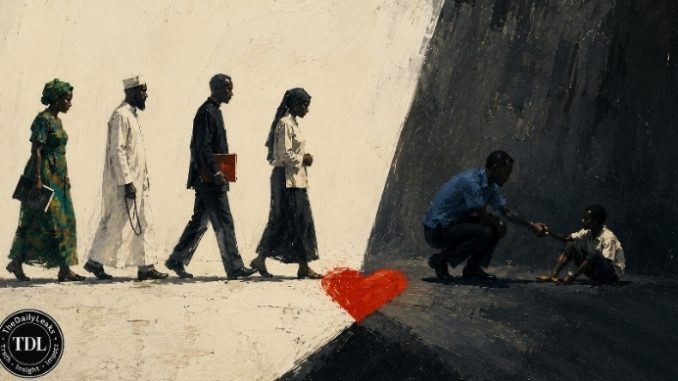
His ministry was measured less by rituals than by compassion.
He touched lepers.
He dined with sinners.
He forgave offenders.
He fed the hungry.
He healed the broken.
Then He stretched out His arms upon the Cross in history’s greatest demonstration of love.
“For God so loved the world, that he gave his only begotten Son…” John 3:16.
Love was not merely part of the Gospel.
Love was the Gospel.
Yet somewhere between Calvary and the modern church, many people discovered something more convenient.
Religion.
Religion is easier.
It requires attendance.
Love requires sacrifice.
Religion asks whether you came to church.
Love asks whether CHRIST went home with you.
That is the uncomfortable difference.
ALSO READ: When highways become fearways, and not everyone can fly
The tragedy is hardly confined to one denomination, one congregation, or even one religion.
Wherever ritual becomes more important than righteousness, humanity repeats the same mistake.
Many people today can recite Scripture from Genesis to Revelation.
Across different faiths and beliefs, others can recite their sacred books from cover to cover.
Yet they cannot forgive one offence.
They speak fluently in religious language.
Yet speak harshly to their spouses.
They never miss Sunday service.
Neither do others miss Friday prayers, Sabbath worship, or other sacred gatherings.
Yet disappear from work on Monday.
They pray against corruption before leaving home.
Then collect bribes before lunch.
They lead opening prayers in the office.
Then refuse to open the office on time.
They fast twice a week.
Yet refuse to pay workers what they have earned.
They preach honesty.
Then adjust the scale against customers.
They sponsor church programmes.
Yet owe salaries for months.
They kneel longest during worship.
Yet remain standing against reconciliation.
ALSO READ: Now that Seyi’s surveillance jets are here
Truth demands an uncomfortable admission.
This contradiction knows no religious boundary.
The same drama unfolds wherever religion is practised without transformed character.
Sacred books are memorised.
Prayers faithfully observed.
Fasts religiously kept.
Places of worship faithfully attended.
Generous offerings freely given.
Yet greed survives.
Hatred survives.
Dishonesty survives.
Pride survives.
Love quietly disappears.
Perhaps civilisation’s oldest misunderstanding is that affection and love are the same thing.
They are not.
Affection follows attraction.
Love follows conviction.
Affection asks, Who is good to me?
Love asks, How may I be good to another?
Every society has practised the first.
Only the greatest moral revolutions have demanded the second.
Philosophers have long distinguished between instinct and virtue.
Instinct is transactional.
It returns favour for favour.
It protects those who belong.
It rewards usefulness.
Every tribe has practised it.
Every empire has depended on it.
Even wolves hunt in packs.
Even organised crime rewards loyalty.
Even terrorist groups protect their own.
Reciprocity, therefore, has never been proof of love.
It is merely proof of nature.
Then JESUS CHRIST quietly overturned one of humanity’s oldest assumptions.
“For if ye love them which love you, what reward have ye? do not even the publicans the same?” Matthew 5:46.
In one question, He dismantled centuries of human self congratulation.
Loving those who love you was no longer extraordinary.
Greeting only those who greet you ceased to qualify as virtue.
Returning favours was no longer evidence of a transformed heart.
He raised the standard beyond instinct, beyond reciprocity, beyond ordinary human nature.
“But I say unto you, Love your enemies, bless them that curse you, do good to them that hate you, and pray for them which despitefully use you, and persecute you.” Matthew 5:44.
Suddenly, love ceased to be a transaction.
It became a revelation of character.
It was no longer measured by how we treated those who deserved it.
It was measured by how we treated those who did not.
Yet perhaps the greatest misunderstanding of love is one many religious people have never questioned.
They love those who love them.
They greet those who greet them.
They help those who can repay them.
They forgive only when forgiveness is convenient.
They are generous only where generosity is remembered.
Then they congratulate themselves for being loving.
JESUS CHRIST had already warned that even publicans could pass that examination.
The real examination begins where gratitude is uncertain.
Where kindness is expensive.
Where forgiveness hurts.
Where compassion receives nothing in return.
Where love survives rejection.
That is where religion often stops.
That is where the Gospel begins.
One almost imagines Heaven asking a disturbing question.
Who exactly were you worshipping?
JESUS CHRIST settled that question long ago.
“By this shall all men know that ye are my disciples, if ye have love one to another.” John 13:35.
Notice what He did not say.
Not by the size of the cathedral.
Not by the length of the prayer.
Not by the frequency of fasting.
Not by the titles before one’s name.
Love.
That was His evidence.
The Apostle Paul went even further.
“And though I bestow all my goods to feed the poor, and though I give my body to be burned, and have not charity, it profiteth me nothing.” 1 Corinthians 13:3.
Nothing.
Not little.
Nothing.
That may be the most frightening word in the entire passage.
Nothing.
One can spend an entire lifetime inside religious buildings and still remain a stranger to the GOD Who lives there.
Because GOD has never mistaken religious performance for spiritual transformation.
Perhaps that is why the Apostle John wrote with such unsettling simplicity:
“He that loveth not knoweth not God, for God is love.” 1 John 4:8.
Not that GOD has love.
Not that GOD appreciates love.
GOD is love.
The equation could not be clearer.
If love is absent, something infinitely more important than religion is absent.
For religion, by itself, has never transformed anyone.
Only a heart genuinely surrendered to GOD can do that.
Many religious people are remembered by history.
Loving people are remembered by Heaven.
The difference is eternal.
So before announcing how long you prayed…
Ask how deeply you loved.
Before counting how many services you attended…
Count how many burdens you lifted.
Before telling the world how religious you are…
Ask whether your neighbour has experienced the love of CHRIST because you live next door.
ALSO READ: Is Jonathan counting on good luck, and Patience growing impatient for Aso Rock?
For in the final analysis, Heaven is unlikely to ask how faithfully you occupied a pew.
It may simply ask whether, having claimed to know the GOD Who is love, you ever truly loved anyone.
Because you may be deeply religious.
That alone does not move GOD.